Close Menu
  • Home
  • UNSUBSCRIBE
  • News
  • Lifestyle
  • Tech
  • Entertainment
  • Sports
  • Travel
Facebook X (Twitter) WhatsApp
Trending
  • Andes virus — the only hantavirus strain that can spread between people — identified as culprit on cruise ship
  • New water battery could last until the 24th century — and it can be safely discarded in the environment
  • We remember little to nothing of early childhood — and a new mouse study may help explain why
  • The night sky could get three times brighter as new satellites launch — all but ruining the Vera C. Rubin Observatory’s survey of the universe
  • Happy 100th birthday, David Attenborough: 13 surprising facts about the famous naturalist
  • Clean hydrogen created from plastic waste using battery acid from old cars and solar power
  • Quantum battery charges in a quadrillionth of a second with a laser — larger prototypes could last for years after charging for just a minute
  • Diagnostic dilemma: Black and blue patches appeared on a woman’s body, and an antibiotic was to blame
Facebook X (Twitter) WhatsApp
Baynard Media
  • Home
  • UNSUBSCRIBE
  • News
  • Lifestyle
  • Tech
  • Entertainment
  • Sports
  • Travel
Baynard Media
Home»Lifestyle»CERN scientists unveil plans for MATHUSLA, an upgrade to the Large Hadron Collider that could finally reveal new physics
Lifestyle

CERN scientists unveil plans for MATHUSLA, an upgrade to the Large Hadron Collider that could finally reveal new physics

EditorBy EditorApril 9, 2025No Comments4 Mins Read
Share Facebook Twitter Pinterest LinkedIn Tumblr Reddit Telegram Email
Share
Facebook Twitter LinkedIn Pinterest Email

The world’s biggest atom smasher could be getting an upgrade.

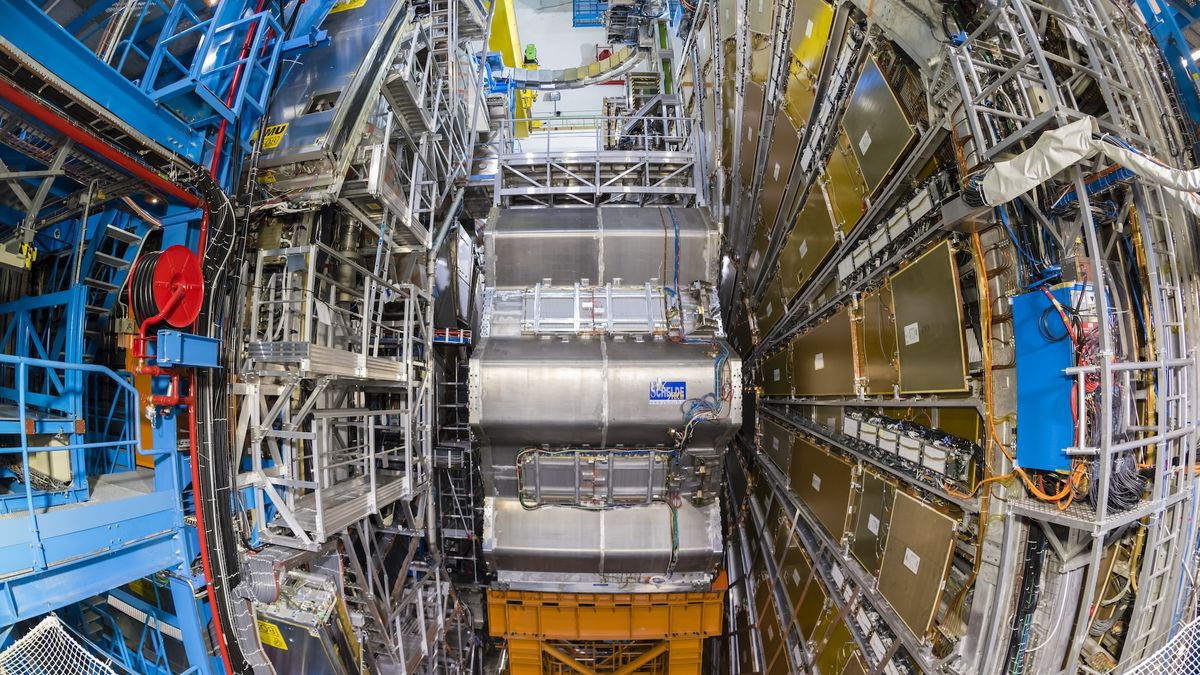
The Large Hadron Collider (LHC), situated at the CERN laboratory on the Swiss-French border, was built over a decade ago with two goals in mind. First, to establish the existence of the Higgs boson, the cornerstone particle of the Standard Model of particle physics, predicted all the way back in the 1960s; And second, to find any new particles, especially ones that could validate one of the many competitors to physical theories beyond the Standard Model.

But while the LHC has proven a success when it comes to the Higgs, whose existence was confirmed by CERN scientists in 2012, the atom smasher has also been a failure when it comes to new particles. Despite more than a decade of searching, the collider has found no traces of any physics beyond the Standard Model.

Failing to find new particles is not exactly a bad thing. The continuous negative results have disproven many alternative models, which means that at least scientists know which ideas are bad and no longer worth working on. But a lack of positive results has also left modern particle physics in the dark, with little to no clues about which hypothetical ideas might still be worth pursuing.

The LHC, as powerful as it is at seeing subatomic particles, does have a blind spot. It was designed with certain hypothetical particles in mind, especially ones that have electric charge and don’t have long lifespans. And there is a class of hypothetical particles, known as long-lived neutral particles, that can slip by LHC’s two main detectors without notice. So the giant machine may have been revealing new physics every single day, but those particles were undetectable.

Related: Scientists claim to find ‘first observational evidence supporting string theory,’ which could finally reveal the nature of dark energy

This fact was not lost on the LHC’s original designers. Soon after the collider began operations, a team gathered to design an add-on detector to look for long-lived particles. That detector, known as MATHUSLA — named for Methuselah, the Biblical character who supposedly lived for over 900 years, and stands for MAssive Timing Hodoscope for Ultra-Stable neutraL pArticles — is in its final design stages, according to a report by more than 30 scientists involved in the project, published March 26 to the preprint server arXiv.

Get the world’s most fascinating discoveries delivered straight to your inbox.

If funding stays on track, the team hopes to begin construction this year.

An illustration showing an addition to CERN's particle collider infrastructure

An illustration showing the proposed location for the MATHUSLA detector at CERN. (Image credit: CERN)

Waking MATHUSLA

MATHUSLA will consist of a giant chamber 130 feet (40 meters) across, filled with nothing but air and surrounded by banks of detectors. It would be placed about 330 feet (100 m) away from the main collider beam, with dirt and rock filling the space between.

In particle physics, “long-lived” is a relative term. In this case, many hypothetical particles have lifespans of around a few hundred nanoseconds — an eternity compared to the vast majority of particles that are currently being studied at the LHC.

If MATHULSA works, the add-on detector will wait for one of these long-lived particles to make its way into the main chamber. There it will decay into a shower of other particles, and banks of sensors will look for their telltale glow.

Long-lived particles could give physicists insights into the detailed nature of the Higgs boson, possible companions to the Higgs and explanations as to why the force of gravity is so weak. They may even help reveal the identity of dark matter — the mysterious substance that is predicted to make up about 85% of all matter in the universe and yet remains largely unknown to science.

With such exciting results potentially within reach, let’s just hope that we won’t have to wait 900 years for MATHUSLA to be built.

Source link

Share. Facebook Twitter Pinterest LinkedIn Tumblr Email
Previous ArticlePhysicists create hottest Schrödinger’s cat state ever in quantum mechanics breakthrough
Next Article ‘Titanic: The Digital Resurrection’ documentary sheds light on night ship sank
Editor
  • Website

Related Posts

Lifestyle

Andes virus — the only hantavirus strain that can spread between people — identified as culprit on cruise ship

May 7, 2026
Lifestyle

New water battery could last until the 24th century — and it can be safely discarded in the environment

May 7, 2026
Lifestyle

We remember little to nothing of early childhood — and a new mouse study may help explain why

May 7, 2026
Add A Comment

Comments are closed.

Categories
  • Entertainment
  • Lifestyle
  • News
  • Sports
  • Tech
  • Travel
Recent Posts
  • Andes virus — the only hantavirus strain that can spread between people — identified as culprit on cruise ship
  • New water battery could last until the 24th century — and it can be safely discarded in the environment
  • We remember little to nothing of early childhood — and a new mouse study may help explain why
  • The night sky could get three times brighter as new satellites launch — all but ruining the Vera C. Rubin Observatory’s survey of the universe
  • Happy 100th birthday, David Attenborough: 13 surprising facts about the famous naturalist
calendar
May 2026
M T W T F S S
 123
45678910
11121314151617
18192021222324
25262728293031
« Apr    
Recent Posts
  • Andes virus — the only hantavirus strain that can spread between people — identified as culprit on cruise ship
  • New water battery could last until the 24th century — and it can be safely discarded in the environment
  • We remember little to nothing of early childhood — and a new mouse study may help explain why
About

Welcome to Baynard Media, your trusted source for a diverse range of news and insights. We are committed to delivering timely, reliable, and thought-provoking content that keeps you informed
and inspired

Categories
  • Entertainment
  • Lifestyle
  • News
  • Sports
  • Tech
  • Travel
Facebook X (Twitter) Pinterest WhatsApp
  • Contact Us
  • About Us
  • Privacy Policy
  • Disclaimer
  • UNSUBSCRIBE
© 2026 copyrights reserved

Type above and press Enter to search. Press Esc to cancel.