
Close Menu
  • Home
  • UNSUBSCRIBE
  • News
  • Lifestyle
  • Tech
  • Entertainment
  • Sports
  • Travel
Facebook X (Twitter) WhatsApp
Trending
  • New robotic heart mimics common, mysterious condition to help researchers study it
  • Canon EOS R6 III review: A wildlife wonder
  • Medieval babies and adults buried together in Sweden were not related, archaeologists discover — raising big questions about early Christian burial practices
  • NASA is creating a fifth state of matter on the ISS, thanks to an upgrade to a mini-fridge-sized quantum lab
  • New sodium metal battery design charges in just 4 minutes and retains its capacity for years
  • Quantum computing wielded to create extremely rare material critical to nuclear fusion
  • Scientists build tiny ‘diving suit’ for cockroaches, turning them into search-and-rescue cyborgs
  • Physicists develop the first working model of quantum mechanics using only ‘real’ numbers
Facebook X (Twitter) WhatsApp
Baynard Media
  • Home
  • UNSUBSCRIBE
  • News
  • Lifestyle
  • Tech
  • Entertainment
  • Sports
  • Travel
Baynard Media
Home»Lifestyle»Physicists create hottest Schrödinger’s cat state ever in quantum mechanics breakthrough
Lifestyle

Physicists create hottest Schrödinger’s cat state ever in quantum mechanics breakthrough

EditorBy EditorApril 9, 2025No Comments3 Mins Read
Share Facebook Twitter Pinterest LinkedIn Tumblr Reddit Telegram Email
Share
Facebook Twitter LinkedIn Pinterest Email

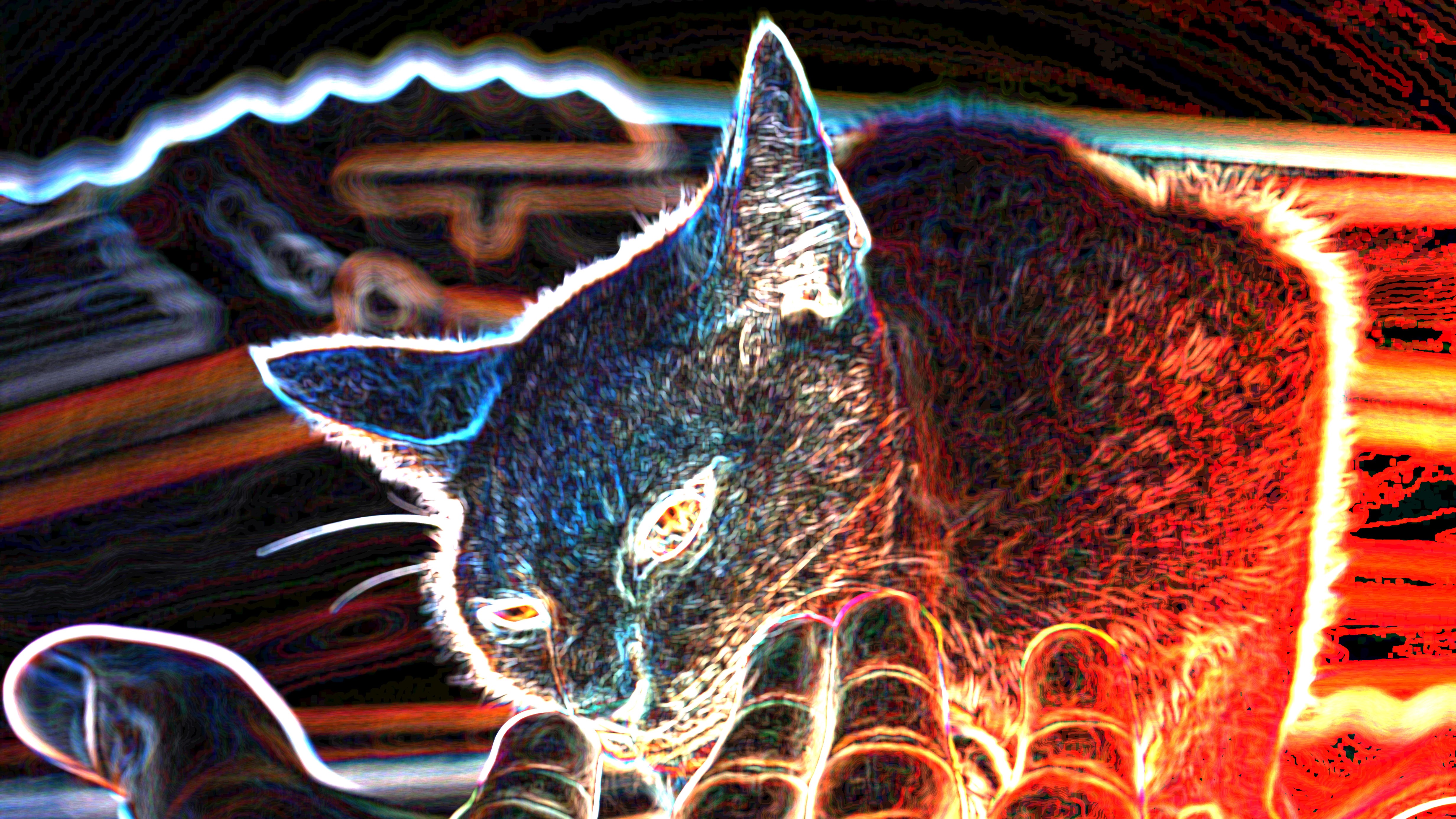
Physicists have created a Schrödinger’s cat state at unusually hot temperatures, and it could be a major step toward the development of practical quantum computers.

Schrödinger’s cat states exist in two distinct quantum states simultaneously and take their name from Erwin Schrödinger’s famous thought experiment of a cat that is both simultaneously alive and dead.

Yet to achieve these states, quantum objects usually have to be cooled to their ground states, which exist just a few fractions above absolute zero (minus 459.67 degrees Fahrenheit or minus 273.15 degrees Celsius).

But now, a team of scientists has shown that a state of quantum superposition can be achieved at significantly warmer temperatures than before. The researchers published their findings April 4 in the journal Science Advances.

“Schrödinger also assumed a living — i.e., ‘hot’ — cat in his thought experiment,” study co-author Gerhard Kirchmair, a physicist at the University of Innsbruck in Austria, said in a statement. “We wanted to know whether these quantum effects can also be generated if we don’t start from the ‘cold’ ground state.”

In Schrödinger’s thought experiment, the weird rules of the quantum world are envisioned by imagining a cat placed inside an opaque box with a poison vial whose release mechanism is controlled by radioactive decay — a completely random quantum process. Until the box is opened and the cat is observed, Schrödinger said, the rules of quantum mechanics mean that the unfortunate feline should exist in a superposition of states, simultaneously dead and alive.

Related: World’s 1st modular quantum computer that can operate at room temperature goes online

Get the world’s most fascinating discoveries delivered straight to your inbox.

As most quantum effects typically decohere and disappear at larger scales, Schrödinger’s analogy was meant to demonstrate the fundamental differences between our world and the world of the very small.

Usually, quantum states of this kind can only be achieved at extremely low temperatures. This means that the qubits (quantum bits) found inside quantum computers have to be maintained inside extremely cold cryostats in order for them to not decohere and lose their information.

Yet no hard limit between the quantum realm and ours exists, and physicists have had past success cajoling larger objects into showing weird quantum behavior.

With this in mind, the physicists behind the new research placed a qubit inside a microwave resonator. After some careful tweaking, they nudged the qubit into a state of superposition at a temperature of 1.8 kelvins (minus 456.43 F or minus 271.35 C). This is still a very chilly temperature, but it is 60 times hotter than the ambient temperature in the cavity.

“Many of our colleagues were surprised when we first told them about our results, because we usually think of temperature as something that destroys quantum effects,” study co-author Thomas Agrenius, a doctoral student at the Institute of Photonic Sciences in Barcelona, said in the statement. “Our measurements confirm that quantum interference can persist even at high temperatures.”

While likely too incremental to have an immediate practical impact, the scientists’ findings could one day liberate quantum computing from the necessity of storing the computers in extremely cold environments — especially if researchers can continue to raise the temperatures at which superposition can be achieved.

“Our work reveals that it is possible to observe and use quantum phenomena even in less ideal, warmer environments,” Kirchmair said. “If we can create the necessary interactions in a system, the temperature ultimately doesn’t matter.”

Source link

Share. Facebook Twitter Pinterest LinkedIn Tumblr Email
Previous ArticleWinter sea ice cover lowest on record as global warming continues to breach 1.5 C, Copernicus reveals
Next Article CERN scientists unveil plans for MATHUSLA, an upgrade to the Large Hadron Collider that could finally reveal new physics
Editor
  • Website

Related Posts

Lifestyle

New robotic heart mimics common, mysterious condition to help researchers study it

July 11, 2026
Lifestyle

Canon EOS R6 III review: A wildlife wonder

July 10, 2026
Lifestyle

Medieval babies and adults buried together in Sweden were not related, archaeologists discover — raising big questions about early Christian burial practices

July 10, 2026
Add A Comment

Comments are closed.

Categories
  • Entertainment
  • Lifestyle
  • News
  • Sports
  • Tech
  • Travel
Recent Posts
  • New robotic heart mimics common, mysterious condition to help researchers study it
  • Canon EOS R6 III review: A wildlife wonder
  • Medieval babies and adults buried together in Sweden were not related, archaeologists discover — raising big questions about early Christian burial practices
  • NASA is creating a fifth state of matter on the ISS, thanks to an upgrade to a mini-fridge-sized quantum lab
  • New sodium metal battery design charges in just 4 minutes and retains its capacity for years
calendar
July 2026
M T W T F S S
 12345
6789101112
13141516171819
20212223242526
2728293031  
« Jun    
Recent Posts
  • New robotic heart mimics common, mysterious condition to help researchers study it
  • Canon EOS R6 III review: A wildlife wonder
  • Medieval babies and adults buried together in Sweden were not related, archaeologists discover — raising big questions about early Christian burial practices
About

Welcome to Baynard Media, your trusted source for a diverse range of news and insights. We are committed to delivering timely, reliable, and thought-provoking content that keeps you informed
and inspired

Categories
  • Entertainment
  • Lifestyle
  • News
  • Sports
  • Tech
  • Travel
Facebook X (Twitter) Pinterest WhatsApp
  • Contact Us
  • About Us
  • Privacy Policy
  • Disclaimer
  • UNSUBSCRIBE
© 2026 copyrights reserved

Type above and press Enter to search. Press Esc to cancel.