Close Menu
  • Home
  • UNSUBSCRIBE
  • News
  • Lifestyle
  • Tech
  • Entertainment
  • Sports
  • Travel
Facebook X (Twitter) WhatsApp
Trending
  • If humans are getting smarter, why are our brains shrinking?
  • ‘Feuding tech bros’ go head to head in legal showdown. But what does it mean for the future of AI?
  • Pregnancy quiz: Can you deliver on the science of growing babies?
  • Science news this week: The latest on the cruise ship hantavirus infections, a shortcut to Mars, and a fast-charging quantum battery
  • Hantavirus cruise LIVE: Cruise passengers monitored in at least 5 US states as American passengers set to receive repatriation flight
  • Mangroves clean up $8.7 billion of nitrogen pollution every year, study finds
  • Flowering plants transformed into ‘hopeful monsters’ in 9 dire bursts across evolutionary time, study finds
  • US government declassifies nearly 200 UAP files, including strange sightings from Apollo astronauts
Facebook X (Twitter) WhatsApp
Baynard Media
  • Home
  • UNSUBSCRIBE
  • News
  • Lifestyle
  • Tech
  • Entertainment
  • Sports
  • Travel
Baynard Media
Home»Lifestyle»3 rivers merge into striking half-and-half waterway in Guyana — Earth from space
Lifestyle

3 rivers merge into striking half-and-half waterway in Guyana — Earth from space

EditorBy EditorMarch 3, 2026No Comments4 Mins Read
Share Facebook Twitter Pinterest LinkedIn Tumblr Reddit Telegram Email
Share
Facebook Twitter LinkedIn Pinterest Email

QUICK FACTS

Where is it? Bartica, Guyana [6.4073096658, -58.62373473]

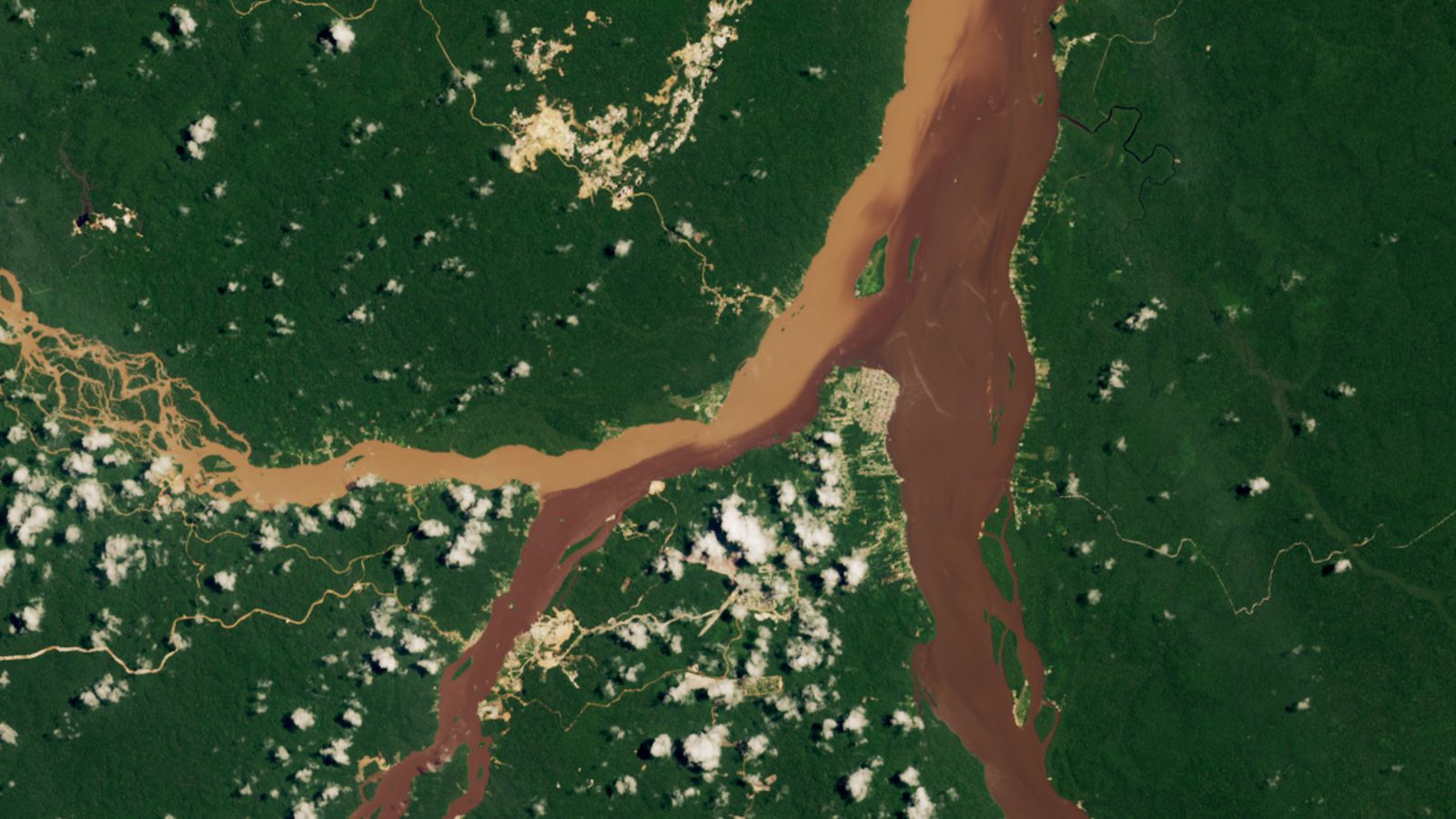
What’s in the photo? A trio of waterways merging into a striking “half-and-half” river

Which satellite took the photo? Landsat 8

When was it taken? Aug. 16, 2023

This striking satellite photo shows off the contrasting colors at the point where three rivers converge in Guyana. The multicolor waterways result from the country’s unique geology, as well as an increasingly disruptive human-caused factor.

In the Indigenous Arawak language, Guyana means “land of many waters,” which is an apt name, given that the country is home to 10 major rivers and dozens of smaller waterways, despite being around the size of South Carolina, according to NASA’s Earth Observatory.

This unique hydrology is linked to the Guiana Shield, a 1.7 billion-year-old geologic feature that covers Guyana as well as parts of Venezuela, Brazil, Suriname and French Guiana. The shield contains hard crystalline bedrock made up of rocks such as gneiss and granite, meaning it does not easily erode except from flowing water, which has carved out many routes through the region.


You may like

In this photo, two smaller rivers — the Cuyuni River (left) and the Mazaruni River (center left) — come together shortly before merging with the Essequibo River (center right) to form one of Guyana’s largest waterways.

The town of Bartica, which is home to around 15,000 people, is located on the piece of land that juts into the water at the point of the secondary merger. From there, the enlarged Essequibo River flows northward for around 30 miles (50 kilometers), before draining into the Atlantic Ocean.

Photo of a town in Guyana by a river

The town of Bartica is located at the site of the second merger and is surrounded by rivers on three sides. (Image credit: Luisdavidleonlopez/Wikimedia)

Prior to merging, the Mazaruni and Essequibo are dark brown, which is likely the result of tannins — chemicals released by rotting vegetation that stain waterways via a process similar to tea brewing. The Cuyuni is light brown due to high levels of suspended sediment in its water, according to the Earth Observatory.

When the rivers meet, the lighter and darker waters do not readily mix because of the differences in density caused by varying levels of sediment.

Get the world’s most fascinating discoveries delivered straight to your inbox.

While the presence of tannins is a natural phenomenon triggered by flooding, the high levels of sediment are the result of mining waste that is dumped in the Mazaruni.

“This image is from a wet time of year when all three rivers were running high and carrying a lot of sediment,” Evan Dethier, a hydrologist at Colby College in Maine, told the Earth Observatory. “But the Cuyuni is the clear outlier, which we can attribute to the intensity of mining upstream.”

Guyana is a hotspot for mining, largely because of its vast deposits of gold, diamonds and bauxite, as well as lithium, copper and nickel, which are also linked to the Guiana Shield, according to the U.S. Department of Commerce.

An aerial photograph of the Essequibo River

After merging, the Essequibo River continues on for around 30 miles (50 kilometers) until it drains into the Atlantic Ocean. (Image credit: PATRICK FORT/AFP via Getty Images)

The country’s mining industry began in ernest in the mid-2000s, and since then, the concentration of sediment in the Cuyuni has likely increased tenfold, Dethier said. Similar changes have been documented in rivers across the planet.

A 2022 study led by Dethier revealed that sediment concendrations in rivers in the Southern Hemisphere has risen by around 40%, largely due to mining and deforestation. However, the opposite is true in the Northern Hemisphere due to the construction of large-scale dams, which have blocked sediment flow by around half.

The changes in global sediment flow also may be affecting the marine environment, because the sediment input in most of the world’s oceans has changed drastically, the study warned ‪—‬ but it is still too soon to see what sort of long-term effect this may have.


An astronaut photo of a golden river in the shape of a Chinese dragon
‘Golden dragon’ river in Alabama

A 2023 astronaut photo shows the moment the Alabama River briefly morphed into an undulating golden serpent, similar in shape to a Chinese dragon.


Source link

Share. Facebook Twitter Pinterest LinkedIn Tumblr Email
Previous ArticleBest TV deal: Save $40 on Amazon Fire TV 2-Series
Next Article OC Budget Survey, I Give it One Star
Editor
  • Website

Related Posts

Lifestyle

If humans are getting smarter, why are our brains shrinking?

May 9, 2026
Lifestyle

‘Feuding tech bros’ go head to head in legal showdown. But what does it mean for the future of AI?

May 9, 2026
Lifestyle

Pregnancy quiz: Can you deliver on the science of growing babies?

May 9, 2026
Add A Comment

Comments are closed.

Categories
  • Entertainment
  • Lifestyle
  • News
  • Sports
  • Tech
  • Travel
Recent Posts
  • If humans are getting smarter, why are our brains shrinking?
  • ‘Feuding tech bros’ go head to head in legal showdown. But what does it mean for the future of AI?
  • Pregnancy quiz: Can you deliver on the science of growing babies?
  • Science news this week: The latest on the cruise ship hantavirus infections, a shortcut to Mars, and a fast-charging quantum battery
  • Hantavirus cruise LIVE: Cruise passengers monitored in at least 5 US states as American passengers set to receive repatriation flight
calendar
May 2026
M T W T F S S
 123
45678910
11121314151617
18192021222324
25262728293031
« Apr    
Recent Posts
  • If humans are getting smarter, why are our brains shrinking?
  • ‘Feuding tech bros’ go head to head in legal showdown. But what does it mean for the future of AI?
  • Pregnancy quiz: Can you deliver on the science of growing babies?
About

Welcome to Baynard Media, your trusted source for a diverse range of news and insights. We are committed to delivering timely, reliable, and thought-provoking content that keeps you informed
and inspired

Categories
  • Entertainment
  • Lifestyle
  • News
  • Sports
  • Tech
  • Travel
Facebook X (Twitter) Pinterest WhatsApp
  • Contact Us
  • About Us
  • Privacy Policy
  • Disclaimer
  • UNSUBSCRIBE
© 2026 copyrights reserved

Type above and press Enter to search. Press Esc to cancel.