
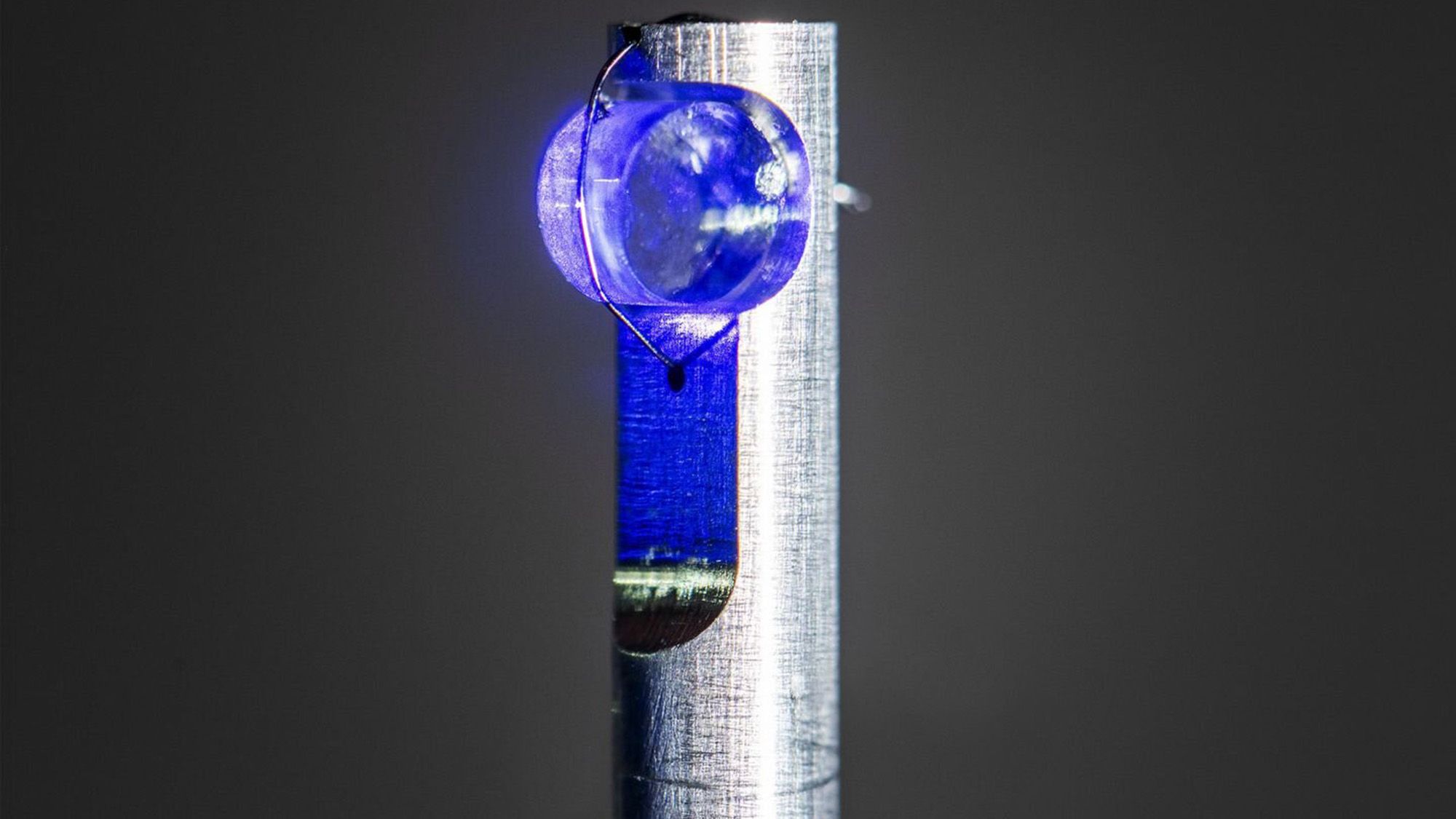
For decades, physicists have pursued a goal that sounds nearly impossible: to build a clock that keeps time using an atom’s nucleus rather than the electrons orbiting it.
Now, researchers have demonstrated the first functioning nuclear clock — an advancement that could eventually lead to more robust timekeeping devices and new ways to search for dark matter and physics beyond the Standard Model.
“Having worked in this field for more than 15 years, it is just beautiful, how a very ‘wild’ idea such as manipulating an atomic nucleus with a laser has turned into reality,” Thorsten Schumm, a professor of quantum metrology at the Vienna University of Technology and a member of the research team, told Live Science via email.
How is a nuclear clock different from an atomic clock?
Today’s most accurate clocks are optical atomic clocks, which measure the frequency of electrons jumping between different energy levels inside atoms. These clocks are so precise that they would lose less than a second over a 100 million years.
A nuclear clock works similarly, but it uses a transition within the nucleus itself, where the nucleus jumps between energy levels. Because the nucleus sits deep inside the atom, it’s far less affected by external disturbances from things like electric or magnetic fields. According to Schumm, the nuclear transition can be 1,000 to 10,000 times less sensitive to environmental noise than atomic transitions are.

A diagram showing how a nuclear clock works.
(Image credit: N. Hanacek/NIST)
“This means that it would be easier to stabilize a nuclear clock over long periods of time,” Jacob Higgins, a postdoctoral researcher at Northwestern University who previously worked on thorium clock experiments at JILA in Colorado but was not affiliated with the study, told Live Science in an email. “The transition used for the nuclear clock experiment has a higher quality factor than optical atomic clock transitions, which means that in principle, it can be measured more precisely given the same amount of measurement time.”
Together, those advantages could allow nuclear clocks to outperform even today’s best atomic clocks according to Higgins.
Get the world’s most fascinating discoveries delivered straight to your inbox.
Why thorium-229 is special
The nuclear clock relies on a rare isotope called thorium-229, whose nucleus contains an unusually low-energy excited state that can be manipulated with ultraviolet laser light.
For decades, scientists had suspected thorium had a low transition, but identifying and controlling it proved extremely challenging. Researchers spent years testing different thorium-containing materials, laser systems and detection methods before finally pinning down the transition.
“It was a long road,” Higgins said.
One key advancement was the development of continuous-wave lasers that operate at the precise wavelength needed to excite the thorium nucleus. Before those lasers existed, researchers had to excite the nucleus and then wait several minutes for it to decay and emit a detectable signal. That process was too slow to build a practical clock.
“With the continuous lasers, we can measure the nucleus in absorption and get an immediate response, whether the laser is still at the right frequency (and if not, correct it back),” Schumm said. “Once we had that, it was ‘just’ implementing some electronics and atomization to have the clock stabilize itself to the nucleus.”
Thanks to this set-up, the researchers kept the nuclear clock running continuously for 24 hours.
Unlike many optical atomic clocks, which require ultracold atoms to be suspended in a vacuum chamber, the thorium nuclei are embedded inside a crystal at room temperature.
Because the thorium transition remains stable inside a solid material, researchers may eventually be able to build compact clocks that are useful for navigation systems, telecommunication networks and data synchronization.

NASA’s Deep Space Atomic Clock, seen here in an artist’s illustration, was launched in June 2019 to use atomic clocks in space.
(Image credit: NASA)
Some physicists are more excited about what nuclear clocks could reveal about fundamental physics, rather than the clocks’ timekeeping abilities.
Atomic clocks primarily probe electromagnetic interactions involving electrons. Nuclear clocks, by contrast, are sensitive to the strong nuclear force, weak nuclear force and electromagnetism — three of the four fundamental forces of the universe, along with gravity. This can make them useful detectors of new physics, in a way.
“The nuclear clock is foremost a different clock, ticking on different fundamental physics mechanisms,” Schumm said. “Essentially all modern theories beyond the standard model predict additional particles or 5th forces … which can be probed with the nuclear clock in some parameter regime.”
Thorium-229 is particularly intriguing because the energy difference between its two nuclear states results from a delicate balance between electromagnetic and nuclear forces. Because those large contributions nearly cancel each other out, even tiny changes in the underlying forces could shift the clock’s frequency.
“So small shifts in these forces — like if the nucleus were to couple to certain forms of dark matter or if there were an oscillation of a fundamental constant — will be amplified in our measurement,” Higgins said.
Researchers, including Higgins, have already used early versions of the clock to place constraints on some dark matter models, and they expect its sensitivity to improve as the technology itself gets better.
Although the first functioning nuclear clock is a major achievement, these timekeepers remain in their infancy. Scientists still need to gain a better understanding of how the thorium transition responds to factors like temperature and magnetic fields while developing more powerful and stable laser systems.
“I think it will be many years before the thorium clock can compete with today’s best optical atomic clocks,” Higgins said, “but we will learn a lot of new science on the pathway to getting there.”
Toscani, D. C. L., Riebner, T., Morawetz, I., Schneider, F., Sempelmann, N., Schlachet-Lépinay, J., Schaden, F., Bartokos, M., Kazakov, G. A., Beeks, K., Gerstenecker, B., Pimon, M., Lahs, S., Hellerschmied, A., Lercher, T., Premper, J., Niessner, A., Matus, M., Denker, H., . . . Schumm, T. (2026, June 3). A thorium-229 optical nuclear clock with feedback loop. arXiv.org. https://arxiv.org/abs/2606.04997
