

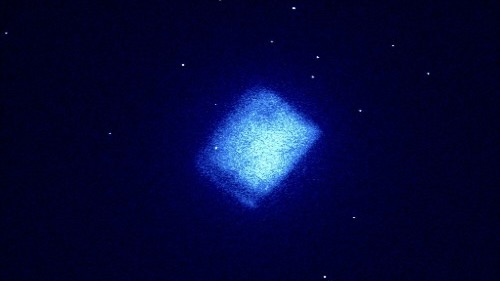
The world’s first nuclear-powered battery, which uses a radioactive isotope embedded in a diamond, could power small devices for thousands of years, scientists say.
The nuclear battery uses the reaction of a diamond placed close to a radioactive source to spontaneously produce electricity, scientists at the University of Bristol in the U.K. explained in a Dec. 4 statement. No motion — neither linear nor rotational — is required. That means no energy is needed to move a magnet through a coil or to turn an armature within a magnetic field to produce electric current, as is required in conventional power sources.
The diamond battery harvests fast-moving electrons excited by radiation, similar to how solar power uses photovoltaic cells to convert photons into electricity, the scientists said.
Scientists from the same university first demonstrated a prototype diamond battery — which used nickel-63 as the radioactive source — in 2017. In the new project, the team developed a battery made of carbon-14 radioactive isotopes embedded in manufactured diamonds.
The researchers chose carbon-14 as the source material because it emits short-range radiation, which is quickly absorbed by any solid material — meaning there are no concerns about harm from the radiation. Although carbon-14 would be dangerous to ingest or touch with bare hands, the diamond that holds it prevents any short-range radiation from escaping.
“Diamond is the hardest substance known to man; there is literally nothing we could use that could offer more protection,” Neil Fox, a professor of materials for energy at the University of Bristol, said in the statement.
Related: ‘Springy’ solid-state battery is twice the width of a white blood cell and could drastically increase EV range
Carbon-14 occurs naturally, but it is generated in plentiful amounts in graphite blocks that are used to control nuclear power plants. Researchers found the isotype concentrated on the surface of these blocks.
A single nuclear-diamond battery containing 0.04 ounce (1 gram) of carbon-14 could deliver 15 joules of electricity per day. For comparison, a standard alkaline AA battery, which weighs about 0.7 ounces (20 grams), has an energy-storage rating of 700 joules per gram. It delivers more power than the nuclear-diamond battery would in the short term, but it would be exhausted within 24 hours.
By contrast, the half-life of carbon-14 is 5,730 years, which means the battery would take that long to be depleted to 50% power. This is close to the age of the world’s oldest civilization. As another point of comparison, a spacecraft powered by a carbon-14 diamond battery would reach Alpha Centauri — our nearest stellar neighbor, which is about 4.4 light-years from Earth — long before its power were significantly depleted.
The battery could be used in various applications, including electronics, medical devices and space travel, the scientists said. Specific uses include X-ray machines and medical devices that need to operate for a long time but require low power, such as pacemakers, and machines that operate in difficult and dangerous environments, like oil and gas machinery on the seabed. The battery could also be made small enough to power radio-frequency tags for identifying and tracking devices and payloads on Earth or in space.
The battery, which was built on a plasma deposition rig near Abingdon, Oxfordshire, in the U.K. by a team from the University of Bristol and the U.K. Atomic Energy Authority (UKAEA), has no moving parts and thus requires no maintenance, nor does it have any carbon emissions.
