
Today (April 14) marks 2025’s World Quantum Day, an international celebration held to promote public understanding of quantum science.
The date, 4/14, was chosen because 4.14 represents the first three digits of Planck’s constant (4.135667696 x 10⁻¹⁵ electron volts per hertz, rounded to 4.14 x 10⁻¹⁵) — an important number in quantum physics.
Quantum physics is the branch of science that deals with the tiniest particles in the universe, such as atoms, electrons, photons (light particles), and other subatomic particles like quarks.
In the everyday world, at the scale that we can see, things tend to follow the laws of classical physics. However, when you zoom all the way in to the smallest particles, classical physics stops working quite as well, and the rules of quantum mechanics come into play.
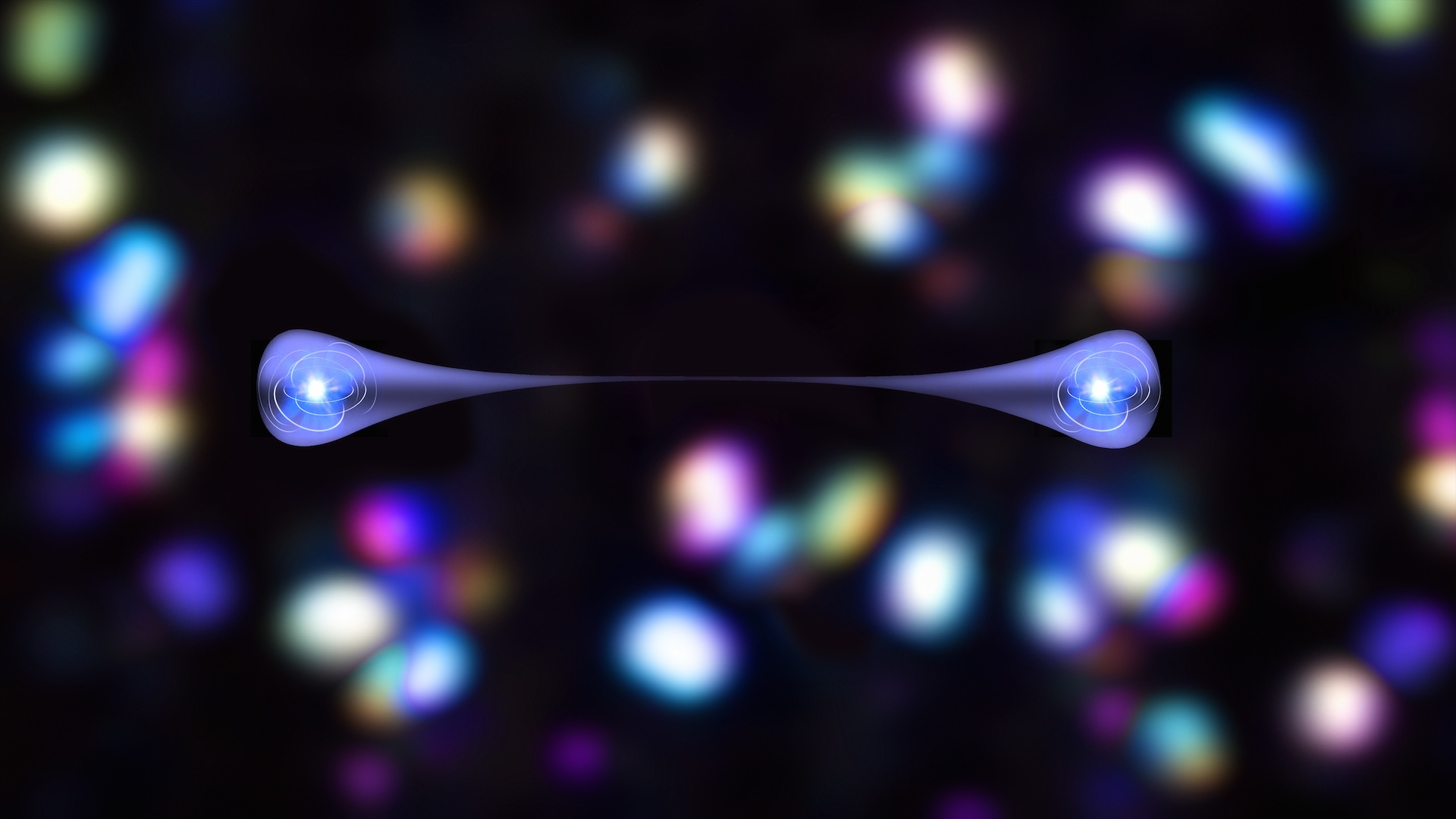
Some of the key concepts of quantum physics are that particles like electrons can behave as waves, and vice versa (known as wave-particle duality); two particles can be linked in such a way that if you measure one, you instantly know something about the other (quantum entanglement); and a quantum particle can be in multiple states at once until it’s observed (quantum superposition).
What is quantum superposition?
In everyday life, something can only be in one state at a time: a light switch is either on or off, a cat is either dead or alive. In the quantum world, things don’t work quite the same way. Quantum superposition describes how a quantum particle, like an electron, a photon, or even an atom, can exist in multiple different states at the same time — until it’s measured. Before it’s observed, it’s not halfway between states, but is instead a “superposition” of the two at once.
In quantum physics, the state of a particle is described by a wave equation, which tells us the probabilities of where a particle might be or what its properties might be. This probability wave can exist in a blend of multiple states.
What is Schrödinger’s Cat?
Schrödinger’s Cat is a famous thought experiment that illustrates how superposition works. Imagine a cat in a box with a mechanism that has a 50/50 chance of killing it, depending on whether or not a quantum particle decays radioactively, spontaneously changing into a different type of atom and releasing radioactive particles like electrons.
Until someone opens the box and observes it, the cat is considered to be in a superposition of both alive and dead. When you measure or observe the system — or in the case of Schrödinger’s Cat look inside the box — the superposition settles into one definite state, and the cat’s fate is discovered.
Related: Physicists create hottest Schrödinger’s cat ever in quantum technology breakthrough
Quantum superposition has been experimentally observed by scientists on multiple occasions. One famous example is the double-slit experiment, where photons are fired at a barrier with two slits, behind which is a a screen that records where the particles land. If you send particles through one slit, you get a single band on the screen, but if you open both, you get a wave-like interference pattern with multiple bands on the screen, which also proves that particles and waves can act like each other. Sending one particle at a time, you would expect each one to go through one slit or the other. However, the interference pattern still builds up, as if each single particle is interfering with itself. This means that each single particle is somehow going through both slits at once, and therefore is in a superposition of both possibilities
If you try to measure which slit the particle goes through, the superposition collapses: the particle does appear to have passed through a single slit, and the interference pattern disappears, leaving only two bands on the screen.
Additionally, ions and larger molecules have been experimentally trapped in a superposed state, and chlorophyll in the leaves of plants has been discovered to use quantum superposition to more efficiently harvest light from the sun.
Why is superposition so important in quantum computing?
Quantum superposition is also used as a tool in quantum computing and is the main reason quantum computers can be so powerful.
A classical binary bit can only be in one state at a time: 0 or 1. These bits are encoded on transistors, usually made from silicon, germanium or other semiconductors. With three bits present, they can have a potential of 8 different states: 000, 001, 010, 011, 100, 101, 110, and 111. To process all possibilities, a classical computer has to check them one at a time.
In quantum computers, particles such as electrons or photons act as a qubit (quantum bit), which can be in a superposition of both 0 and 1. Three qubits can be in a superposition of all 8 possible states at once, meaning that quantum computers can process a much larger number of calculations simultaneously. With three qubits present, a quantum computer could process all eight states listed above at once.
This much greater processing power than traditional computers could mean that quantum computers could one day be used to perform complex simulations in pharmaceuticals, climate modeling, and manufacturing. In theory, a quantum computer powerful enough can perform calculations in seconds that would have taken the most powerful supercomputers millions of years to complete.
