
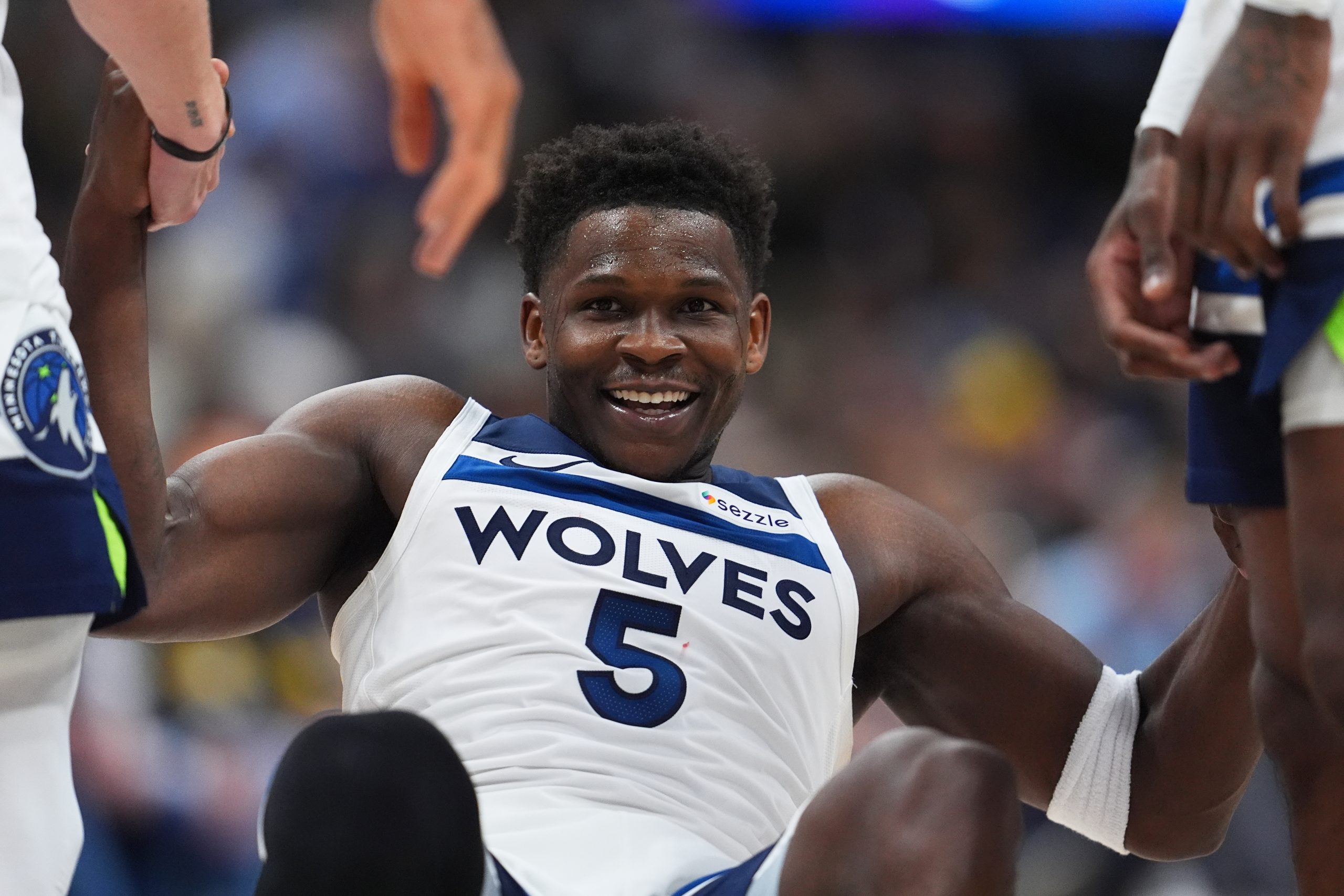
When the Minnesota Timberwolves dawdle, they die.
We’ve all seen it. Julius Randle and Anthony Edwards on the dribble, dribble, dribble, dribble; then bum-rushing or back-siding their way into a crowd. Then deke, upfake, pivot, upfake, pivot, deke, then toss up a contested shot or fling a pass with precious few seconds left for teammates to create.
We’ve all seen it. Timberwolves watching opponents quicken their dribble, splitting the seams in the defense, morphed by lethargy into a gulf-stream glide to the hoop. Or a kickout pass to a lonely marksman in the corner. Or a crowd awaiting an offensive rebound. Or simply Timberwolves watching the backs of jerseys receding from engagement down the court in transition.
The Wolves did not dawdle in Denver on Sunday. They christened the crucial month of March with alacrity. Instead of die, they thrived, with a pace, purpose and physicality that mined all the precious mettle out of the Nuggets.
It was a consequential contest. The teams entered the game tied for 4th and 5th place in the standings — the bridge separating the home and road team in the first round of the playoffs — with records of 37-23, by the Nuggets own the tiebreaker by having beaten the Wolves in all three prior meetings this season.
It was the finale of a three-game road trip for Minnesota, who had been resilient but unimpressive, eking out wins against a pair of opponents — the Trailblazers in Portland, then the Clippers in Los Angeles — missing their top players due to injury. Denver also was shorthanded — power forwards Aaron Gordon and Peyton Watson were out — but still possessed the most dynamic offensive duo in the NBA via MVP candidate Nikola Jokic and his fellow All-Star Jamal Murray.
But Jokic and Murray conjure the vast majority of their magic in expertly choreographed half-court actions, in part because Jokic carries the intellect and finesse of a surgeon inside a lumbering 284-pound physique. Not coincidentally, Denver has played at a pace below the NBA average in nine of his 11 seasons with the team.
The Wolves don’t exploit that vulnerability as often as they should, but the Nuggets have thoughtfully extended it by acquiring a backup center, veteran Jonas Valanciunas, who likewise is prone to collecting cobwebs around his ankles. And with their two most mobile rim-protectors — Gordon and Watson — on the shelf, Denver invited an up-tempo shellacking by resting Jokic, Murray and energetic forward Christian Braun to start the second quarter.
Related: The plus/minus experience of the Anthony Edwards superstardom
Minnesota’s go-go bench rockets, Bones Hyland and the recently acquired Ayo Dosunmu were already warmed up through 3:39 of play to close out the first quarter. They open the second stanza alongside center Rudy Gobert, speed-friendly sixth man Naz Reid and the transition titan Jaden McDaniels.
With Jokic, Murray and Braun combining for 27 points, 7 rebounds and 7 assists in the first quarter, the Nuggets had jumped to a 31-22 lead. The Wolves erased that in two minutes and eight seconds, snuffing Denver’s offense with a blocked shot and three turnovers. Nuggets coach David Adelman hustled Murray back into the game at that point, then brought back Jokic with 6:34 remaining in the first half, but the fuse had been lit. From 8:26 to 4:05 remaining, the Wolves went on another run, 10-2, and finished out the quarter outscoring Denver 36-19.
After scoring just two fast-break points and two points off the one Nuggets turnover in the first quarter, Minnesota had 10 fast-break points and seven points off four Denver miscues in the second frame. Everyone in coach Chris Finch’s taut eight-player rotation saw action in the quarter, ranging from Hyland’s 3:58 up to McDaniels’ 9:21.
As they are wont to do, the Wolves let go of the rope late in the third quarter, as a 10-2 Denver run cut a 13-point lead down to five with 30 seconds to play. But the Nuggets never drew nearer, as Minnesota racked up a dozen fast break points in the fourth period and forced 7 Denver turnovers resulting in 10 points. Some of that overlaps of course — fast break baskets commonly happen in transition after a turnover.
In the final three quarters, the Wolves sped their way to a 95-77 margin. Twenty of those points were off 13 Denver turnovers and 28 were registered on the break. By contrast, the Nuggets garnered just eight points in the final three periods from Minnesota’s 11 turnovers and had just four fast-break points.
The news here is that the Wolves now have a bench crew that loves to tromp the throttle. Ideally, Finch prefers to stretch out three players to allow all eight in the rotation the leeway to settle into a rhythm. Naz, Bones and Ayo scored a combined 38 points in 62:53 collective minutes, more than usual, albeit still well below the league average for total bench contribution due to the short rotation. But the key is pace: When Bones was on the floor, the Wolves played at a pace of 106.22 offensive possessions per game. During Naz’ time, it jumped to 108.41. And with Ayo, the pace was 108.81.
That is in sharp contrast to the Wolves’ overall pace of 100.50 offensive possessions for the game. But lose that desultory first period and concentrate on the last three quarters. Minnesota’s possessions per game average jumps to 102.00, with Bones (108.53), Naz (110.45) and Ayo (110.92) literally setting the pace.
When the Wolves dawdle, they die. But the rise in tempo can’t be haphazard, nor careless, devoid of purpose, making it speed just for the sake of speed. As we head into the crucible of a playoff race in the Western Conference that feels very familiar to the logjam in last year’s standings, the greatest improvement — and biggest reason or optimism, in my opinion — from this year’s squad compared with the 2024-25 edition of the Wolves, is their poise and planful execution when engaged in a more up-tempo style of play.
In the Wolves’ 38 wins thus far this season, the games have been played at a pace of 102.34 possessions (for each team). In their 23 losses, the games have been played at a pace of 100.37 possessions. That difference of 1.97 is the biggest disparity in tempo between games won and games lost by a team in the Western Conference. (Orlando at +2.78 and Brooklyn at 2.06 — albeit with only 15 wins for the latter — have a larger disparity in the East.)
Remember, this doesn’t mean that the faster the Wolves perform, the better they’ll be. What it means is that they have more versatility; that their offense has a counter to throw at opponents devoted to stopping isolation plays from Ant and Randle, and that they are taking better advantage of the transition opportunities provided by their defense.
Last season the Wolves finished 30th, dead last, in the impact made by transition plays in their offensive arsenal — just 15.3% of their total playtypes. This season they have leaped to 11th in frequency, up to 19.2% of their plays. Their efficiency has improved alongside their initiative — they score 1.16 points per transition play (8th in the NBA) compared with 1.14 points (16th) last season.
It’s more fun to ignore the numbers and just watch the difference when the Wolves snare a defensive rebound. Almost instantly the ball is out of their hands and headed to a middleman already positioned to turn up court for either a speed-dribble or a go-ahead pass to another teammate in the chain. It’s systemic and beautiful in its fearless, mostly successful, execution, even amid the hubbub of players on both teams shifting mindsets to the other end of the court. It saves creative seconds and enhances matchup opportunities even if the offense does evolve into half-court actions. And it sets up an aggressive, probing style of play that often bleeds over into more alert and opportunistic defense when transition tilts in the other direction.
Related: As Wolves tumble into season’s homestretch, consistency of effort is biggest X-factor for how far team will go
That ability to pounce more effectively has had a huge impact. Thus far this season, the Wolves have averaged 21 points off opponents’ turnovers per game in their 38 wins and just 15 points off those turnovers in their 23 losses. That six-point disparity is larger than every other team except for the Washington Wizards, whose numbers are skewed by having only 16 wins in their positive sample size versus 43 losses.
Another satisfying thing about this improvement is that it is being driven by the “role players,” instead of the more marquee performers like Ant and Randle. Jaden McDaniels and Donte DiVincenzo (“Ragu”) top this list, with Gobert the bench trio not far behind.
For the sake of brevity, and an appropriately brighter spotlight, let’s focus on McDaniels, the primary beneficiary of the Wolves enhanced commitment to transition offense. His transition plays per game have nearly doubled, from 2.1 last season to 4 in 2025-26, comprising 28.7% of his playtypes compared with 17.4% a year ago, with the same high efficiency rate of 1.18 points scored per play.
It’s fitting that this is happening, because Jaden’s defense is perhaps more responsible for generating turnovers and rebounds than anyone but Gobert. The added repetitions and resulting success has also boosted his confidence and involvement in other aspects of the Wolves offense. The accuracy of his three-point shooting — 44.3%, demolishing his previous career high of 39.8% — is the most eye-opening, but McDaniels is also doing yeoman work via career-high attempts in two-pointers (at 55.8% accuracy) and the free-throw line (84.7%). Throw in a career-high assist percentage (12.4 — previous best 9.0) and usage rate (18.2 — previous best 16.0) and it is easy to forget he earned his spurs as All NBA Defense wing stopper. Until he blocked five shots in the first half of a game last week anyway.
Put simply, McDaniels epitomizes the ways the Wolves have improved this season. Not only are they better balanced between offense and defense, but have more purposeful, versatile approaches when attacking and defending. And transitioning between them.
It provides some perspective on a team that dabbles in loud losses and underwhelming victories. For a roster that lost the services of Nickeil Alexander-Walker and the vintage performances of Mike Conley while never really benefiting from the expected growth spurt of Rob Dillingham, Terrence Shannon Jr. and Jaylen Clark, there has been some upholstery on the fly amid the exalted expectations of back-to-back appearances in the conference finals.
So don’t lose the caveats — in a tight race for playoff positioning, anything can happen. But instead of fretting over lottery odds or wish-casting somebody’s castoff — a once-promising first-rounder or over-the-hill vet — into a 2027 rotation piece, note that the rides of March are upon us. Latch the bar, lean back and watch the thrills and ills flash and fade through your eyes and memories.
And don’t dawdle in despair.
