
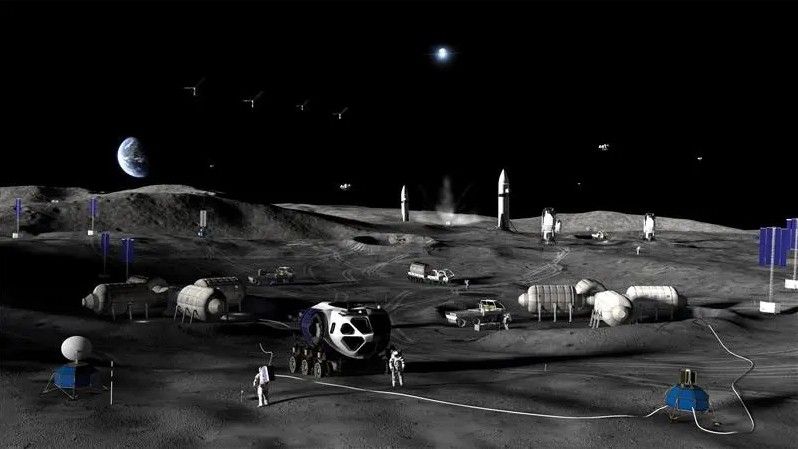
NASA has announced “near‑impossible” plans to ramp up moon landing activities and launch a nuclear-powered spacecraft by 2028.
The changes are yet another Artemis program shakeup that will see NASA pause its work on humanity’s first lunar space station, the lunar Gateway, in order to instead use its parts on a newly announced $20 billion moon base.
“NASA is committed to achieving the near‑impossible once again, to return to the Moon before the end of President Trump’s term, build a Moon base, establish an enduring presence, and do the other things needed to ensure American leadership in space,” NASA Administrator Jared Isaacman said in a statement.
Article continues below
Isaacman laid out plans for the moon base during an all-day news conference dubbed “Ignition” on Tuesday (March 24). At the same event, Isaacman also announced plans to develop the “Space Reactor‑1 Freedom,” the world’s first nuclear-powered interplanetary spacecraft, which NASA claims will launch for Mars as soon as 2028.
The announcement means that NASA is now targeting two crewed lunar landing missions and the launch of a first-of-its-kind spacecraft in 2028 alone.
That’s an ambitious schedule, especially keeping in mind the delays the space agency’s moon program has experienced up to this point. For example, back in 2019, NASA was targeting a moon landing in 2024 with Artemis III, and yet here we are in 2026, and NASA still has yet to launch Artemis II, its first crewed lunar flyby mission — though that could finally lift off as early as next Wednesday (April 1).
Why is NASA in such a hurry?
During his opening address, Isaacman spoke of wasted billions and years lost, referencing the delays and spiralling costs that have plagued the Artemis program in recent years. He also reiterated that NASA wants to return humans to the moon before the end of President Donald Trump’s current term and that the space agency faced competition from a “real geopolitical rival challenging American leadership in the high ground of space.”
It’s no secret that China is threatening to overtake the U.S. as the leader in space exploration, and the U.S. doesn’t want to fall behind. China is planning to land its own astronauts on the moon before 2030, with both nations eyeing the same lunar south pole landing sites.
“The difference between success and failure will be measured in months, not years,” Isaacman said. “They may be early, and recent history suggests we might be late.”
NASA plans to ramp up its lunar activities by standardizing rocket architecture, inserting NASA expertise across industry, and making launches that support operations on the moon more frequent, according to Isaacman.
The Ignition event comes a month after NASA announced a sweeping overhaul of Artemis’ return to the moon. This included changes to Artemis III, which will now be retooled to test the docking of the Orion crew capsule with a lunar lander in Earth orbit in 2027. Artemis IV and Artemis V aim to put astronauts on the lunar surface in 2028, with Artemis V now scheduled as a second crewed landing attempt, which is supposed to lay the foundations for NASA’s permanent lunar base.
NASA always wanted to establish a permanent lunar presence with its Artemis missions, though details revealed at the Ignition event have offered some clues for how it will do this. The base will be installed in three phases, the first marked by experimentation around design and functionality, the second consisting of semi-habitable early infrastructure, and, finally, the permanent lunar base.
The Ignition event also included plans for what comes after Artemis V, with NASA saying that it will target “frequent and affordable crewed missions to the lunar surface” every 6 months by incorporating more commercially sourced and reusable hardware.
The sacrifice made against ramping up lunar surface activities is NASA’s long-planned Gateway — a small space station that would orbit the moon and host rotating crews of international astronauts. Once described by NASA as “central to the NASA-led Artemis missions to return to the Moon” and scheduled for launch in 2027, it will now be on ice for the foreseeable future. The future of Gateway has been in doubt for a while, even though NASA has made significant progress building the space station, aided by partner space agencies in Europe, Canada, Japan and the United Arab Emirates.
The moon is meant to serve as a stepping stone to Mars and deeper space exploration. NASA’s newly announced Space Reactor‑1 Freedom could also help the agency ramp up Mars operations. Space Reactor‑1 Freedom will supposedly drop Skyfall payloads of mini helicopters to explore the Martian surface, according to NASA. It is unclear how much progress has already been made on the nuclear spacecraft or fleet of Mars-copters.
