Close Menu
  • Home
  • UNSUBSCRIBE
  • News
  • Lifestyle
  • Tech
  • Entertainment
  • Sports
  • Travel
Facebook X (Twitter) WhatsApp
Trending
  • New robotic heart mimics common, mysterious condition to help researchers study it
  • Canon EOS R6 III review: A wildlife wonder
  • Medieval babies and adults buried together in Sweden were not related, archaeologists discover — raising big questions about early Christian burial practices
  • NASA is creating a fifth state of matter on the ISS, thanks to an upgrade to a mini-fridge-sized quantum lab
  • New sodium metal battery design charges in just 4 minutes and retains its capacity for years
  • Quantum computing wielded to create extremely rare material critical to nuclear fusion
  • Scientists build tiny ‘diving suit’ for cockroaches, turning them into search-and-rescue cyborgs
  • Physicists develop the first working model of quantum mechanics using only ‘real’ numbers
Facebook X (Twitter) WhatsApp
Baynard Media
  • Home
  • UNSUBSCRIBE
  • News
  • Lifestyle
  • Tech
  • Entertainment
  • Sports
  • Travel
Baynard Media
Home»Lifestyle»Wilkes Land crater: The 315-mile anomaly beneath East Antarctica that’s possibly the ‘greatest impact crater known’ on Earth
Lifestyle

Wilkes Land crater: The 315-mile anomaly beneath East Antarctica that’s possibly the ‘greatest impact crater known’ on Earth

EditorBy EditorApril 11, 2025No Comments4 Mins Read
Share Facebook Twitter Pinterest LinkedIn Tumblr Reddit Telegram Email
Share
Facebook Twitter LinkedIn Pinterest Email

QUICK FACTS

Name: Wilkes Land crater

Location: East Antarctica

Coordinates: 70°S 120°E

Why it’s incredible: Evidence suggests it could be the greatest known impact crater on Earth.

The Wilkes Land crater is a hole in the bedrock beneath East Antarctica‘s ice sheet measuring 315 miles (510 kilometers) across. Researchers have been trying to explain its existence since the 1960s, and the most recent evidence suggests it was born from a cataclysmic meteorite impact.

The crater was first detected as a huge dent in Earth’s gravitational field. Initial ground-based seismic and gravity surveys already indicated that the crater was huge — around 150 miles (240 km) across — but newer techniques reveal that it is likely more than double this size.

According to a 2018 study, the Wilkes Land crater sits about 1 mile (1.6 km) beneath the surface of Antarctica’s ice sheet. The study showed the crater in more detail than ever before and examined its potential link with southern Australia, which was connected to East Antarctica until around 35 million years ago. While the origin of the crater remains uncertain, the results of the study suggest the event that created the hole likely occurred before the continents separated.

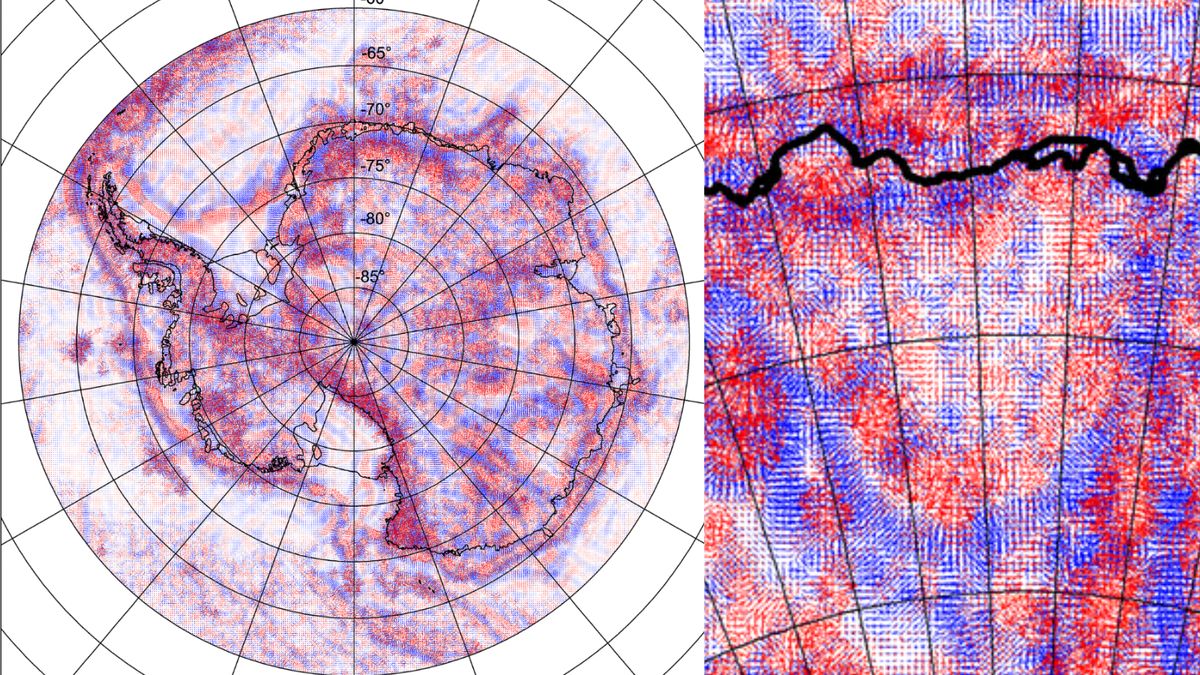
Researchers have proposed several explanations for the Wilkes Land crater, including that it could be a volcanic structure, a sedimentary basin, a deeply eroded valley or a meteor impact crater, according to a 2015 paper. For that paper, scientists used satellite remote sensing techniques to map the crater and determine its physical characteristics. In the middle of the hole in Earth’s gravitational field, known as a negative gravity anomaly, they found a positive gravity anomaly, with the ice sheet filling the gap around this central peak like a huge, frosty donut.

Related: Scientists create new map showing ice-free Antarctica in more detail than ever before

The central peak is likely a structure known as a mass concentration, or a “mascon,” according to the study. Mascons can occur within meteor impact structures due to the meteor crashing through Earth’s crust and affecting the mantle beneath. Following the impact, the mantle may recoil and form a dense plug, resulting in a positive gravity anomaly, the study authors wrote.

Map of Antarctica showing values of gravity disturbances in neon green and blue.

A map of Antarctica showing gravity data across the frozen continent. Wilkes Land is situated in the bottom right corner of the map. A patch resembling a U-shape surrounded by dark blue is the Wilkes Land crater. (Image credit: Klokočník, Kostelecký & Bezděk. Earth Planets Space (2018). Reshared under the terms of Creative Commons (CC BY 4.0))

The Wilkes Land crater and its mascon aren’t perfectly circular and instead form a U-shape, according to the 2018 study, whose results support the conclusion that the crater was caused by a meteor impact. The northern side of the crater is fragmented, perhaps as a result of tectonic processes that ripped Australia and Antarctica apart, the authors noted. Parts of the crater are clearly visible in southern Australia, they added.

Get the world’s most fascinating discoveries delivered straight to your inbox.

If the Wilkes Land crater is an impact crater, then it “would be the greatest impact crater known” on Earth in terms of its size, the authors wrote.

In the 2015 study, researchers found that the crater’s diameter matches the speed and size of space rocks that regularly crashed into Earth during its early history between 4.1 billion and 3.8 billion years ago. “The WLA [Wilkes Land Anomaly] could have been created by such bolides,” they wrote in the study.

“Nonetheless, because of the constraints imposed by the overlying continental ice sheet, […], we believe that the other explanations for the subglacial structure remain viable,” they added.


Discover more incredible places, where we highlight the fantastic history and science behind some of the most dramatic landscapes on Earth.


Antarctica quiz: Test your knowledge on Earth’s frozen continent

Source link

Share. Facebook Twitter Pinterest LinkedIn Tumblr Email
Previous ArticleGet a closer look at wildlife for less: This huge $60 saving on the Bushnell 10x42mm Trophy XLT binoculars — now down to their lowest-ever price at Adorama
Next Article US company to use giant spinning cannon to blast hundreds of pancake-like ‘microsatellites’ into space
Editor
  • Website

Related Posts

Lifestyle

New robotic heart mimics common, mysterious condition to help researchers study it

July 11, 2026
Lifestyle

Canon EOS R6 III review: A wildlife wonder

July 10, 2026
Lifestyle

Medieval babies and adults buried together in Sweden were not related, archaeologists discover — raising big questions about early Christian burial practices

July 10, 2026
Add A Comment

Comments are closed.

Categories
  • Entertainment
  • Lifestyle
  • News
  • Sports
  • Tech
  • Travel
Recent Posts
  • New robotic heart mimics common, mysterious condition to help researchers study it
  • Canon EOS R6 III review: A wildlife wonder
  • Medieval babies and adults buried together in Sweden were not related, archaeologists discover — raising big questions about early Christian burial practices
  • NASA is creating a fifth state of matter on the ISS, thanks to an upgrade to a mini-fridge-sized quantum lab
  • New sodium metal battery design charges in just 4 minutes and retains its capacity for years
calendar
July 2026
M T W T F S S
 12345
6789101112
13141516171819
20212223242526
2728293031  
« Jun    
Recent Posts
  • New robotic heart mimics common, mysterious condition to help researchers study it
  • Canon EOS R6 III review: A wildlife wonder
  • Medieval babies and adults buried together in Sweden were not related, archaeologists discover — raising big questions about early Christian burial practices
About

Welcome to Baynard Media, your trusted source for a diverse range of news and insights. We are committed to delivering timely, reliable, and thought-provoking content that keeps you informed
and inspired

Categories
  • Entertainment
  • Lifestyle
  • News
  • Sports
  • Tech
  • Travel
Facebook X (Twitter) Pinterest WhatsApp
  • Contact Us
  • About Us
  • Privacy Policy
  • Disclaimer
  • UNSUBSCRIBE
© 2026 copyrights reserved

Type above and press Enter to search. Press Esc to cancel.