Close Menu
  • Home
  • UNSUBSCRIBE
  • News
  • Lifestyle
  • Tech
  • Entertainment
  • Sports
  • Travel
Facebook X (Twitter) WhatsApp
Trending
  • Wildlife inside Chernobyl exclusion zone acted differently during Russia’s invasion, camera traps reveal
  • Denisovan DNA influences the immune systems of modern Oceanians — but researchers aren’t sure why
  • ‘They don’t bear the costs when it comes to pollution’: The environmental costs of AI are astounding, and the world’s poorest will pay for it as the top 1% profits
  • ‘River in the Sky’: China’s doomed plan to create a ‘cloud seeding corridor’ tells us how far the country will go to solve its climate crisis
  • ‘They reliably chose the statistically more favorable option’: A crow researcher explains how these winged geniuses process numbers, and what it could reveal about human math smarts
  • Atlantic ‘cold blob’ is responsible for shifts in the Indian summer monsoon that threaten over 1 billion people
  • China’s secretive Tianwen-2 mission is about to attempt a daring landing on near-Earth asteroid Kamo’oalewa
  • Oldest known plague victims found in a 5,500-year-old burial ground in Siberia — and many of them were children
Facebook X (Twitter) WhatsApp
Baynard Media
  • Home
  • UNSUBSCRIBE
  • News
  • Lifestyle
  • Tech
  • Entertainment
  • Sports
  • Travel
Baynard Media
Home»Lifestyle»Wildlife inside Chernobyl exclusion zone acted differently during Russia’s invasion, camera traps reveal
Lifestyle

Wildlife inside Chernobyl exclusion zone acted differently during Russia’s invasion, camera traps reveal

EditorBy EditorJune 19, 2026No Comments4 Mins Read
Share Facebook Twitter Pinterest LinkedIn Tumblr Reddit Telegram Email
Share
Facebook Twitter LinkedIn Pinterest Email

Camera traps from inside the Chernobyl exclusion zone reveal how the occupation of Russian forces at the site in February and March 2022 altered the behavior of wildlife living in the area.

After the invasion, which involved significant armed conflict inside the exclusion zone, mammals like deer and horses became less active and spent less time moving around at night, a new study reports.

Researchers discovered the changes by comparing footage from camera traps collected during the early months of Russia’s 2022 invasion with recordings from the same period a year earlier, before the conflict began. The findings, published Thursday (June 18) in the journal Science, offer a rare glimpse of how animals respond to the immediate disruption caused by warfare.

“I wish the opportunity to analyze how the unfolding invasion affected wildlife ha[d] never happened,” Svitlana Kudrenko, who conducted the study as part of her PhD at the Albert Ludwig University of Freiburg in Germany, told Live Science in an email. “Unlike in preindustrial times, current interstate conflicts are highly detrimental for wildlife because of a long list of warfare, often operated remotely.”

The study took place in the Chernobyl exclusion zone, a roughly 1,000-square-mile (2,600 square kilometers) area surrounding the site of the 1986 Chernobyl nuclear disaster. Following the reactor explosion, authorities evacuated the region and restricted most human activity. Over the decades, with little to no human activity, wildlife populations have flourished, turning the zone into a natural laboratory for scientists studying ecosystem recovery and animal behavior.


You may like

Image 1 of 4

A person stands amidst a series of downed trees
(Image credit: Denys Vyshnevskyi)

Researchers revisit the Chernobyl exclusion zone in 2025, after the Russian invasion.

Three large storks sit on top of a large metal frame with a forest in the background
(Image credit: Kateryna Korepanova)

Black storks and a gray heron rest on metal structures at the former cooling pond of the Chernobyl Nuclear Power Plant in 2020.

An aerial view of the Chernobyl exclusion zone
(Image credit: Kateryna Korepanova)

An aerial view of the Chernobyl Nuclear Power Plant cooling pond in 2019.

A view of a nuclear power plant with a mural of a person wearing a gas mask painted on a tower.
(Image credit: Kateryna Korepanova)

A view inside the Chernobyl power plant cooling tower.


But in February 2022, Russian forces seized control of the region during the beginning stages of the invasion of Ukraine. Military vehicles, troop movements, weapons being fired and other wartime disturbances suddenly transformed one of Europe’s most unusual wildlife refuges into an active war zone.

To investigate the impact, researchers analyzed data from camera traps already operating in the exclusion zone from 2020 to 2022. Studying the ecological effects of armed conflict is difficult because war zones are dangerous and often hard for researchers to access.

Get the world’s most fascinating discoveries delivered straight to your inbox.

By using the existing network of automated cameras, the scientists captured wildlife responses that would have been impossible to record otherwise. In total, the team analyzed almost 2,000 photographs and videos from the exclusion zone to build a picture of behavioral changes in response to the conflict.

The images and footage revealed responses from 11 wild mammal species, ‪showing that some animals changed their behavior during periods of heavier fighting.

Image 1 of 4

A deer looks into the camera as one bends down in the grass behind it.
(Image credit: Kudrenko et al (2026))

Roe deer are spotted near the Uzh River in the Chernobyl Exclusion Zone.

A series of brown and tan horses stand near power lines.
(Image credit: Kateryna Korepanova)

Przewalski’s horses are seen near the Chernobyl Nuclear Power Plant in 2020.

Two deer run across a snowy road in the middle of a forest.
(Image credit: Kateryna Korepanova)

Roe deer bound across a road in an abandoned village of Kupovate in 2024.

A brown rusty gas mask sits on top of a broken piano covered in ash.
(Image credit: Kateryna Korepanova)

Gas masks were left behind after the evacuation of Chernobyl in 1986.


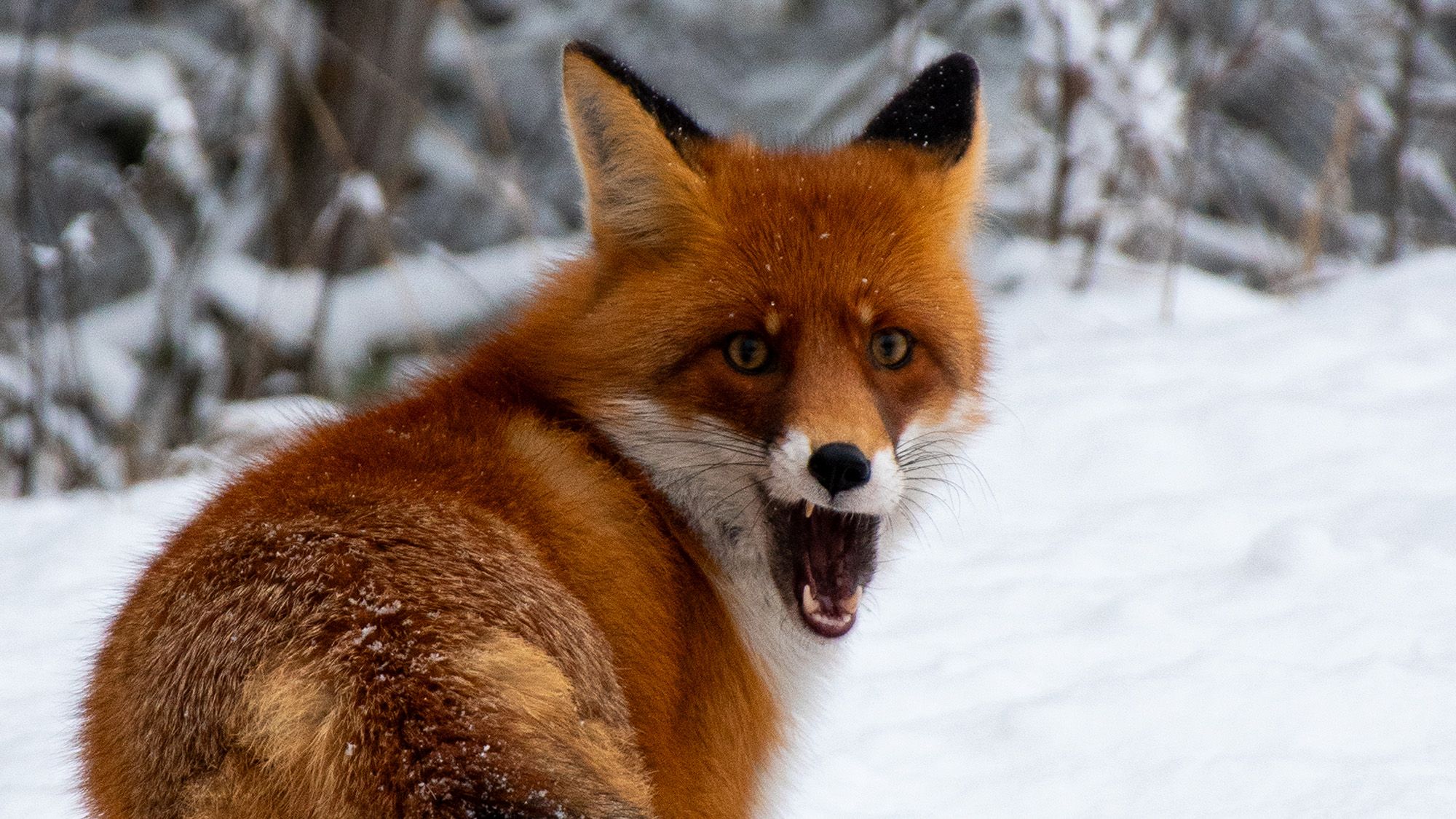
Several mammal species — including roe deer (Capreolus capreolus), red deer (Cervus elaphus), moose (Alces alces) and red foxes (Vulpes vulpes) — were less active during the occupation than before the conflict, especially at night, the team reported.


What to read next

The findings suggest that the impact of conflict can ripple through entire ecosystems. While Russia no longer occupies the Chernobyl exclusion zone, the authors highlighted that this study still shows how animal behavior can adapt to warfare.

Camera traps could become a valuable tool for measuring the environmental costs of conflict and understanding how wildlife copes with sudden human disturbances across the globe, the researchers added.

“Our study highlights the need to develop and implement research and conservation strategies focusing on armed conflict impacts on wildlife and environment in general, especially in areas of conservation importance,” Kudrenko said.

Kudrenko, S., Vyshnevskyi, D., Korepanova, K., Bischof, R., Zedrosser, A., Selva, N., Domashevskyi, S., Obrizan, S., Gahbauer, M., Borsuk, O., Varukha, A., & Heurich, M. (2026). Changes in wildlife activity patterns in response to war in Ukraine. Science. https://doi.org/10.1126/science.aed1493


What do you know about the animal kingdom? Test your knowledge with our animal quiz!

Source link

Share. Facebook Twitter Pinterest LinkedIn Tumblr Email
Previous ArticleDenisovan DNA influences the immune systems of modern Oceanians — but researchers aren’t sure why
Editor
  • Website

Related Posts

Lifestyle

Denisovan DNA influences the immune systems of modern Oceanians — but researchers aren’t sure why

June 18, 2026
Lifestyle

‘They don’t bear the costs when it comes to pollution’: The environmental costs of AI are astounding, and the world’s poorest will pay for it as the top 1% profits

June 18, 2026
Lifestyle

‘River in the Sky’: China’s doomed plan to create a ‘cloud seeding corridor’ tells us how far the country will go to solve its climate crisis

June 18, 2026
Add A Comment

Comments are closed.

Categories
  • Entertainment
  • Lifestyle
  • News
  • Sports
  • Tech
  • Travel
Recent Posts
  • Wildlife inside Chernobyl exclusion zone acted differently during Russia’s invasion, camera traps reveal
  • Denisovan DNA influences the immune systems of modern Oceanians — but researchers aren’t sure why
  • ‘They don’t bear the costs when it comes to pollution’: The environmental costs of AI are astounding, and the world’s poorest will pay for it as the top 1% profits
  • ‘River in the Sky’: China’s doomed plan to create a ‘cloud seeding corridor’ tells us how far the country will go to solve its climate crisis
  • ‘They reliably chose the statistically more favorable option’: A crow researcher explains how these winged geniuses process numbers, and what it could reveal about human math smarts
calendar
June 2026
M T W T F S S
1234567
891011121314
15161718192021
22232425262728
2930  
« May    
Recent Posts
  • Wildlife inside Chernobyl exclusion zone acted differently during Russia’s invasion, camera traps reveal
  • Denisovan DNA influences the immune systems of modern Oceanians — but researchers aren’t sure why
  • ‘They don’t bear the costs when it comes to pollution’: The environmental costs of AI are astounding, and the world’s poorest will pay for it as the top 1% profits
About

Welcome to Baynard Media, your trusted source for a diverse range of news and insights. We are committed to delivering timely, reliable, and thought-provoking content that keeps you informed
and inspired

Categories
  • Entertainment
  • Lifestyle
  • News
  • Sports
  • Tech
  • Travel
Facebook X (Twitter) Pinterest WhatsApp
  • Contact Us
  • About Us
  • Privacy Policy
  • Disclaimer
  • UNSUBSCRIBE
© 2026 copyrights reserved

Type above and press Enter to search. Press Esc to cancel.