Close Menu
  • Home
  • UNSUBSCRIBE
  • News
  • Lifestyle
  • Tech
  • Entertainment
  • Sports
  • Travel
Facebook X (Twitter) WhatsApp
Trending
  • 800-year-old ‘hugging skeletons’ are genetically confirmed as Poland’s only medieval same-sex double burial
  • There’s a new T. rex from the dinosaur age — and it ruled the seas with a skull-crushing bite
  • Great Pyramid of Giza is remarkably resilient to earthquakes —‬ and it’s due to the ancient Egyptians’ ‘extraordinary’ engineering knowledge
  • China’s real-life ‘transformer’ mech is a giant humanoid robot that can switch from bounding on 4 legs to walking on 2
  • How can we prevent AI models from cannibalizing themselves when human-generated data runs out? Scientists say they’ve found the answer.
  • ‘The system is likely to reach a breaking point’: Major Italian volcano is speeding toward a transition, and a major eruption could be on the way
  • China installs world’s largest floating wind turbine in deep water test — it generates enough energy to power 4,200 homes annually
  • Diagnostic dilemma: A biopsy of a woman’s cancerous tumor caused it to vanish
Facebook X (Twitter) WhatsApp
Baynard Media
  • Home
  • UNSUBSCRIBE
  • News
  • Lifestyle
  • Tech
  • Entertainment
  • Sports
  • Travel
Baynard Media
Home»Lifestyle»Why does Pluto have such a weird orbit?
Lifestyle

Why does Pluto have such a weird orbit?

EditorBy EditorSeptember 20, 2025No Comments4 Mins Read
Share Facebook Twitter Pinterest LinkedIn Tumblr Reddit Telegram Email
Share
Facebook Twitter LinkedIn Pinterest Email

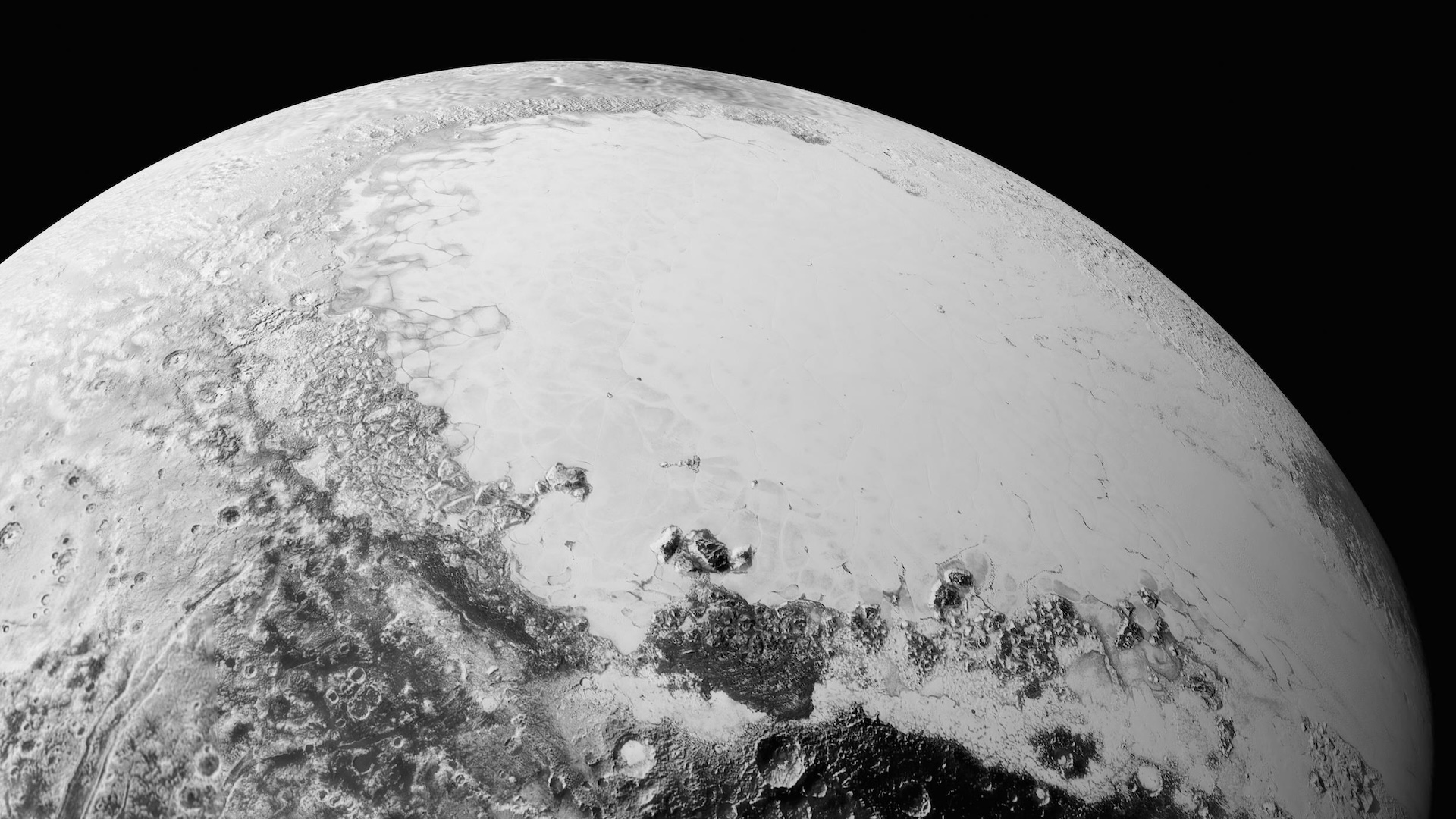
Pluto is a bit of a loner. The dwarf planet is no longer considered a regular planet; it does not orbit on the same plane as the solar system’s eight planets; and its orbit is both highly elliptical and extremely tilted.

In fact, its orbit is much more similar to that of its neighbors in the Kuiper Belt, a doughnut-shaped region beyond Neptune’s orbit that’s also home to other dwarf planets like Makemake and Eris, as well as millions of icy objects. But even compared with the rest of the objects in the Kuiper Belt, Pluto’s orbit is peculiar.

So, how did Pluto’s orbit end up this way?


You may like

First, let’s compare Pluto to Earth and other planets in the solar system. The dwarf planet’s orbit has an eccentricity — how much it deviates from a perfect circle — of 0.25. For comparison, Earth’s orbit has an eccentricity of 0.0167, meaning it’s nearly circular. Saturn and Mars have eccentricities of 0.054 and 0.093, respectively.

Pluto’s orbit is tilted 17.4 degrees, compared with Earth’s 1.5 degrees and Mercury’s roughly 2 degrees.

Pluto’s unusual eccentricity and tilt is likely due to its interactions with neighboring Neptune and other giant planets, said Renu Malhotra, a planetary scientist at the University of Arizona who has studied Pluto’s orbit extensively.

Related: Why aren’t all orbits circular?

Scientists believe Neptune’s migration due to gravitational interactions with its giant neighbors plays a part in explaining Pluto’s orbit. At some point, the planets migrated, and Pluto “was in this kind of orbit because Neptune’s orbit had migrated outward … and swept Pluto up into this resonance,” or when the gravities of orbiting bodies periodically influence each other as they pass nearby, Malhotra told Live Science.

Say you have a flat surface, Malhotra said. If you randomly toss rocks on it, they’ll end up anywhere. But if you have dips in the surface, the rocks will end up in those dips. In the case of the planets, Neptune’s migration created a gravitational well for resonant objects like Pluto.

An illustration showing the orbits of all the planets in the solar system

Compared to the solar system’s eight planets, Pluto’s strange orbit is off the charts. (Image credit: NASA; Public domain)

Neptune keeps Pluto in check despite its strange orbit. For 20 years of 248-year orbit, Pluto is inside Neptune’s orbit. The two planets are in a 3:2 orbital resonance, which means that Pluto completes two orbits every time Neptune completes three.


You may like

“That configuration is very stable and it protects Pluto from getting jostled further,” said Will Grundy, an astronomer at the Lowell Observatory in Arizona and co-investigator on NASA’s New Horizons mission to Pluto.

There’s another odd aspect of Pluto’s orbit. When the dwarf planet reaches perihelion — its closest point to the sun — it’s always above the plane of the planets. That’s “really peculiar,” Malhotra said. Generally, planets and other dwarf planets dip above and below the plane over time — something that simulations suggest Pluto has never done. This is caused by a dance between Pluto and the planets Jupiter and Uranus that works to keep Pluto from launching into chaos.

“We used to think it was just the fact of Neptune and Pluto, but it turns out that the other planets are also very important in this other characteristic of Pluto,” Malhotra said.

Pluto isn’t alone in having a strange orbit, though. For instance, the dwarf planet Eris has an eccentricity of 0.45 and an inclination of about 43 degrees. “It’s a much more extreme orbit,” Grundy told Live Science.

There’s still a lot to learn about how the planets migrated and by how much. And Pluto’s cosmic neighborhood, the Kuiper Belt, is certain to offer even more mysteries.

“There’s more landscape on objects [100 kilometers, or about 60 miles, and bigger] in the Kuiper Belt than there is in the entire rest of the solar system combined on solid surfaces,” Grundy said. “It really is a ripe area for exploration.”


Solar system quiz: How well do you know our cosmic neighborhood?

Source link

Share. Facebook Twitter Pinterest LinkedIn Tumblr Email
Previous ArticleWATCH: Rhetoric and free speech collide after Kirk assassination, lawmakers react
Next Article Kirk assassin’s alleged gun was powerful, vintage and hard to trace
Editor
  • Website

Related Posts

Lifestyle

800-year-old ‘hugging skeletons’ are genetically confirmed as Poland’s only medieval same-sex double burial

May 21, 2026
Lifestyle

There’s a new T. rex from the dinosaur age — and it ruled the seas with a skull-crushing bite

May 21, 2026
Lifestyle

Great Pyramid of Giza is remarkably resilient to earthquakes —‬ and it’s due to the ancient Egyptians’ ‘extraordinary’ engineering knowledge

May 21, 2026
Add A Comment

Comments are closed.

Categories
  • Entertainment
  • Lifestyle
  • News
  • Sports
  • Tech
  • Travel
Recent Posts
  • 800-year-old ‘hugging skeletons’ are genetically confirmed as Poland’s only medieval same-sex double burial
  • There’s a new T. rex from the dinosaur age — and it ruled the seas with a skull-crushing bite
  • Great Pyramid of Giza is remarkably resilient to earthquakes —‬ and it’s due to the ancient Egyptians’ ‘extraordinary’ engineering knowledge
  • China’s real-life ‘transformer’ mech is a giant humanoid robot that can switch from bounding on 4 legs to walking on 2
  • How can we prevent AI models from cannibalizing themselves when human-generated data runs out? Scientists say they’ve found the answer.
calendar
May 2026
M T W T F S S
 123
45678910
11121314151617
18192021222324
25262728293031
« Apr    
Recent Posts
  • 800-year-old ‘hugging skeletons’ are genetically confirmed as Poland’s only medieval same-sex double burial
  • There’s a new T. rex from the dinosaur age — and it ruled the seas with a skull-crushing bite
  • Great Pyramid of Giza is remarkably resilient to earthquakes —‬ and it’s due to the ancient Egyptians’ ‘extraordinary’ engineering knowledge
About

Welcome to Baynard Media, your trusted source for a diverse range of news and insights. We are committed to delivering timely, reliable, and thought-provoking content that keeps you informed
and inspired

Categories
  • Entertainment
  • Lifestyle
  • News
  • Sports
  • Tech
  • Travel
Facebook X (Twitter) Pinterest WhatsApp
  • Contact Us
  • About Us
  • Privacy Policy
  • Disclaimer
  • UNSUBSCRIBE
© 2026 copyrights reserved

Type above and press Enter to search. Press Esc to cancel.