
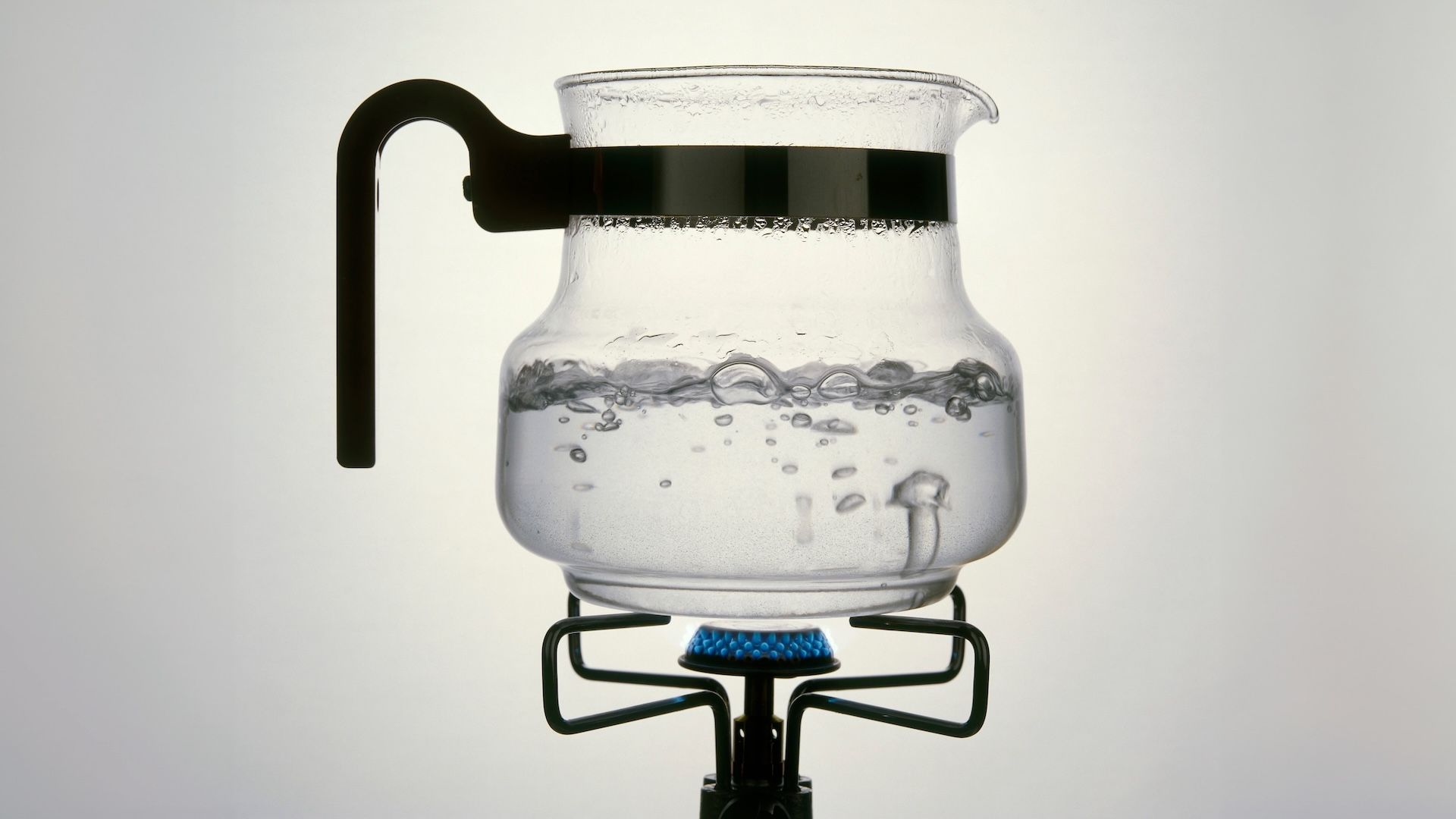
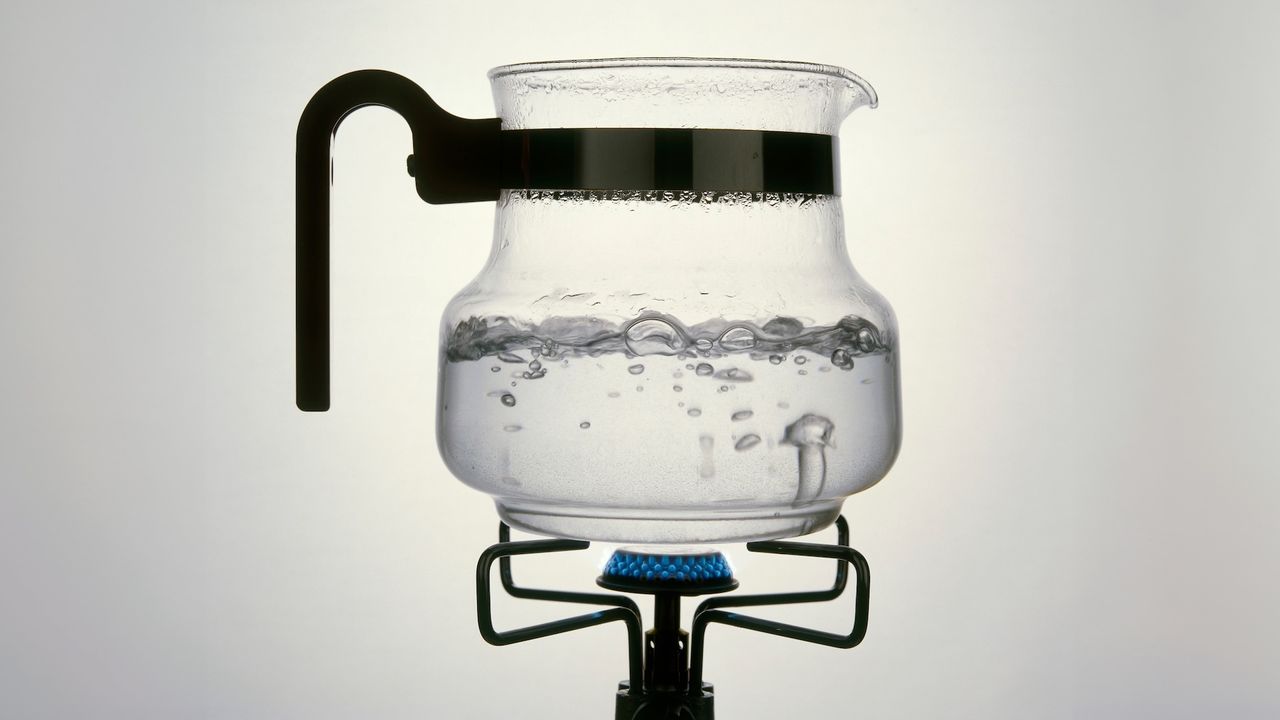
When you’re waiting for a pot of water to heat up on the stove, tiny bubbles are the first sign it’s getting ready to boil. As the water gets hotter, the bubbles get bigger, until a rolling boil signals the water has reached 212 degrees Fahrenheit (100 degrees Celsius).
Or does it? Anyone who has boiled water in a microwave will note the lack of bubbles. So, why does boiling water have bubbles, except in a microwave?
“The boiling point means that at anything above that temperature, your molecules are happier being a vapor than being a liquid,” said Jonathan Boreyko, a fluid dynamist at Virginia Tech. Beyond 212 F, the intrinsic energy of the water molecules — known as the chemical potential — is lower for the gas than the liquid, making the vapor the most stable form.
“But to actually execute boiling, you have to create a bubble, which has an energy cost,” Boreyko told Live Science. “So just because you’re happier being a vapor doesn’t mean you’ll successfully boil.”
Therefore, the temperature at which water actually boils is a trade-off between the chemical potential energy saved by becoming a gas and the energy spent to form a bubble.
Crucially, a bubble is not just a volume of gas but also an interface between gas and liquid phases. And like all liquid interfaces, this surface is subject to surface tension.
Surface tension is a force that constantly tries to shrink the gas-liquid boundary to the smallest possible area. In the case of a bubble, this would mean collapsing entirely back into a uniform liquid. A stable bubble must therefore contain enough gas that the chemical potential energy saving is greater than the surface tension of the interface, making larger bubbles more stable.
“Surface tension is basically an energetic cost per area,” Boreyko said. “Really small bubbles have a very large surface-area-to-volume ratio, whereas a bigger bubble has a smaller area relative to its volume. The volume dominates the bigger you get, which outcompetes the surface tension cost.”
Consequently, water often doesn’t boil until it’s a little hotter than 212 F — a phenomenon known as superheating. The boiling point marks the temperature at which the gas becomes more stable than the liquid, and the extra degrees correspond to the activation energy required to create a sufficiently large bubble.
However, various factors influence how easily these bubbles can form, Mirko Gallo, a fluid dynamist at Sapienza University of Rome, told Live Science.
“Dissolved gases, impurities in the water, the surface of the container can all reduce the energy barrier for the formation of the bubble,” Gallo explained. These irregularities within the bulk liquid provide a distinct nucleation point around which bubbles can form, reducing the surface tension penalty of forming a completely spherical bubble.
“If you form a bubble on an edge, it is only half a sphere, so you have a smaller surface and will need less energy,” he added. “That’s why the first bubbles always start appearing on the boundary of the pot.”
Boiling water in microwaves
Conversely, in a microwave, the unusual heating conditions suppress bubble formation so effectively that it’s possible to superheat the water by up to 36 F (20 C).
“The electromagnetic waves are penetrating and exciting the water molecules through the entire volume, so it heats the water very quickly and uniformly, whereas on a stovetop, it’s the bottom wall of the pot that’s getting hottest,” Boreyko explained. “You also tend to [heat up things in a microwave] in a pretty smooth container — say, glass — so you don’t have those localized hotspots that help you get over that energy barrier to create the first interface.”
This huge store of chemical potential energy in the superheated liquid is spontaneously released in the form of a giant, explosive bubble as soon as the container is disturbed, making water heated in the microwave surprisingly dangerous.
But superheating isn’t exclusive to water; it’s possible for any liquid, Gallo said.
“Water has a very high surface tension compared to most liquids, but basically, the higher the surface tension, the more dramatic the effect,” Boreyko added.
