
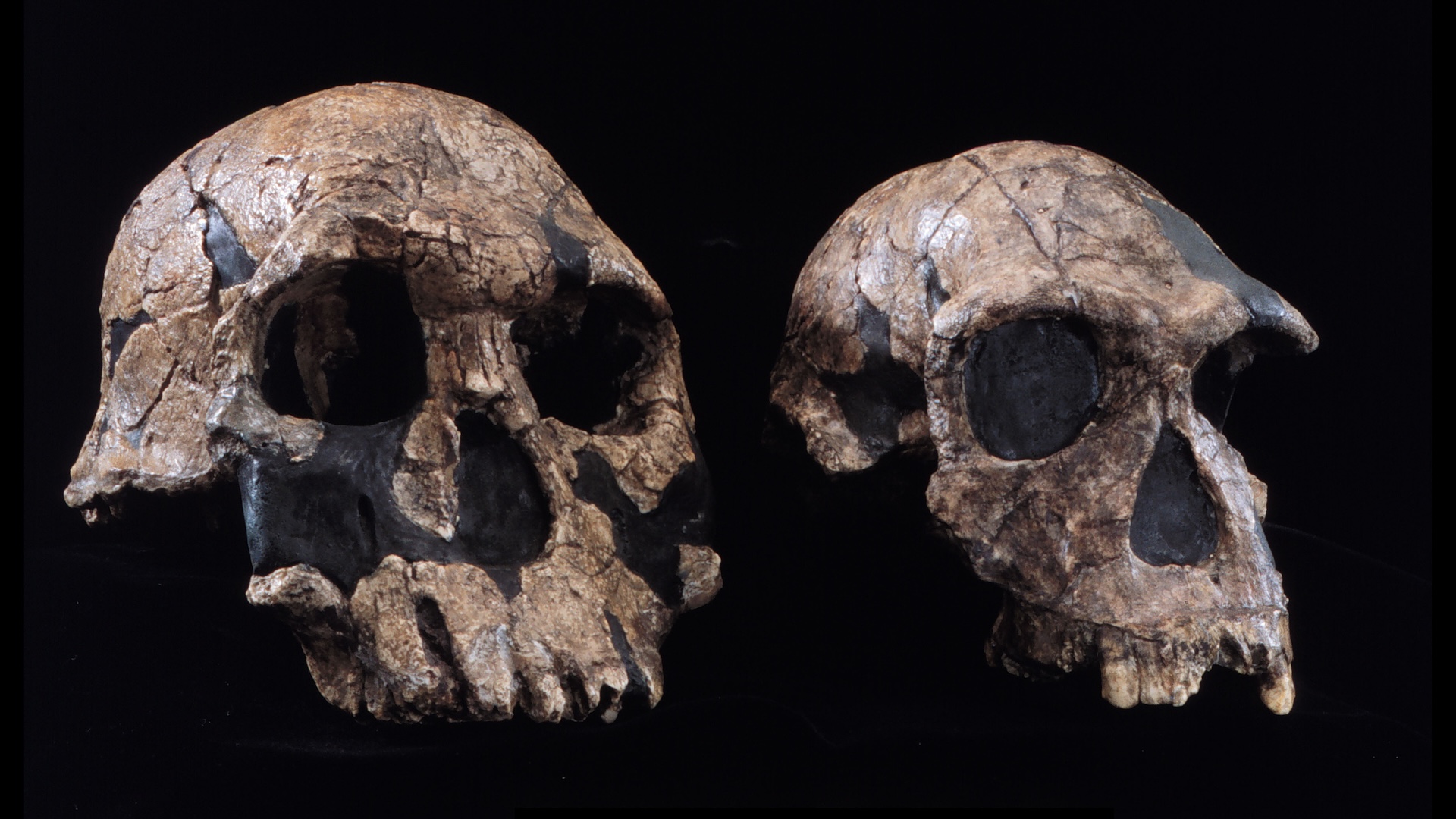
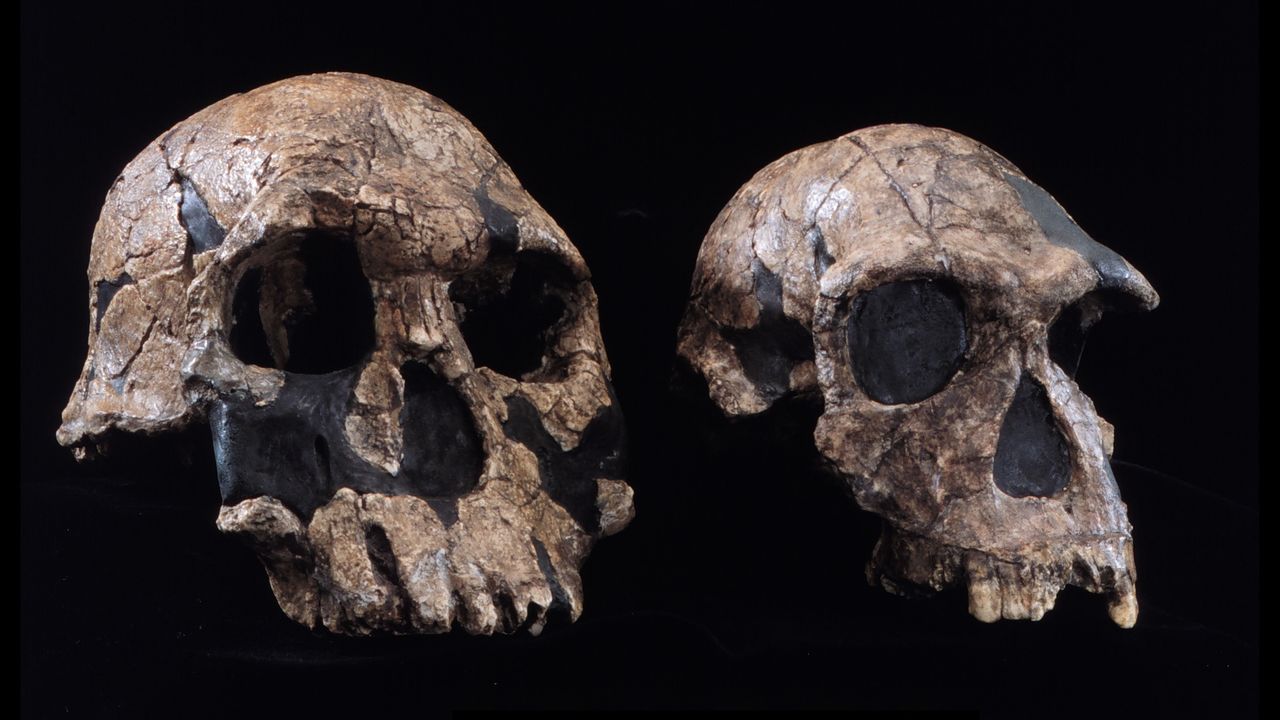
All humans today are members of the modern human species Homo sapiens — Latin for “knowing man.” But we’re far from the only humans who ever existed. Fossils are revealing more and more about early humans in the genus Homo — ancestors like Homo erectus (Latin for “upright man”), who lived in Africa, Asia and parts of Europe between 1.9 million and 110,000 years ago.
Scientists now recognize more than a dozen species in the Homo genus. So what, exactly, was the first human species? The answer, it turns out, is not crystal clear.
Fossil finds in Morocco have revealed that anatomically modern humans emerged at least 300,000 years ago. But the oldest human species scientists definitively know about is called Homo habilis, or “handy man” — a tool-using primate who walked upright and lived in Africa between 2.4 million and 1.4 million years ago.
However, earlier fossils hint that other Homo species may predate H. habilis. The scarcity of early human fossils makes it challenging to know if unusual specimens are a newfound species or simply an atypical member of a known species. On top of that, evolution can be gradual, so it’s hard to pinpoint when a new species emerges, especially when fossils have a mix of features from different species.
“The process of evolution is continuous, but the labels we place on it for convenience are static,” Tim D. White, a paleoanthropologist at the University of California Berkeley, told Live Science.
Related: Why did Homo sapiens outlast all other human species?
Earliest Homo
Most evolutionary theories suggest that H. habilis evolved from an earlier genus of primate named Australopithecus — Latin for “southern ape” because its fossils were first discovered in South Africa.
Various species of Australopithecus lived from about 4.4 million to 1.4 million years ago. It may be that H. habilis evolved directly from the species Australopithecus afarensis — the best-known example of which is “Lucy,” who was unearthed at Hadar in Ethiopia in 1974.
The fossils of our genus are usually distinguished from Australopithecus fossils by Homo‘s distinctively smaller teeth and a relatively large brain, which led to the greater use of stone tools.
But White noted that traits like smaller teeth and bigger brains must have emerged at times in the Australopithecus populations that early Homo evolved from.
“If you had an Australopithecus female, there wasn’t a birth at which point she would have christened the child Homo,” he said.
As a result, there is no fixed point in time in which Homo originated; instead, the Homo genus emerged roughly between 2 million and 3 million years ago, White said.
Evolving in Africa
Since the 1970s, researchers in Africa have discovered fossils that they’ve attributed to another ancient species, Homo rudolfensis, which challenges the idea that H. habilis was the earliest Homo.
H. rudolfensis seems to have been physically much bigger, had a larger brain and a flatter facial structure than H. habilis, which may have made it look more like a modern human.
Its fossils are roughly the same age as H. habilis — as much as 2.4 million years old. But “there is only one really good fossil of this Homo rudolfensis,” according to the Smithsonian National Museum of Natural History, so scientists don’t know if H. rudolfensis is an unusual H. habilis or even an Austrolopithicus with a larger-than-usual brain.
Paleoanthropologist Rick Potts, who heads the Smithsonian Institute’s Human Origins program, told Live Science that even older fossils from Africa appear to be from the genus Homo and may predate both of those species.
The oldest of those fossils date from about 2.8 million years ago, but they are only fragments — a few jaw bones and a few teeth — so they are not enough to establish if they came from a different, unnamed species of Homo, he said. A 2025 study found additional teeth dating to 2.59 million and 2.78 million years old that may also belong to this mysterious early Homo species.
So it may be that the first human species has not yet been found. “There’s a whole lot of excitement, but there is also a lot of uncertainty, about trying to discover more about the origins of the genus Homo,” Potts said.
