
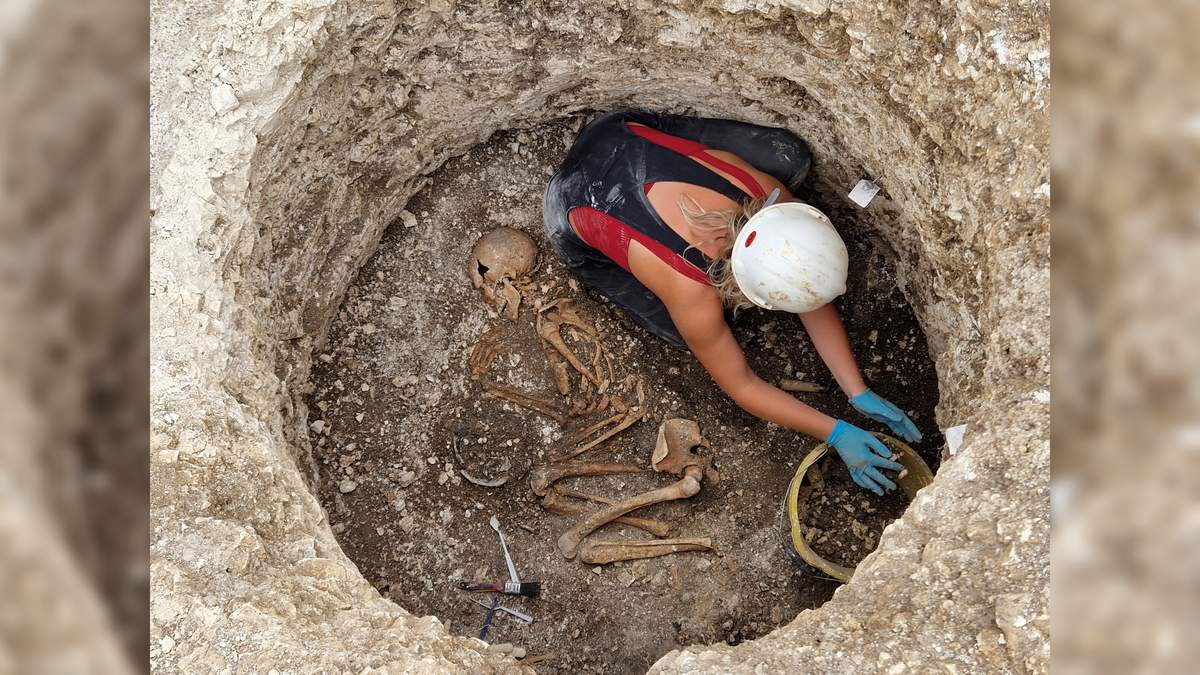
Celtic society in England was female-focused 2,000 years ago, a genetic study of Iron Age skeletons reveals. DNA analysis of dozens of ancient burials uncovered a community whose lineage could be traced back to one woman, and showed that men joined the group upon marriage.
“This is the first time this type of system has been documented in European prehistory,” study lead author Lara Cassidy, a human geneticist at Trinity College Dublin, said in a statement, “and it predicts female social and political empowerment. It’s relatively rare in modern societies, but this might not always have been the case.”
Cassidy and her team analyzed the genomes of 57 people who were buried in cemeteries in Dorset, a county in southwest England, to investigate the social structure of the Durotriges, a Celtic tribe that occupied the coast between 100 B.C. and A.D. 100. Their study was published Wednesday (Jan. 15) in the journal Nature.
Historically, little is known about the pre-Roman people of Britain, although Julius Caesar wrote about the Iceni tribe, which was later ruled by Boudica, and noted that Celtic women were allowed to marry multiple men. But archaeological evidence from Celtic graves has long suggested that women were buried with prestigious items, hinting at their high status.
To figure out who was buried in the Dorset cemeteries, the researchers first sequenced the buried individuals’ genomes. They discovered that 85% of the people were related to one another. Additionally, more than two-thirds of these relatives shared a rare mitochondrial DNA lineage — U5b1 — and Y chromosome diversity was high, meaning most people had the same maternal ancestors but not the same paternal ones.
Related: 2,600-year-old Celtic wooden burial chamber of ‘outstanding scientific importance’ uncovered by archaeologists in Germany

“The U5b1 haplogroup has an ancient association with Europe and Britain,” Cassidy told Live Science in an email, but “the few modern individuals who belong to this haplotype are not necessarily direct descendants of women who lived in this community.”
Further investigation of the genomic data allowed the research team to generate a family tree that began with one founding woman and her four daughters and spanned at least two centuries and several generations. Given that most of the family members who did not share the same mitochondrial DNA were male, they suspected men were marrying into this community.
“Using genetic data, we found multiple incidences of fathers,” Cassidy told Live Science in an email, “one of whom had two adult daughters with the same mother. It is highly likely these individuals were considered husbands to women in the community.”
Because the partners they found showed no evidence of recent relatedness, the researchers suggested in the study that these Celts “had a deep knowledge of their own genealogies, which may have been used to guide marital arrangements among a pool of related groups in the local region.”
Additionally, the researchers studied previously published genetic data from over 150 archaeological sites across Europe. They found that the British Iron Age was unique in having low mitochondrial genetic diversity and high Y chromosome diversity, meaning that Celtic groups all over Britain were likely organized around important maternal lineages.
Tom Booth, a bioarchaeologist at the Francis Crick Institute in London who was not involved in the study, told Live Science in an email that this study is “one of the most compelling examples of how archaeogenetics is maturing,” as it focuses on the history of a specific ancient community.
“We should be cautious when interpreting patterns of genetic relatedness in ancient cemeteries,” Booth said, since “we cannot be sure something equivalent to marriage as we understand it existed in Iron Age societies in Britain” and should not assume that people who were buried together lived together.
Nevertheless, the study has “pretty exquisite detail on how maternal relationships were often pre-eminent in deciding who ended up in particular Durotriges cemeteries,” Booth said, and the analysis “allows us to glimpse them much more on their own terms rather than through a Roman lens.”
That lens appears to have been female-focused, which resonates with Roman descriptions of Celtic women. The researchers concluded in their study that “although classical depictions of conquered peoples are often viewed with scepticism, we find here some truths in these writers’ appraisal of Iron Age Britain.”
