
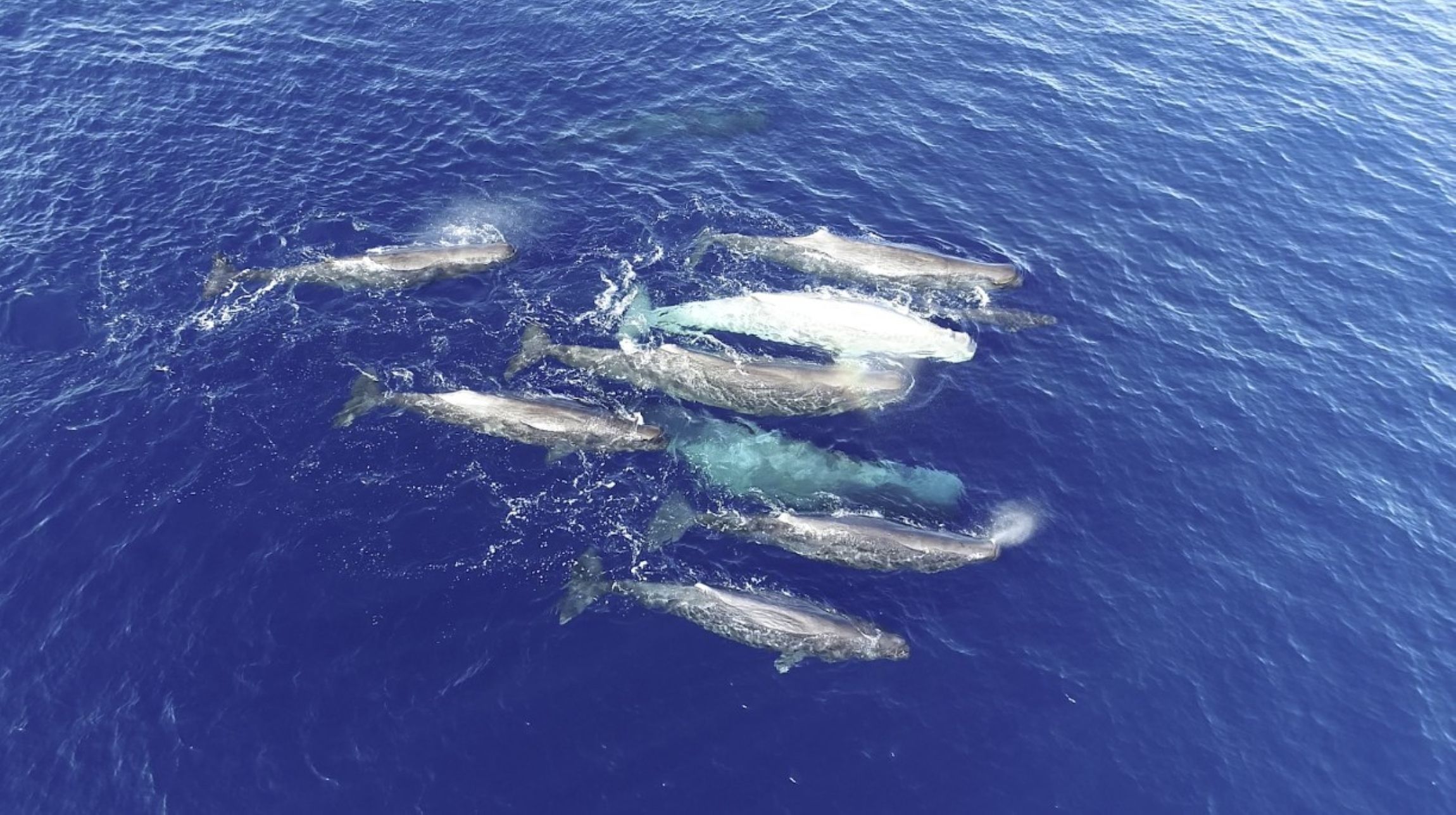
An isolated population of sperm whales in the Mediterranean Sea are splitting into two distinct groups with different dialects, a new study reveals. This shift has likely been happening for thousands of years, as two groups split from an initial single population.
The findings, published Tuesday (June 23) in the journal Proceedings of the Royal Society B: Biological Sciences, are providing a rare insight into the process of different dialects emerging among non-human species.
The sperm whales (Physeter macrocephalus) live in small social units of females and young, and they associate with other groups in the same area. They use social vocalizations called codas — shortpatterns of clicks — to communicate. The particular codas they use identify them as being part of the same cultural group.
Taylor Hersh, a researcher in the School of Biological Sciences at the University of Bristol in the U.K. and first author of the research, and her colleagues have analyzed codas recorded over almost 20 years in the Mediterranean, where there is a unique population of a few thousand sperm whales, to see if they all use the same dialect.
Sperm whales entered the Mediterranean via the Strait of Gibraltar about 20,000 years ago, and they have spread throughout the area. The whales rarely leave the sea — even males, which normally migrate. Other sperm whales don’t seem to enter often, either, so the Mediterranean ones are effectively isolated from other populations and are considered an endangered subpopulation.
“The sperm whales in the Mediterranean are really cool,” Hersh told Live Science. “I’ve always thought of them as the weirdos of the sperm whale world in that they don’t leave through the Strait of Gibraltar even though they could. They are unique, and for a long time, they were also thought to be acoustically unique.”
The thinking was that all the sperm whales in the Mediterranean belonged to the same clan, identified by their use of a single coda 90% of the time. This coda consists of three clicks and then a pause before the fourth and final click — a pattern called the three-plus-one type.
Get the world’s most fascinating discoveries delivered straight to your inbox.
But the analysis by Hersh’s team of 5,291 codas recorded between 2003 and 2021 revealed that sperm whales living in the eastern Mediterranean around the Hellenic Trench, off Greece, have a slightly different dialect from that used by animals in the western basin around Spain’s Balearic Islands.
The eastern whales produce a distinct form of the three-plus-one coda. “It’s a very similar pattern of clicks, but it’s much, much faster,” Hersh said.

Researchers found distinct dialects between the two populations, with the eastern population producing slower codas.
(Image credit: Asociación Tursiops)
In some recordings, whales in the eastern Mediterranean produced the slower coda, showing they were familiar with both dialects.
“The western sperm whales religiously stick to their dialect, but there were four instances of eastern whales using the western dialect,” Hersh said. “The question of why is still an open one. Their dialect seems to be a lot more diverse than we expected. They do occasionally make those slow three-plus-one codas, but they make a lot of other coda types, too.”
Hersh hopes further recordings alongside records that tie individual whales to sounds and events might help elucidate why the whales switch between dialects.
“It’s exciting to see this study showing different populations behaving closely, but also differently,” said Gašper Beguš, linguistics lead at Project CETI, a nonprofit organization that aims to translate the communication of sperm whales.
The study paints a picture of sperm whales progressively occupying the Mediterranean from west to east, with the dialect of one group gradually changing. “The groups in the east clearly remember the western dialect because they have these ‘throwback’ days,” Hersh said.
It’s still a mystery how and why these dialects evolved.
“Every speech is a dialect; the question is how did they arise and why?” said Beguš, who wasn’t involved in the new study. He said the historical change in habitat does help to show which dialect came first. “In the Mediterranean, maybe they’re forming different groups, so that’s why they’re trying to distinguish themselves,” he told Live Science, giving the parallel of young people who distinguish themselves from previous generations by coming up with new slang.
“It’s possible that these two groups with repertoires that are very similar but still distinctive could represent a sort of midway phase,” Ellen Jacobs, a marine biologist at Aarhus University in Denmark who wasn’t involved in the research, told Live Science via email.
“Changes in the rhythm might be a very feasible and meaningful way for coda signals to start to diverge,” she said, like the way the English words “How do you do?” got mashed together until they morphed into “howdy.”
The timescale on which a sperm whale dialect develops is uncertain, but it’s likely a slow process, according to Hersh. “It’s probably happening on the scale of hundreds and thousands of years, because sperm whales can live into their 60s and 70s. And this study is looking over 19 years of data, and that’s just a snapshot of one animal’s life,” Hersh said.
This means the eastern whale dialect was conceivably emerging in the Mediterranean Sea as famous human civilizations were speaking different languages on the surrounding lands, including when the ancient Greeks and Romans were rising and then falling.
“Maybe if we could leave them for another 10,000 years, we would come back to find the completely separated dialects of clans,” Jacobs said.
Hersh, T. A., Alexiadou, P., Brotons, J. M., Cerdà, M., Pirotta, E., Frantzis, A., & Rendell, L. (2026). Dialect variation in Mediterranean sperm whales shows evidence of cultural evolution in an isolated population. Proceedings of the Royal Society B, 293(2071). https://doi.org/10.1098/rspb.2026.0165
