
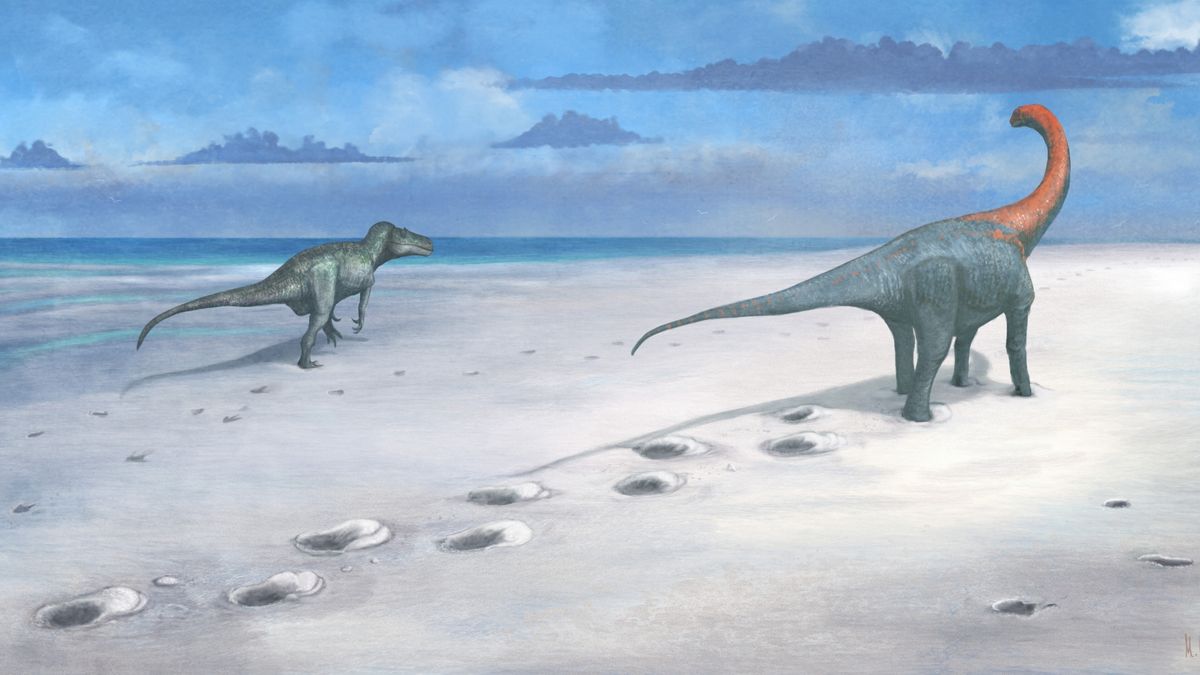
Researchers and quarry workers have uncovered a massive dinosaur “highway,” which includes hundreds of footprints left by some of U.K.’s biggest dinosaurs.
The tracks were uncovered at Dewars Farm Quarry in Oxfordshire and date back to the middle of the Jurassic Period (201.3 million to 145 million years ago). It is the largest dinosaur footprint site in the U.K., researchers said.
A quarry worker named Gary Johnson discovered the first footprints after he felt strange bumps on the quarry floor last year. In June, researchers worked with quarry staff to excavate the dinosaur “highway,” according to a statement released on Jan. 2.
One of the trackways belonged to the 30-foot-long (9 meters) predator Megalosaurus, the largest-known carnivorous dinosaur that lived in what is now the U.K. during the Jurassic. The other four trackways were from giant sauropods — most likely Cetiosaurus. At up to 60 feet (18 m) long, Cetiosaurus — a close relative of the famous Diplodocus — is likely Britain’s largest-known dinosaur from that time.
“The size of the individual tracks and the area that they cover is just huge,” Kirsty Edgar, a professor of micropaleontology at the University of Birmingham who was part of the excavation team, told Live Science in an email. “I’m in awe that I’m standing exactly where some of the largest animals to have existed once stood, and I love trying to think about where they were going, and why.”
The excavation was filmed for the BBC TV series “Digging for Britain,” which will air in the U.K. on Wednesday (Jan. 8). The findings also form part of the recently opened “Breaking Ground” exhibition at the Oxford University Museum of Natural History.
Related: Like ‘walking through the woods of millions of years ago’: Ancient ecosystem brimming with dinosaur tracks discovered in Alaska
The 166 million-year-old rocks at Dewars Farm Quarry connect to another Oxfordshire quarry site called Ardley Quarry, where more than 40 trackways were discovered and reburied in the 1990s. Edgar noted that these two quarries together make up one of the largest dinosaur track sites in the world.
Oxfordshire was a tropical coastal area during the Jurassic period with shallow marine lagoons and mudflats, similar to the Florida Keys today. This environment was good at preserving the footprints of dinosaurs that stomped through.
“There is a little bit of moisture so the sediment will take and hold the track but not so much that it loses its definition entirely and collapses,” Edgar said. “And, it was rapidly covered up, e.g., by a storm or such, enabling it to be preserved before it was eroded away or destroyed by other animals.”

Researchers used cameras and drones to document the site and create 3D models of the footprints. The Megalosaurus tracks were around 2 feet (65 centimeters) long, while the longest sauropod tracks were 3 feet (90 cm) long. From the size and spacing of the tracks, the team estimated that Megalosaurus and the sauropod walked at around 3 mph (5 km/h), which is about the same speed as a human walks, according to a statement released by the researchers.
Megalosaurus and Cetiosaurus
When they were first discovered in the 1800s, Megalosaurus and Cetiosaurus were both misidentified. Victorian scientists thought that Megalosaurus was a squat, four-legged creature rather than the two-legged Tyrannosaurus rex-like animal researchers know it to be today, while early interpretations of Cetiosaurus depicted it as a crocodile-like marine predator when it was actually a long-necked land herbivore.
The researchers will now use their models and other fossil evidence to learn more about these dinosaurs and their environment.
“The preservation is so detailed that we can see how the mud was deformed as the dinosaur’s feet squelched in and out,” Duncan Murdock, an Earth scientist at the Oxford University Museum of Natural History who took part in the excavations, said in the statement. “Along with other fossils like burrows, shells and plants we can bring to life the muddy lagoon environment the dinosaurs walked through.”
