Close Menu
  • Home
  • UNSUBSCRIBE
  • News
  • Lifestyle
  • Tech
  • Entertainment
  • Sports
  • Travel
Facebook X (Twitter) WhatsApp
Trending
  • AI could consume up 3% of world’s electricity the UN warns
  • Kaleidoscopic meteorite could be a piece of a ‘lost world’ from the early solar system — Space photo of the week
  • Some ‘extinct’ volcanoes may just be going through a growth spurt, before they ‘wake up in this catastrophic stage,’ emerging research suggests
  • Jupiter and Venus conjunction 2026: See two bright planets at the same time this weekend
  • Flu drugs might fight cognitive decline seen in HIV, early study hints
  • NASA astronauts briefly shelter in ‘safe haven’ procedure following worsening leaks on International Space Station
  • Why can’t we figure out how strong gravity is?
  • Stupid hot: Heat waves cause cognitive changes in animals, making them more aggressive and unable to complete basic tasks
Facebook X (Twitter) WhatsApp
Baynard Media
  • Home
  • UNSUBSCRIBE
  • News
  • Lifestyle
  • Tech
  • Entertainment
  • Sports
  • Travel
Baynard Media
Home»Lifestyle»Webb and Hubble sink deep into the dazzling Whirlpool Galaxy — Space photo of the week
Lifestyle

Webb and Hubble sink deep into the dazzling Whirlpool Galaxy — Space photo of the week

EditorBy EditorMay 17, 2026No Comments3 Mins Read
Share Facebook Twitter Pinterest LinkedIn Tumblr Reddit Telegram Email
Share
Facebook Twitter LinkedIn Pinterest Email

Quick facts

What it is: A spiral arm of the Whirlpool Galaxy (M51)

Where it is: 31 million light-years away in the constellation Canes Venatici

When it was shared: May 6, 2026

Stars form when vast clouds of dust and hydrogen gas collapse, creating a dense core that heats up until it transforms into a nuclear fusion reactor. What happens in the moments after a star emerges from its birth cloud, however, is a mystery.

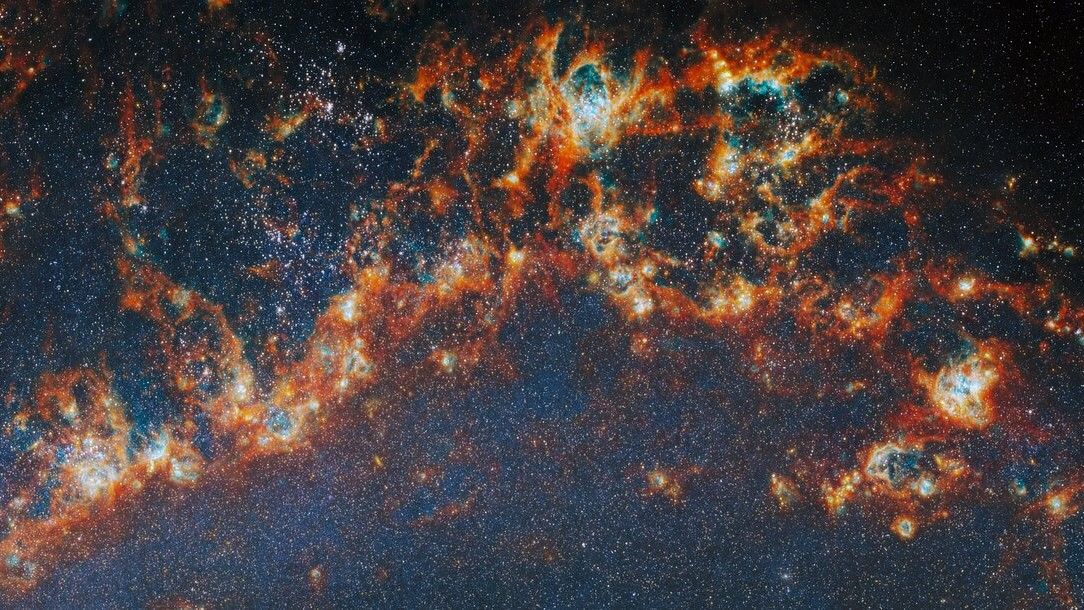
This image of one of the spiral arms in the Whirlpool Galaxy (Messier 51) gets astronomers closer to solving that mystery — and in doing so, could answer a key question about the early universe.

Made by combining data from the James Webb Space Telescope (JWST) and the Hubble Space Telescope, the image shows that larger groups of stars leave their birth clouds much quicker than smaller ones. It is just one of a series from a paper published May 6 in the journal in Nature Astronomy, which reveals the processes that shape different galaxies.

Latest Videos From

You may like

As more stars are born in a collapsing cloud, strong stellar winds, harsh ultraviolet light, and powerful explosions called supernovas begin to push the surrounding gas away. This process, called stellar feedback, keeps much of a galaxy’s gas from turning into new stars.

In this photo, red-orange threads of gas and dust stretch into lines, while blue bubbles light up some areas from the inside. Gaps in the gas show bright white groups of stars. (JWST’s ability to see infrared light uncovered new stars that would be hidden behind dust with normal telescopes.)

A blue and orange whirpool of stars seen by the James Webb Space Telescope

Two zoomed-out and zoomed-in views of the Whirlpool Galaxy, as seen by the JWST and Hubble

(Image credit: ESA/Webb, NASA & CSA, A. Pedrini, A. Adamo (Stockholm University) and the FEAST JWST team)

When combined with the other images from the study, this showed a clear pattern: the largest groups of stars cleared their birth gas clouds in about 5 million years, while smaller groups took between 7 and 8 million years to fully emerge. That has major implications for how galaxies evolve — and how the universe became hot again about 500 million to 1 billion years after the Big Bang.

After the universe cooled, electrons and protons combined to form neutral atoms. Later, an unknown energy source separated them again during a period called reionization. Could this have been caused by the intense ultraviolet radiation released into galaxies by massive star clusters?

Get the world’s most fascinating discoveries delivered straight to your inbox.

“It had to be the formation of massive star clusters that helped drive the reionization of the universe,” study co-author Daniela Calzetti of the University of Massachusetts Amherst, said in a statement. “The fact that the most massive clusters can emerge from their natal clouds in just 5 million years means that they had enough time for producing the photons that reionized the universe.”

TOPICS

space photo of the week

Source link

Share. Facebook Twitter Pinterest LinkedIn Tumblr Email
Previous Article‘Last titan’ of Thailand discovered, and it’s the longest-necked dinosaur on record from Southeast Asia
Next Article ‘Truly significant’: James Webb telescope reveals largest-ever map of the universe’s hidden megastructures
Editor
  • Website

Related Posts

Lifestyle

AI could consume up 3% of world’s electricity the UN warns

June 7, 2026
Lifestyle

Kaleidoscopic meteorite could be a piece of a ‘lost world’ from the early solar system — Space photo of the week

June 7, 2026
Lifestyle

Some ‘extinct’ volcanoes may just be going through a growth spurt, before they ‘wake up in this catastrophic stage,’ emerging research suggests

June 7, 2026
Add A Comment

Comments are closed.

Categories
  • Entertainment
  • Lifestyle
  • News
  • Sports
  • Tech
  • Travel
Recent Posts
  • AI could consume up 3% of world’s electricity the UN warns
  • Kaleidoscopic meteorite could be a piece of a ‘lost world’ from the early solar system — Space photo of the week
  • Some ‘extinct’ volcanoes may just be going through a growth spurt, before they ‘wake up in this catastrophic stage,’ emerging research suggests
  • Jupiter and Venus conjunction 2026: See two bright planets at the same time this weekend
  • Flu drugs might fight cognitive decline seen in HIV, early study hints
calendar
June 2026
M T W T F S S
1234567
891011121314
15161718192021
22232425262728
2930  
« May    
Recent Posts
  • AI could consume up 3% of world’s electricity the UN warns
  • Kaleidoscopic meteorite could be a piece of a ‘lost world’ from the early solar system — Space photo of the week
  • Some ‘extinct’ volcanoes may just be going through a growth spurt, before they ‘wake up in this catastrophic stage,’ emerging research suggests
About

Welcome to Baynard Media, your trusted source for a diverse range of news and insights. We are committed to delivering timely, reliable, and thought-provoking content that keeps you informed
and inspired

Categories
  • Entertainment
  • Lifestyle
  • News
  • Sports
  • Tech
  • Travel
Facebook X (Twitter) Pinterest WhatsApp
  • Contact Us
  • About Us
  • Privacy Policy
  • Disclaimer
  • UNSUBSCRIBE
© 2026 copyrights reserved

Type above and press Enter to search. Press Esc to cancel.