
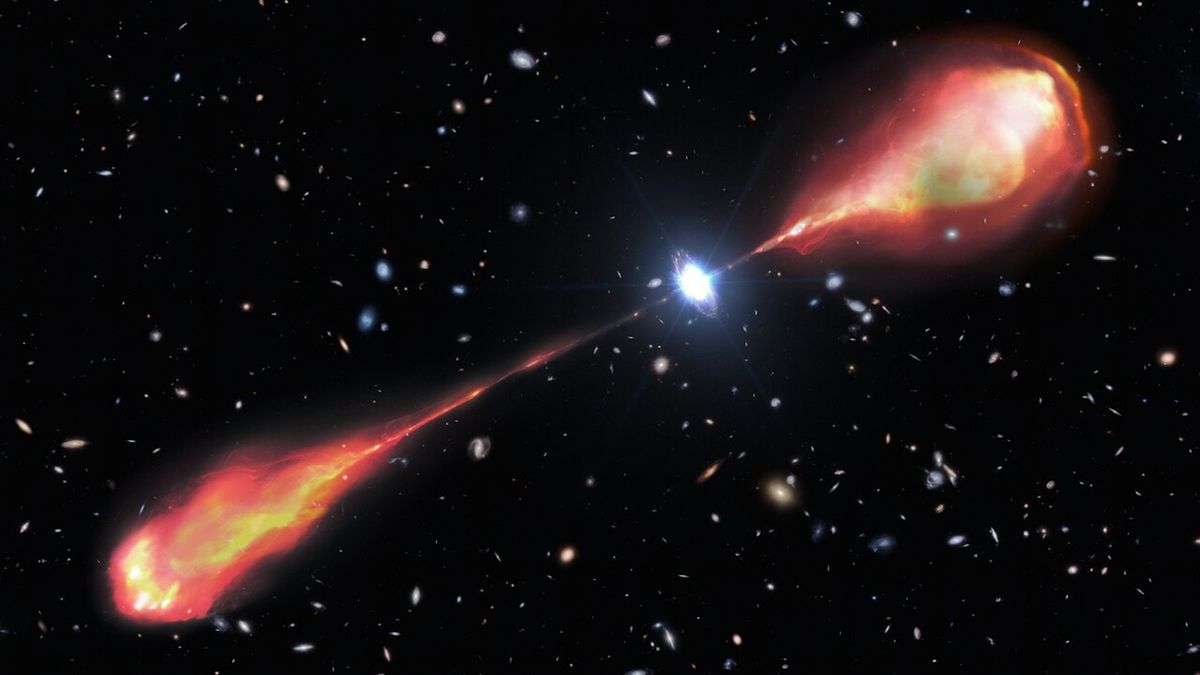
Astronomers have discovered a black hole jet that erupted into existence when the universe was less than 1.2 billion years old, or roughly 9% its current age. The jet spans 200,000 light-years — twice the width of the Milky Way — making it the largest black hole jet ever observed from such an early epoch.
Decades of observations have revealed that black holes that lurk at the centers of galaxies accrete nearby gas and dust into a swirling disk. As this material falls in, it releases immense amounts of energy due to friction, thus driving the black holes to expel some of the material as powerful jets. Although radio telescopes have found hundreds of such jets — even large ones — none have been spotted in the distant, early universe.
“This discovery now shows that these jets do exist and we can detect them,” Anniek Gloudemans, a postdoctoral research fellow at the National Science Foundation’s NOIRLab who led the discovery, told Live Science. In addition to helping astronomers pin down when the first black hole jets formed in the universe, the discovery helps them understand how jets influenced the early evolution of their host galaxies, she added.
‘We were amazed, but also skeptical’
The newly discovered jet blasts from both sides of an actively feeding black hole — a quasar named J1601+3102, which has 450 million times the mass of the sun and resides at the heart of a galaxy approximately 10 billion to 13 billion light-years from Earth.
The quasar was discovered in 2022 by a network of radio antennae in the Netherlands that are part of the Low Frequency Array (LOFAR). That discovery, also led by Gloudemans, had revealed that this quasar completely outshines its host galaxy — so much so that it stood out as the brightest among nearly two dozen of its counterparts surveyed by LOFAR.
Related: Black holes could be driving the expansion of the universe, new study suggests
This caught Gloudemans’ attention, prompting her and her colleagues to conduct follow-up observations. This time, the researchers used all of LOFAR’s 51 antennae across Europe, effectively creating a continent-sized radio telescope that improved the level of detail by 20-fold compared with previous observations. The resulting image of the black hole jet was crucial in confirming its size, according to the new study, which was published Feb. 6 in The Astrophysical Journal Letters.
Chiefly, that image revealed a northern lobe of the jet located 29,358 light-years from the quasar, as well as a southern blob that appeared to span a whopping 186,954 light-years. Further scrutiny confirmed that the southern blob indeed belonged to the quasar, leading Gloudemans and her colleagues to interpret it as the counterjet, and thus the largest jet observed in the early universe.
“We were amazed, but also skeptical, so we made sure to assemble all the evidence before publishing this work,” Gloudemans told Live Science.

An extreme glow
Although not uncommon in the nearby universe, such large jets have remained undetected in the early universe because the radiation left over from the Big Bang, known as the cosmic microwave background, was more intense during earlier epochs, when the universe was smaller and denser. Interactions between this remnant radiation and black hole jets cause the jets — like the newly discovered one — to weaken at radio wavelengths, making their diminished emissions difficult to detect in telescope observations.
“It’s only because this object is so extreme that we can observe it from Earth, even though it’s really far away,” Gloudemans said in a statement. Despite the jet’s extreme properties, data from the Gemini Observatory in Hawaii show the black hole responsible for the stream is relatively lightweight compared with other quasars from the early universe, which typically have billions of times the sun’s mass.
This finding suggests the most powerful jets aren’t necessarily created from exceptionally massive black holes, or from black holes that are heavily accreting material close to the theoretical limit, Gloudemans told Live Science.
“We were expecting this newly discovered jet to host an extraordinary black hole, but this wasn’t the case,” she said. More of these extended jets need to be discovered in the early universe for astronomers to better understand how common they were, she said, “but this work at least suggests that a black hole does not need to have an exceptional mass to generate such a jet at this epoch.”
The immense energy released by black hole jets can alter the evolution of galaxies through several interconnected mechanisms that regulate the amount of material available for forming stars. Therefore, J1601+3102 will be a valuable cosmic laboratory for studying how jets influence galaxies in the early universe.
Future observations are likely to reveal more extended radio jets in the early universe, according to Gloudemans. “There are definitely more of these extended radio jets out there,” she said.
