
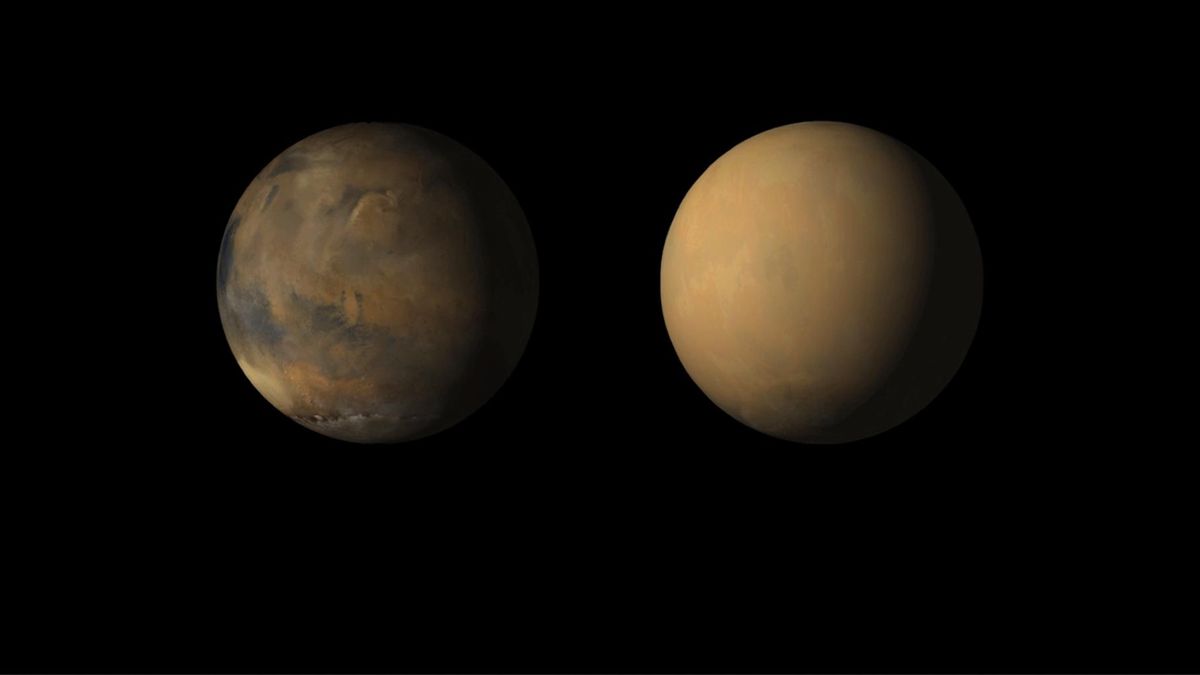
Monstrous dust storms often ravage Mars, engulfing the Red Planet for months. Now, a new study suggests these global storms may be related to a peculiar energy imbalance recently discovered across the Martian surface.
The solar system’s planets and moons absorb energy from the sun, but they also emit energy back into space. The difference between these two is called the radiative energy budget, or REB. “The REB and its spatial distribution [across latitudes] directly influence the thermal characteristics of the surface and atmosphere” of planets, Liming Li, a professor of physics at the University of Houston and the study’s second author, told Live Science via email. This means a planet’s REB determines its climate.
Scientists have studied Earth’s REB in great detail, finding “an energy surplus in the tropics and an energy deficit in the polar regions,” Li said. However, Earth’s annual REB is largely balanced, with the amount of solar energy absorbed roughly balancing the heat radiated over a year’s time (although greenhouse gases are changing this to a tiny net absorption).
In contrast, researchers know little about Mars’ REB, especially if it’s balanced. Although theory suggests this should be the case, it’s hard to know without hard numbers.
Related: Giant ‘kidney beans’ spotted in Mars satellite images could point to signs of water and life
Not knowing Mars’ REB has also prevented researchers from gaining a better understanding of the planet’s climate. Curiosity and other NASA rovers have captured tons of Martian weather phenomena. The most striking of these are the planet-engulfing dust storms that arise in Mars’ southern hemisphere, some of which are powerful enough to imperil current and future exploration missions. But these observations don’t reveal the long-term climate over the entire planet. An estimate of Mars’ REB would solve part of that puzzle, according to lead study author Larry Guan, a doctoral student at the University of Houston.
To do this, Guan, Li and researchers from U.S., Spanish and South Korean universities drew on data about the infrared and visible radiation that Mars’ surface emitted and reflected over several years. Collected by the Thermal Emission Spectrometer aboard NASA’s now-defunct Mars Global Surveyor, these observations spanned five Martian years (about 10 Earth years, since one Martian year is 687 Earth days). From these measurements, the researchers calculated how much energy Mars absorbed and emitted across its latitudes, from the equator to the poles. For comparison, the researchers also calculated Earth’s REB, averaged over 10 Earth years, across bands of latitudes.
The researchers found that when Mars’ northern hemisphere experiences spring and summer, the area around the northern latitudes absorbs more energy than it emits, creating an “energy excess” centered on the planet’s north pole. Likewise, during the northern hemisphere’s autumn and winter — the southern hemisphere’s spring and summer — the reverse occurs, with an energy excess developing over more southerly regions, although this is stronger and cloaks the entire hemisphere. The researchers reasoned that this extreme scenario occurs because, during the southern spring, Mars is at its closest to the sun, which maximizes the solar energy the planet receives.

The energy surplus may also trigger the global dust storms, the research suggests. As the southern hemisphere warms up, so does the layer of Mars’ thin atmosphere in contact with it. This creates conditions that can loft dust particles, thus kicking off the storms, the researchers suggested.
But the reverse is true, too: The dust storms likely influence the planet’s REB. The Mars Global Surveyor dataset included measurements during a dust storm that originated in the southerly Hellas Planitia impact basin and swathed the whole planet one southern spring. Analysis of this data revealed that the storms tend to reduce both the solar energy absorbed and the heat emitted by Mars, possibly owing to the numerous dust particles floating in the atmosphere.
Despite these seasonal imbalances, Mars’ annual REB is roughly balanced. But when considered across latitudes, it differs profoundly from Earth’s. “Earth’s deficits are at the poles; Mars has deficits at the tropics — and vice versa for excesses,” Guan told Live Science via email. This means that whereas Earth’s poles absorb less energy than they emit, Mars’ poles behave exactly the opposite.
Plus, Guan said, unlike Earth, Mars’ polar REB can vary by 100% between seasons. This may be due to the planet’s thin atmosphere, Li suggested, which prevents energy distribution between the tropics and the poles.
The study was published Dec. 19 in the journal AGU Advances.
