Close Menu
  • Home
  • UNSUBSCRIBE
  • News
  • Lifestyle
  • Tech
  • Entertainment
  • Sports
  • Travel
Facebook X (Twitter) WhatsApp
Trending
  • Sleep and Death cista handle: A 2,400-year-old sculpture depicting gods carrying away Zeus’ son during the Trojan War
  • Why does metal stick together in space?
  • Faster ‘biological aging’ in young adults may help explain rise in early-onset cancers, study hints
  • Computer scientists are rushing to tame tame AI’s voracious appetite for energy
  • Our brains aren’t wired to handle this much bad news. But ‘looking away is not the fix,’ expert says.
  • ‘The fate of Earth depends on a delicate balance’: Our planet may survive the death of the sun after all, new models hint
  • Bullseye! Enormous ‘bow and arrow’ galaxy is unlike anything radio astronomers have ever seen — Space photo of the week
  • IBM creates first sub-1nm computer chip — cramming 100 billion transistors into a tiny fingernail-sized space
Facebook X (Twitter) WhatsApp
Baynard Media
  • Home
  • UNSUBSCRIBE
  • News
  • Lifestyle
  • Tech
  • Entertainment
  • Sports
  • Travel
Baynard Media
Home»Lifestyle»Watch eerie ‘UFOs’ and a solar ‘cyclone’ take shape in stunning new ESA video of the sun
Lifestyle

Watch eerie ‘UFOs’ and a solar ‘cyclone’ take shape in stunning new ESA video of the sun

EditorBy EditorApril 1, 2025No Comments4 Mins Read
Share Facebook Twitter Pinterest LinkedIn Tumblr Reddit Telegram Email
Share
Facebook Twitter LinkedIn Pinterest Email

Watch wind whirl from the Sun – YouTube
Watch wind whirl from the Sun - YouTube


Watch On

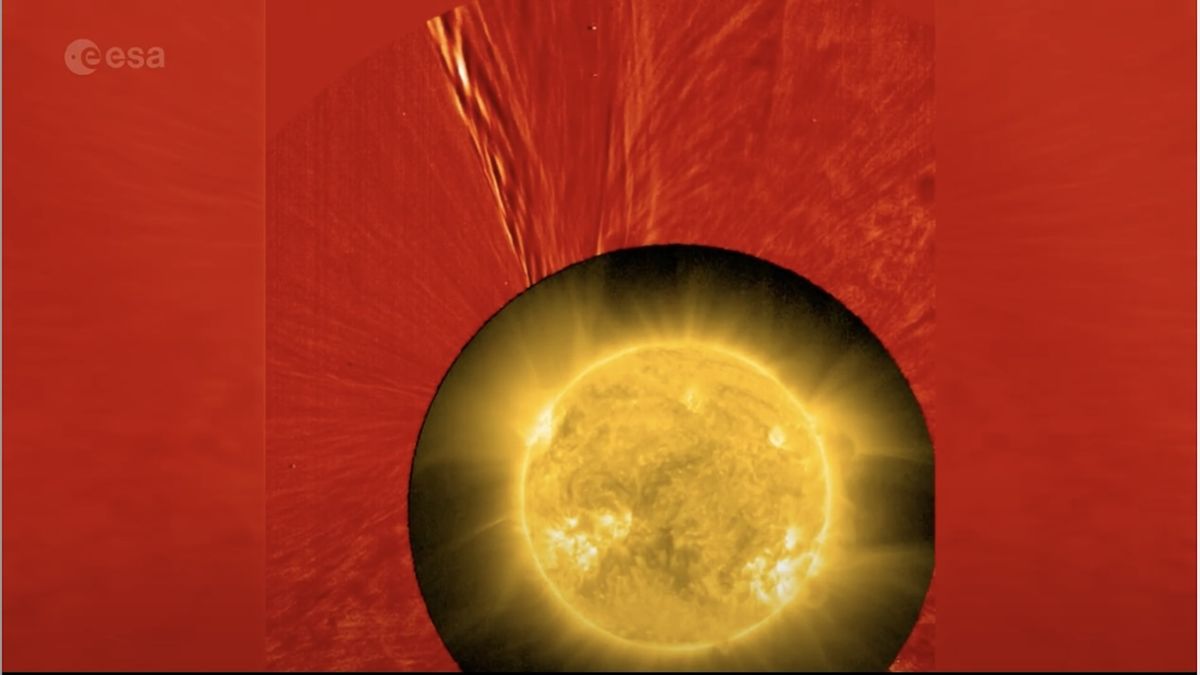
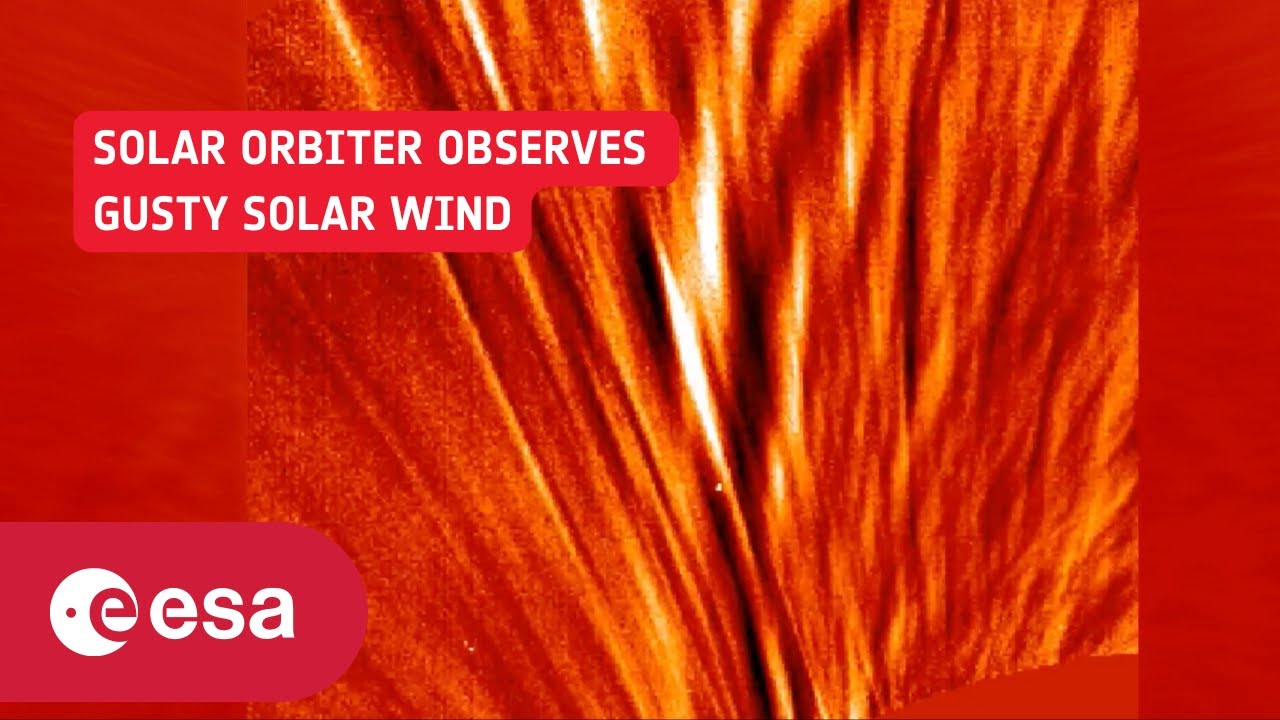
A newly released video has revealed a gigantic plume of solar wind towering above the sun in a never-before-seen, “cyclone-like” configuration that emerged in the wake of a massive solar explosion. The striking timelapse footage also captured strange lines streaking across the fiery scene like pixelated UFOs — but are actually distant stars.

The video, which was released March 26 by the European Space Agency (ESA), is sped-up footage originally taken over an eight-hour period on Oct. 12, 2022, by ESA’s Solar Orbiter. The spacecraft captured the scene by blocking out the main disk of the sun, which enabled the probe’s camera to focus on the extremely faint light given off by the flow of superfast charged particles, or solar wind, that streams out of our home star nearly constantly.

This is the first time solar wind has been recorded “flying out from the sun in a twisting, whirling motion,” ESA representatives wrote in a statement. “The solar wind particles spiral outwards as if caught in a cyclone that extends millions of kilometres from the sun.”

The striking video also shows around a dozen perfectly flat, half-dark, half-light lines that creep across the screen like the UFOs and aliens in arcade games such as “Space Invaders.”

These features are actually stars that are moving across the background as the orbiter circles the sun, which show up thanks to an editing technique used to make the video, ESA representatives wrote.

Related: 10 supercharged solar storms that blew us away in 2024

Solar ‘pseudostreamer’

In a new study of the video, released March 26 in The Astrophysical Journal, researchers described the giant solar corkscrew as a “large pseudostreamer” that erupted near the sun’s north pole in the wake of a solar flare that launched a cloud of plasma, or coronal mass ejection (CME), into space. The pseudostreamer reached up to 1.5 times as long as the sun is wide and lasted for around three hours.

Get the world’s most fascinating discoveries delivered straight to your inbox.

The “helix” structure of the wind jet is likely the result of Alfvénic fluctuations triggered by waves of ions that oscillate in response to magnetic field disturbances that occurred during the flare, the researchers wrote. They noted that the unique shape may also be tied to the streamer’s position near one of the sun’s polar regions, where magnetic fields are usually much stronger than near the sun’s equator.

The sun is currently experiencing the peak in its roughly 11-year cycle of activity, known as solar maximum, which officially began in early 2024. During this phase, powerful solar flares explode more frequently from the sun and solar wind intensifies. However, this video was captured before solar activity started ramping up, which surprised the scientists.

Until recently, the origin and complex behaviors of solar wind have remained largely elusive. But a new generation of spacecraft is helping to unravel these mysteries.

When the video was recorded, ESA’s Solar Orbiter was the only probe capable of capturing solar wind in such great detail. However, ESA’s Proba-3 mission, which launched in December 2024, is also capable of viewing solar wind thanks to its ability to create artificial solar eclipses in space. NASA’s Parker Solar Probe, meanwhile, was launched in 2018 and has helped to capture important solar wind data during its recent super-close flybys of our home star.

Solar wind is expected to become more extreme over the next few years as we enter the solar “battle zone” — a period after solar maximum when magnetic instabilities on the sun cause large coronal holes to open up on the sun’s surface and shoot out extreme solar gusts. These solar events will be much like a dark patch that showered Earth with charged particles last week, triggering significant aurora activity.


Sun quiz: How well do you know our home star?

Source link

Share. Facebook Twitter Pinterest LinkedIn Tumblr Email
Previous ArticleThe US is squandering the one resource it needs to win the AI race with China — human intelligence | Akhil Bhardwaj | Opinion
Next Article Black holes can destroy planets — but they can also lead us to thriving alien worlds. Here’s how.
Editor
  • Website

Related Posts

Lifestyle

Sleep and Death cista handle: A 2,400-year-old sculpture depicting gods carrying away Zeus’ son during the Trojan War

June 29, 2026
Lifestyle

Why does metal stick together in space?

June 29, 2026
Lifestyle

Faster ‘biological aging’ in young adults may help explain rise in early-onset cancers, study hints

June 29, 2026
Add A Comment

Comments are closed.

Categories
  • Entertainment
  • Lifestyle
  • News
  • Sports
  • Tech
  • Travel
Recent Posts
  • Sleep and Death cista handle: A 2,400-year-old sculpture depicting gods carrying away Zeus’ son during the Trojan War
  • Why does metal stick together in space?
  • Faster ‘biological aging’ in young adults may help explain rise in early-onset cancers, study hints
  • Computer scientists are rushing to tame tame AI’s voracious appetite for energy
  • Our brains aren’t wired to handle this much bad news. But ‘looking away is not the fix,’ expert says.
calendar
June 2026
M T W T F S S
1234567
891011121314
15161718192021
22232425262728
2930  
« May    
Recent Posts
  • Sleep and Death cista handle: A 2,400-year-old sculpture depicting gods carrying away Zeus’ son during the Trojan War
  • Why does metal stick together in space?
  • Faster ‘biological aging’ in young adults may help explain rise in early-onset cancers, study hints
About

Welcome to Baynard Media, your trusted source for a diverse range of news and insights. We are committed to delivering timely, reliable, and thought-provoking content that keeps you informed
and inspired

Categories
  • Entertainment
  • Lifestyle
  • News
  • Sports
  • Tech
  • Travel
Facebook X (Twitter) Pinterest WhatsApp
  • Contact Us
  • About Us
  • Privacy Policy
  • Disclaimer
  • UNSUBSCRIBE
© 2026 copyrights reserved

Type above and press Enter to search. Press Esc to cancel.