Close Menu
  • Home
  • UNSUBSCRIBE
  • News
  • Lifestyle
  • Tech
  • Entertainment
  • Sports
  • Travel
Facebook X (Twitter) WhatsApp
Trending
  • Thanks to natural selection, Indigenous Andeans may digest potatoes better than anyone else in the world, study finds
  • Doctors need to understand patients' lived experiences to treat them well — but medical schools may stop requiring that training
  • This yeast-based 3D printed biomaterial could one day replace your wallpaper and drapes
  • Flesh-eating screwworm found in Texas cow. Are humans at risk?
  • New Velociraptor cousin was a ‘4-winged’ dragon that hunted prey from the trees of ancient China, fossil find hints
  • AI models are teaching each other ‘violent and antisocial’ traits through hidden data signals, study finds — and scientists can’t figure out why
  • Scientists race to collect the last seeds from a critically endangered tree before it goes extinct
  • What’s the deepest cave in the world?
Facebook X (Twitter) WhatsApp
Baynard Media
  • Home
  • UNSUBSCRIBE
  • News
  • Lifestyle
  • Tech
  • Entertainment
  • Sports
  • Travel
Baynard Media
Home»Lifestyle»Walvis Bay saltworks: The monster refinery in Namibia with colorful ponds that cover the land like patchwork
Lifestyle

Walvis Bay saltworks: The monster refinery in Namibia with colorful ponds that cover the land like patchwork

EditorBy EditorFebruary 28, 2025No Comments3 Mins Read
Share Facebook Twitter Pinterest LinkedIn Tumblr Reddit Telegram Email
Share
Facebook Twitter LinkedIn Pinterest Email

QUICK FACTS

Name: Walvis Bay salt works

Location: Atlantic coast of Namibia

Coordinates: -23.026816314419552, 14.464431525720594

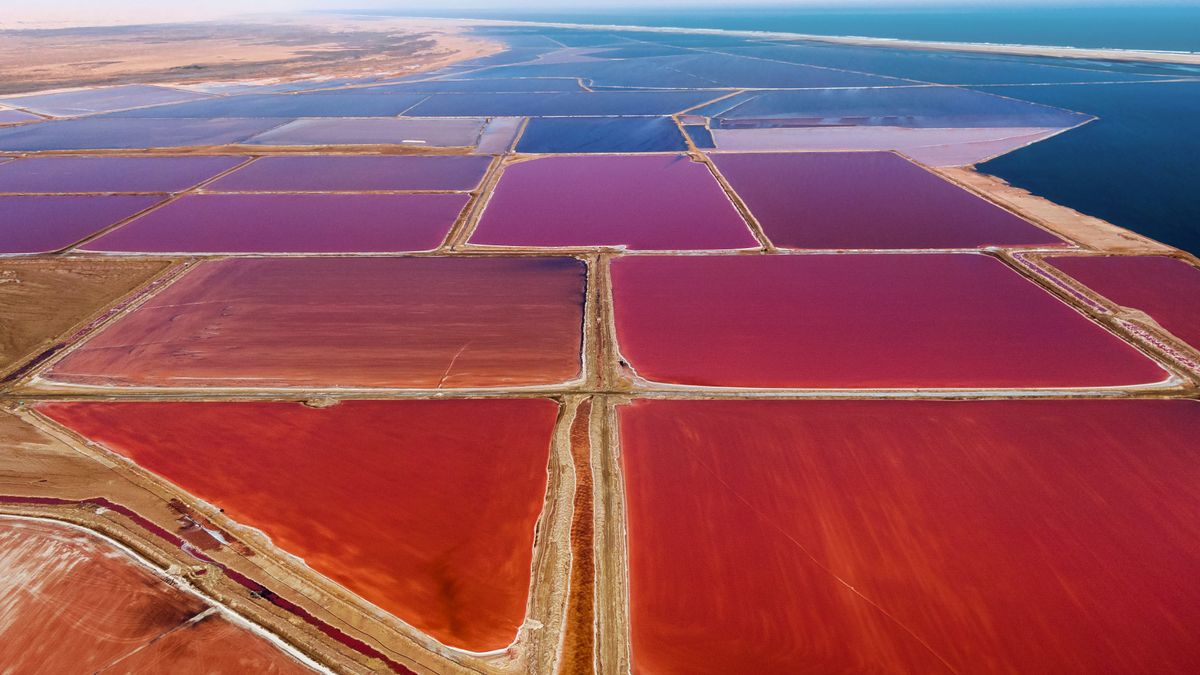
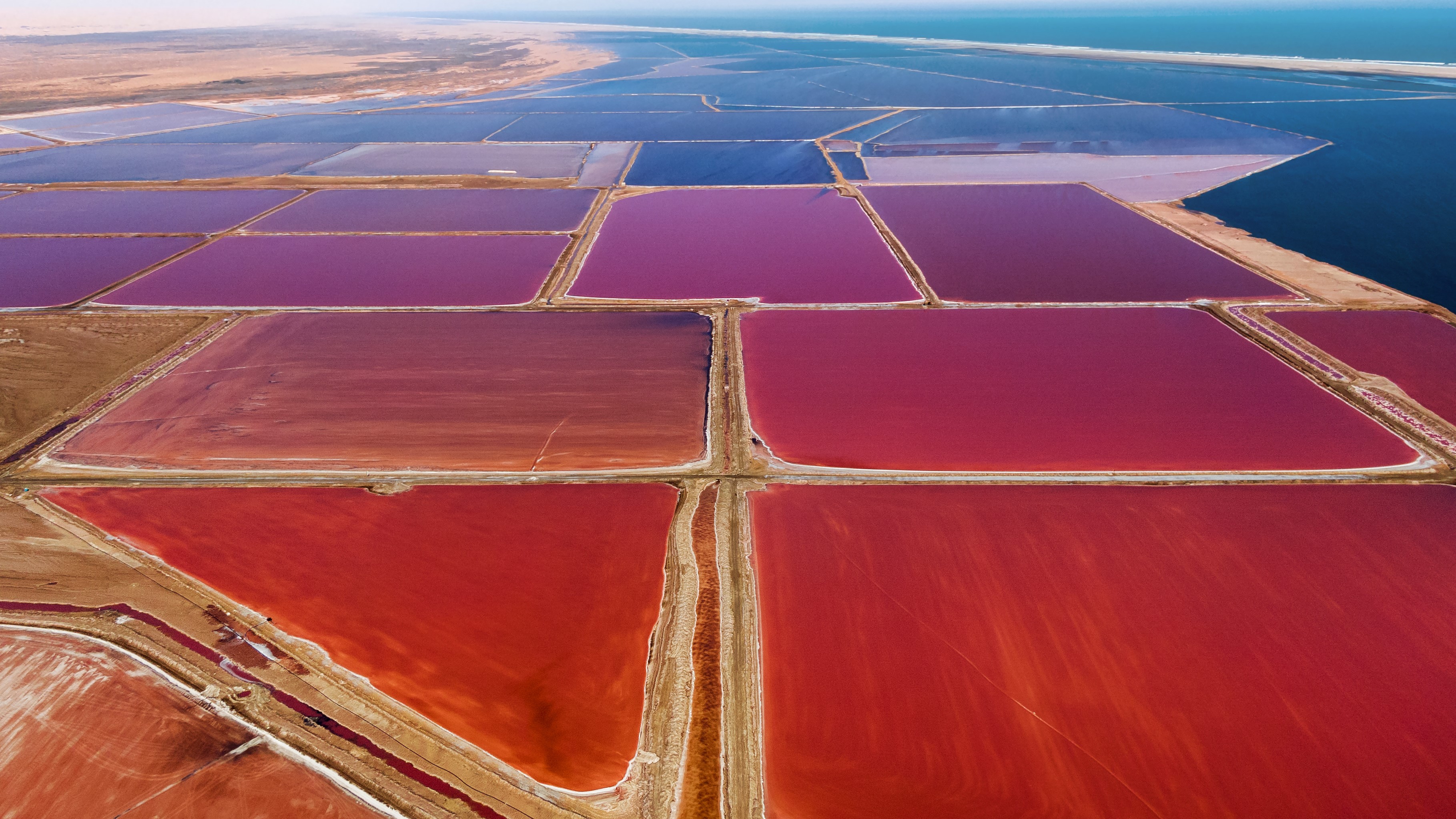
Why it’s incredible: The salt pans look like a colorful patchwork quilt from above.

Walvis Bay is a port city on the Atlantic coast of Namibia that is home to an enormous sea salt production plant. The plant has been operating for more than 60 years thanks to the region’s arid climate and coastal winds, which are ideal for evaporating seawater containing the salt.

The saltworks are located about 5 miles (8 kilometers) southwest of Walvis Bay city center. The plant covers an area of 12,350 acres (5,000 hectares), according to Walvis Bay Salt Holdings, making it roughly half as big as Disney World in Florida.

Salt production at Walvis Bay relies on Atlantic seawater that is pumped at a rate of 8,500 cubic feet (240 cubic meters) per minute into artificial ponds, according to the guided tour operator Desert, Dunes and Dust Tours. The plant is fed by the Benguela Current — a cold, northward flowing ocean current that forms the eastern limb of the South Atlantic subtropical gyre.

Evaporation via a combination of the sun’s warmth and wind increases the salt content in the ponds from about 2.9% to 3.5%, which is still liveable for plankton, algae and small ocean critters. These creatures and microorganisms can turn the ponds so colorful, the plant looks like a tile mosaic from above.

Related: Before and after satellite images show lakes appearing across Sahara after deluge of rain soaks desert

Pumps transfer the brine resulting from this initial evaporation stage to concentration ponds, where the salt content rises to 25%. Another set of pumps then siphons this water into crystallization ponds that each span about 50 acres (20 hectares) in size, or about 38 football fields.

By the end of the crystallization stage, each pond contains a 4- to 6-inch-thick (10 to 15 centimeters) salt crust, which mechanical harvesters remove and dump into huge bins. A conveyor belt then takes these bins to a facility where the salt crystals are washed with a mixture of seawater and gypsum that dissolves impurities such as magnesium and potassium, while keeping the salt intact.

Get the world’s most fascinating discoveries delivered straight to your inbox.

After washing, the salt is dried in huge piles outside. Around 240 tons (220 metric tons) of salt are washed and dried every hour at Walvis Bay, amounting to a total annual production of more than 1.1 million tons (1 million metric tons) of salt, according to Walvis Bay Salt Holdings.

The company exports chemical-grade salt used in industries like animal feed production, water treatment and pharmaceuticals to Nigeria, Cameroon, South Africa and Europe. It also exports table salt for human consumption to several countries in Africa, including South Africa, Angola and the Democratic Republic of Congo.

Walvis Bay’s saltworks are also a feeding ground for shrimp and larval fish, which in turn attracts birds. Together with the nearby Walvis Bay Lagoon and a bird sanctuary, the salt production plant provides coastal wetland habitat for birds like flamingos and pelicans, according to the website Birdingplaces.


Discover more incredible places, where we highlight the fantastic history and science behind some of the most dramatic landscapes on Earth.

Source link

Share. Facebook Twitter Pinterest LinkedIn Tumblr Email
Previous ArticleTrump Set To Meet With Zelenskyy To Broker Peace, Mineral Deal
Next Article Trump and Zelenskyy hold press conference
Editor
  • Website

Related Posts

Lifestyle

Thanks to natural selection, Indigenous Andeans may digest potatoes better than anyone else in the world, study finds

June 8, 2026
Lifestyle

Doctors need to understand patients' lived experiences to treat them well — but medical schools may stop requiring that training

June 8, 2026
Lifestyle

This yeast-based 3D printed biomaterial could one day replace your wallpaper and drapes

June 8, 2026
Add A Comment

Comments are closed.

Categories
  • Entertainment
  • Lifestyle
  • News
  • Sports
  • Tech
  • Travel
Recent Posts
  • Thanks to natural selection, Indigenous Andeans may digest potatoes better than anyone else in the world, study finds
  • Doctors need to understand patients' lived experiences to treat them well — but medical schools may stop requiring that training
  • This yeast-based 3D printed biomaterial could one day replace your wallpaper and drapes
  • Flesh-eating screwworm found in Texas cow. Are humans at risk?
  • New Velociraptor cousin was a ‘4-winged’ dragon that hunted prey from the trees of ancient China, fossil find hints
calendar
June 2026
M T W T F S S
1234567
891011121314
15161718192021
22232425262728
2930  
« May    
Recent Posts
  • Thanks to natural selection, Indigenous Andeans may digest potatoes better than anyone else in the world, study finds
  • Doctors need to understand patients' lived experiences to treat them well — but medical schools may stop requiring that training
  • This yeast-based 3D printed biomaterial could one day replace your wallpaper and drapes
About

Welcome to Baynard Media, your trusted source for a diverse range of news and insights. We are committed to delivering timely, reliable, and thought-provoking content that keeps you informed
and inspired

Categories
  • Entertainment
  • Lifestyle
  • News
  • Sports
  • Tech
  • Travel
Facebook X (Twitter) Pinterest WhatsApp
  • Contact Us
  • About Us
  • Privacy Policy
  • Disclaimer
  • UNSUBSCRIBE
© 2026 copyrights reserved

Type above and press Enter to search. Press Esc to cancel.