Close Menu
  • Home
  • UNSUBSCRIBE
  • News
  • Lifestyle
  • Tech
  • Entertainment
  • Sports
  • Travel
Facebook X (Twitter) WhatsApp
Trending
  • Superintelligent AI in space could explain the Fermi Paradox
  • Diminutive species ‘the Hobbit’ did not hunt or control fire, deepening the mystery of its ancestry, dwarf elephant bones reveal
  • Elite families ruled nomadic Scythian society 2,500 years ago, DNA analysis reveals
  • ‘Machine-gun sun’ could bring auroras to more than a dozen states this Independence Day weekend
  • NASA launches bold mission to rescue Swift space telescope before it falls to Earth
  • ‘It’s more than a hope, it’s a guarantee’: The Vera C. Rubin Observatory’s 10-year movie of the universe is about to ‘blow our minds,’ chief scientist Tony Tyson says
  • 11-year-old boy in Canada dies from rabies after waking up with a bat on his face
  • Subterranean ring discovered on Scottish isle could be a Stonehenge-like monument
Facebook X (Twitter) WhatsApp
Baynard Media
  • Home
  • UNSUBSCRIBE
  • News
  • Lifestyle
  • Tech
  • Entertainment
  • Sports
  • Travel
Baynard Media
Home»Lifestyle»Venus and Jupiter conjunction: How to watch the 2 brightest planets ‘kiss’ on Aug. 12
Lifestyle

Venus and Jupiter conjunction: How to watch the 2 brightest planets ‘kiss’ on Aug. 12

EditorBy EditorAugust 9, 2025No Comments4 Mins Read
Share Facebook Twitter Pinterest LinkedIn Tumblr Reddit Telegram Email
Share
Facebook Twitter LinkedIn Pinterest Email

Just as the Perseid meteor shower approaches its peak, two luminous planets are getting in on the night-sky action.

Venus and Jupiter, the two brightest planets in the sky, will meet in a conjunction very early on Tuesday morning (Aug. 12). On this morning, the two planets will be less than a degree apart — approximately the length of your pinkie when held up to the sky at arm’s length. Because they’ll appear close together, you’ll be able to view both simultaneously through skywatching binoculars or a backyard telescope.

But if you want to see the conjunction, you’ll have to either stay out late or get up early: Venus and Jupiter rise together around 3 a.m. local time and set together around 6 a.m. local time. However, these times vary slightly depending on your exact location. You can use Time and Date to check the precise rise and set times for your area.

Venus and Jupiter will rise in the east with the constellation Gemini and will ascend to about 20 degrees above the horizon before sunrise. Because they’re fairly low on the horizon, you’ll want to observe them in a mostly flat area without many trees, buildings or other obstructions to the east.


You may like

You can easily find Venus and Jupiter with the naked eye thanks to their exceptional brightness. Venus is the second-brightest object in the night sky, after the moon, followed by Jupiter. However, seeing these planets with a decent backyard telescope or pair of binoculars is a treat you won’t want to miss.

Jupiter and Venus skywatching

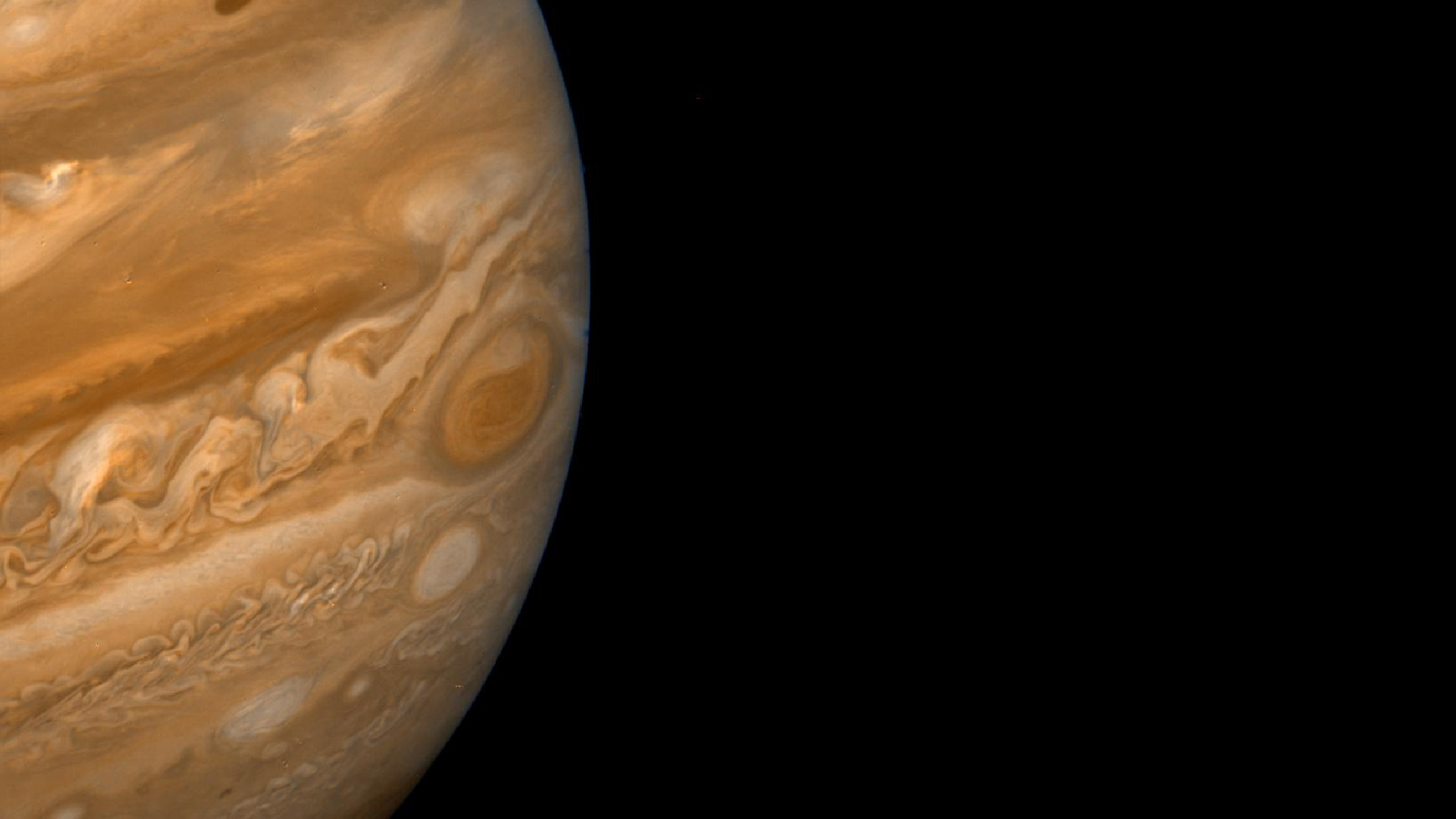
If you look through a backyard telescope or pair of skywatching binoculars, you’ll see Jupiter’s cloud bands and maybe even its famed Great Red Spot. The Red Spot, a giant storm in Jupiter’s cloud bands that spans twice the width of Earth, faces our planet about once every 10 hours when Jupiter completes a rotation.

Related: How to photograph the moon: Tips on camera gear, settings and composition

Jupiter’s Red Spot is most visible when it crosses Jupiter’s meridian, the imaginary line between its north and south poles. You can use this tool from Sky & Telescope to see the Red Spot’s transit times — the times it crosses the meridian.

Get the world’s most fascinating discoveries delivered straight to your inbox.

A four-paneled image showing blurry partial images of the swirling surface of Venus

Venus experiences phases, just like the moon, depending on its position relative to Earth and the sun. (Image credit: NASA/JPL)

Skywatching equipment also reveals hidden wonders on Venus, such as its phases. Like the moon, Venus goes through phases — new, crescent, quarter, gibbous and full— because of its position relative to Earth and the sun.

But unlike the moon’s phases, Venus’ phases are visible only through skywatching equipment. And while the moon completes all of its phases in less than a month, it takes Venus 584 days.

The moon will somewhat disrupt viewing conditions for this event. The planets are best viewed under dark, moonless skies. However, the moon on conjunction night will be a waning gibbous, about 90% to 95% illuminated after the peak of the full Sturgeon Moon, and will rise around 9:30 p.m. and set around 10 a.m. local time.

Fortunately, though, Jupiter and Venus are bright enough to avoid being totally washed out by moonlight. The moon will also be far to the west while Venus and Jupiter rise in the east, so you can view this conjunction away from the bright face of the moon. For an even better viewing experience, try to observe this conjunction from a location where the moon is obscured by trees or other obstacles that block its glare.

And if you miss this conjunction, don’t worry — Venus and Jupiter will remain close together for the next couple of nights, although they will slowly drift apart as August comes to a close.

Source link

Share. Facebook Twitter Pinterest LinkedIn Tumblr Email
Previous ArticleParents demand border security after daughter allegedly killed by illegal immigrant
Next Article Evacuation orders lifted as California’s Canyon Fire reaches 28% containment
Editor
  • Website

Related Posts

Lifestyle

Superintelligent AI in space could explain the Fermi Paradox

July 5, 2026
Lifestyle

Diminutive species ‘the Hobbit’ did not hunt or control fire, deepening the mystery of its ancestry, dwarf elephant bones reveal

July 3, 2026
Lifestyle

Elite families ruled nomadic Scythian society 2,500 years ago, DNA analysis reveals

July 3, 2026
Add A Comment

Comments are closed.

Categories
  • Entertainment
  • Lifestyle
  • News
  • Sports
  • Tech
  • Travel
Recent Posts
  • Superintelligent AI in space could explain the Fermi Paradox
  • Diminutive species ‘the Hobbit’ did not hunt or control fire, deepening the mystery of its ancestry, dwarf elephant bones reveal
  • Elite families ruled nomadic Scythian society 2,500 years ago, DNA analysis reveals
  • ‘Machine-gun sun’ could bring auroras to more than a dozen states this Independence Day weekend
  • NASA launches bold mission to rescue Swift space telescope before it falls to Earth
calendar
July 2026
M T W T F S S
 12345
6789101112
13141516171819
20212223242526
2728293031  
« Jun    
Recent Posts
  • Superintelligent AI in space could explain the Fermi Paradox
  • Diminutive species ‘the Hobbit’ did not hunt or control fire, deepening the mystery of its ancestry, dwarf elephant bones reveal
  • Elite families ruled nomadic Scythian society 2,500 years ago, DNA analysis reveals
About

Welcome to Baynard Media, your trusted source for a diverse range of news and insights. We are committed to delivering timely, reliable, and thought-provoking content that keeps you informed
and inspired

Categories
  • Entertainment
  • Lifestyle
  • News
  • Sports
  • Tech
  • Travel
Facebook X (Twitter) Pinterest WhatsApp
  • Contact Us
  • About Us
  • Privacy Policy
  • Disclaimer
  • UNSUBSCRIBE
© 2026 copyrights reserved

Type above and press Enter to search. Press Esc to cancel.