Close Menu
  • Home
  • UNSUBSCRIBE
  • News
  • Lifestyle
  • Tech
  • Entertainment
  • Sports
  • Travel
Facebook X (Twitter) WhatsApp
Trending
  • ‘A disease anywhere can be a disease everywhere tomorrow morning’: Public health expert on Ebola and the threat of future outbreaks
  • Thanks to natural selection, Indigenous Andeans may digest potatoes better than anyone else in the world, study finds
  • Doctors need to understand patients' lived experiences to treat them well — but medical schools may stop requiring that training
  • This yeast-based 3D printed biomaterial could one day replace your wallpaper and drapes
  • Flesh-eating screwworm found in Texas cow. Are humans at risk?
  • New Velociraptor cousin was a ‘4-winged’ dragon that hunted prey from the trees of ancient China, fossil find hints
  • AI models are teaching each other ‘violent and antisocial’ traits through hidden data signals, study finds — and scientists can’t figure out why
  • Scientists race to collect the last seeds from a critically endangered tree before it goes extinct
Facebook X (Twitter) WhatsApp
Baynard Media
  • Home
  • UNSUBSCRIBE
  • News
  • Lifestyle
  • Tech
  • Entertainment
  • Sports
  • Travel
Baynard Media
Home»Lifestyle»‘Utterly cataclysmic’: James Webb telescope spots 2 alien planets disintegrating before our eyes
Lifestyle

‘Utterly cataclysmic’: James Webb telescope spots 2 alien planets disintegrating before our eyes

EditorBy EditorFebruary 26, 2025No Comments3 Mins Read
Share Facebook Twitter Pinterest LinkedIn Tumblr Reddit Telegram Email
Share
Facebook Twitter LinkedIn Pinterest Email

Astronomers have directly observed two worlds beyond our solar system shedding their outer layers into space for the first time. The new observations offer an unprecedented glimpse into the interiors of planets — a view that has long remained elusive, even for Earth.

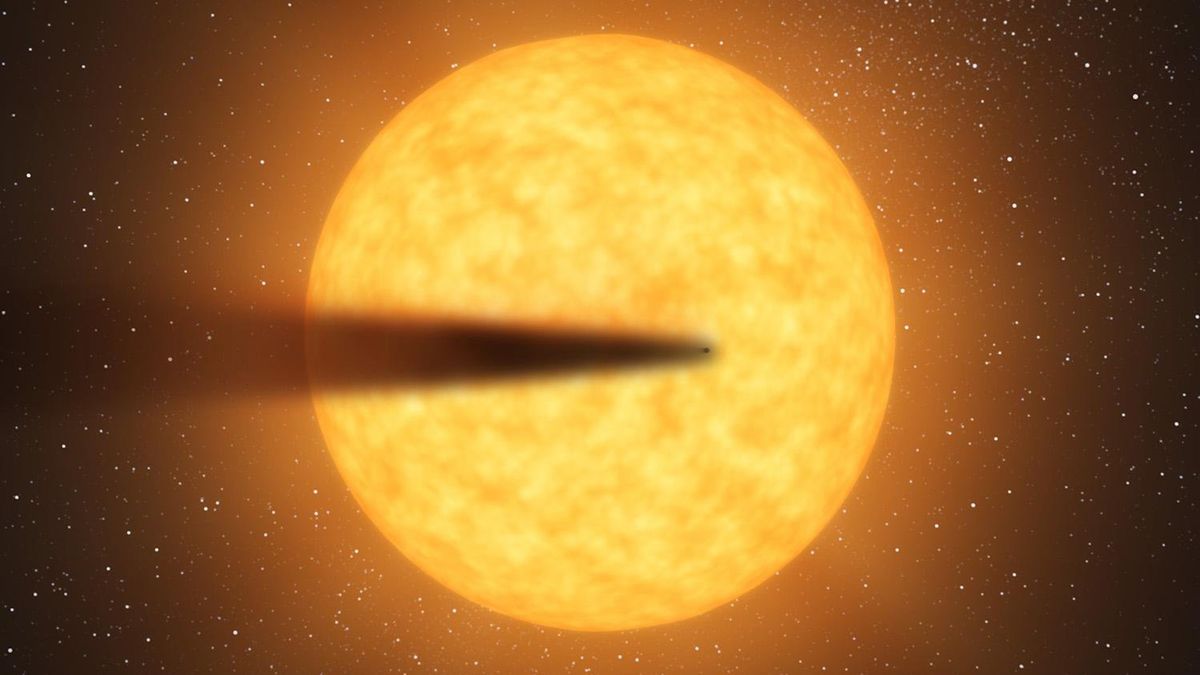
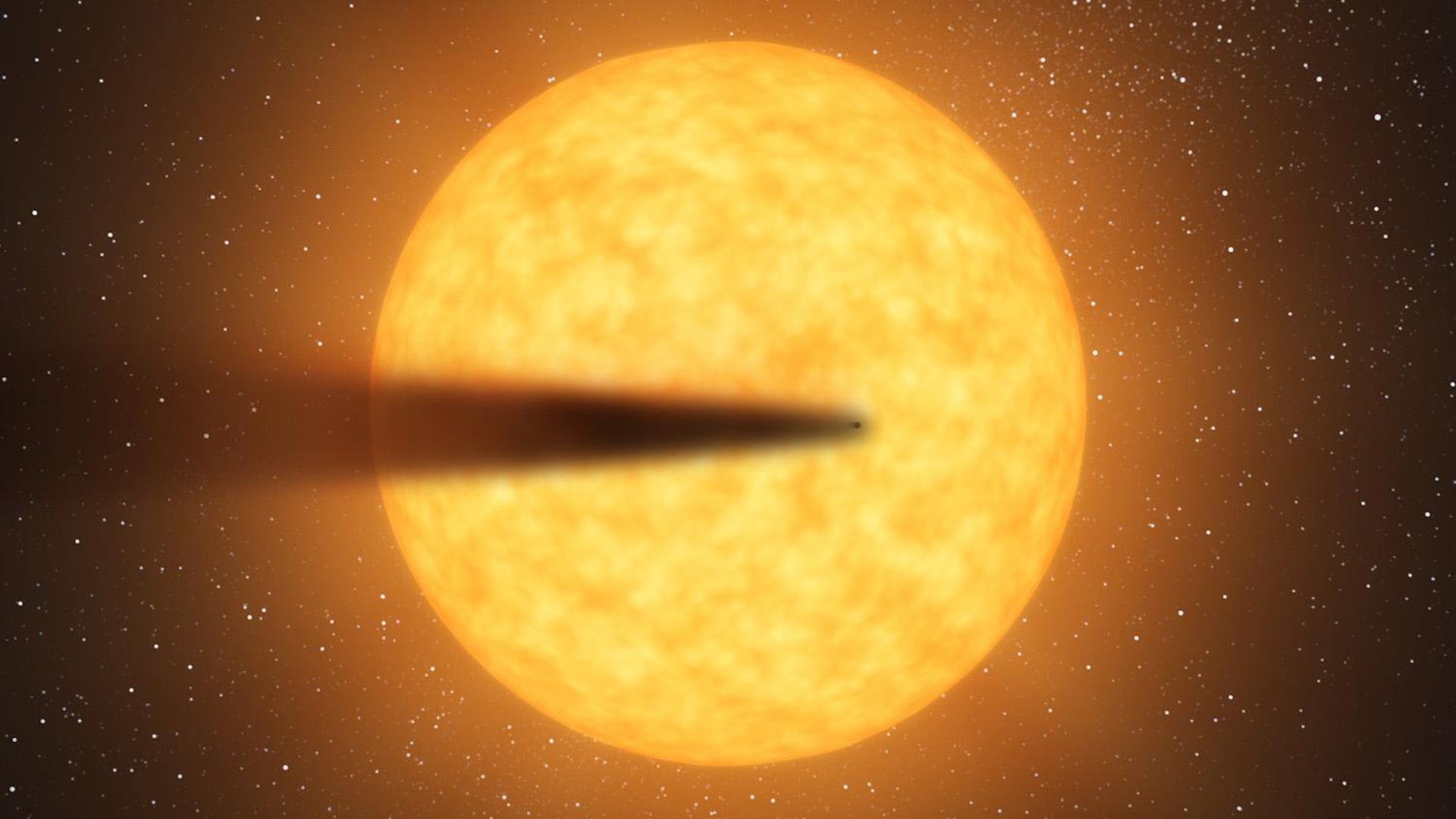
The first “disintegrating” exoplanet is a Neptune-size rocky world called K2-22b, which zips around its star so closely that it completes an orbit in just nine hours. Scientists say the star’s heat literally roasts the planet: K2-22b’s surface reaches temperatures of more than 3,320 degrees Fahrenheit (1,826 degrees Celsius), which is hot enough not just to melt rock, but to vaporize it. Recent observations of K2-22b using the James Webb Space Telescope (JWST) revealed that the evaporated rock has been sculpted into an extended, comet-like tail.

“It’s a remarkable and fortuitous opportunity to understand terrestrial planet interiors,” study co-author Jason Wright, a professor of astronomy and astrophysics at Penn State, said in a statement.

But this isn’t the only evaporating planet spotted recently. Another disintegrating exoplanet circling a different star was discovered by a separate team using the Transiting Exoplanet Survey Satellite (TESS). This roasted world, named BD+054868Ab, is the closest evaporating exoplanet to Earth discovered so far.

TESS data show that BD+054868Ab sports not one, but two massive tails: a leading tail of larger, sand-size particles; and a trailing tail with smaller, soot-size grains. Together, the tails span a whopping 5.6 million miles (9 million kilometers) and occupy roughly half the planet’s orbit.

“These planets are literally spilling their guts into space for us,” Nick Tusay, a graduate student in the Penn State Department of Astronomy and Astrophysics who led the JWST study, said in the statement. “With JWST, we finally have the means to study their composition and see what planets orbiting other stars are really made of.”

Papers detailing the findings about both exoplanets have been uploaded as preprints and are still undergoing peer review.

Get the world’s most fascinating discoveries delivered straight to your inbox.

“Who ordered that?”

The findings come after TESS and JWST observed thousands of stars, searching for subtle-yet-periodic dips of light that occur when a planet crosses in front of its star. These dips, known as transits, reveal spectral fingerprints of the planets’ chemical compositions, which allow astronomers to reverse engineer what the interiors of the crumbling planets may have once looked like.

While studying K2-22b, for instance, JWST detected gases like carbon dioxide and nitric oxide. This is unusual because these gases are typically associated with icy bodies, not with mantles of terrestrial planets, and they should have evaporated into space long ago.

“It was actually sort of a ‘Who ordered that?’ moment,” Tusay said in the statement.

Tusay and his colleague speculate that K2-22b may have originally formed farther from its star and migrated inward by gravitational perturbations, which should not be uncommon, considering the planet’s host star shares its cosmic residence with another star.

Meanwhile, BD+054868Ab is likely losing about a moon’s worth of material every million years. By current estimates, astronomers expect it will cease to exist in about 1 million to 2 million years — a blink of an eye in the typical lifespan of planets in less extreme environments, which exist for billions of years.

“The rate at which the planet is evaporating is utterly cataclysmic, and we are incredibly lucky to be witnessing the final hours of this dying planet,” Marc Hon, a postdoctoral researcher at MIT who led the discovery of BD+054868Ab, said in the statement.


James Webb Space Telescope quiz: How well do you know the world’s most powerful telescope?

Source link

Share. Facebook Twitter Pinterest LinkedIn Tumblr Email
Previous ArticleUkraine agrees to rare mineral deal with US for security guarantees
Next Article What are cancer vaccines? | Live Science
Editor
  • Website

Related Posts

Lifestyle

‘A disease anywhere can be a disease everywhere tomorrow morning’: Public health expert on Ebola and the threat of future outbreaks

June 8, 2026
Lifestyle

Thanks to natural selection, Indigenous Andeans may digest potatoes better than anyone else in the world, study finds

June 8, 2026
Lifestyle

Doctors need to understand patients' lived experiences to treat them well — but medical schools may stop requiring that training

June 8, 2026
Add A Comment

Comments are closed.

Categories
  • Entertainment
  • Lifestyle
  • News
  • Sports
  • Tech
  • Travel
Recent Posts
  • ‘A disease anywhere can be a disease everywhere tomorrow morning’: Public health expert on Ebola and the threat of future outbreaks
  • Thanks to natural selection, Indigenous Andeans may digest potatoes better than anyone else in the world, study finds
  • Doctors need to understand patients' lived experiences to treat them well — but medical schools may stop requiring that training
  • This yeast-based 3D printed biomaterial could one day replace your wallpaper and drapes
  • Flesh-eating screwworm found in Texas cow. Are humans at risk?
calendar
June 2026
M T W T F S S
1234567
891011121314
15161718192021
22232425262728
2930  
« May    
Recent Posts
  • ‘A disease anywhere can be a disease everywhere tomorrow morning’: Public health expert on Ebola and the threat of future outbreaks
  • Thanks to natural selection, Indigenous Andeans may digest potatoes better than anyone else in the world, study finds
  • Doctors need to understand patients' lived experiences to treat them well — but medical schools may stop requiring that training
About

Welcome to Baynard Media, your trusted source for a diverse range of news and insights. We are committed to delivering timely, reliable, and thought-provoking content that keeps you informed
and inspired

Categories
  • Entertainment
  • Lifestyle
  • News
  • Sports
  • Tech
  • Travel
Facebook X (Twitter) Pinterest WhatsApp
  • Contact Us
  • About Us
  • Privacy Policy
  • Disclaimer
  • UNSUBSCRIBE
© 2026 copyrights reserved

Type above and press Enter to search. Press Esc to cancel.