Close Menu
  • Home
  • UNSUBSCRIBE
  • News
  • Lifestyle
  • Tech
  • Entertainment
  • Sports
  • Travel
Facebook X (Twitter) WhatsApp
Trending
  • New robotic heart mimics common, mysterious condition to help researchers study it
  • Canon EOS R6 III review: A wildlife wonder
  • Medieval babies and adults buried together in Sweden were not related, archaeologists discover — raising big questions about early Christian burial practices
  • NASA is creating a fifth state of matter on the ISS, thanks to an upgrade to a mini-fridge-sized quantum lab
  • New sodium metal battery design charges in just 4 minutes and retains its capacity for years
  • Quantum computing wielded to create extremely rare material critical to nuclear fusion
  • Scientists build tiny ‘diving suit’ for cockroaches, turning them into search-and-rescue cyborgs
  • Physicists develop the first working model of quantum mechanics using only ‘real’ numbers
Facebook X (Twitter) WhatsApp
Baynard Media
  • Home
  • UNSUBSCRIBE
  • News
  • Lifestyle
  • Tech
  • Entertainment
  • Sports
  • Travel
Baynard Media
Home»Lifestyle»‘Unlike any we’ve ever seen’: Record-breaking black hole eruption is brighter than 10 trillion suns
Lifestyle

‘Unlike any we’ve ever seen’: Record-breaking black hole eruption is brighter than 10 trillion suns

EditorBy EditorNovember 7, 2025No Comments3 Mins Read
Share Facebook Twitter Pinterest LinkedIn Tumblr Reddit Telegram Email
Share
Facebook Twitter LinkedIn Pinterest Email

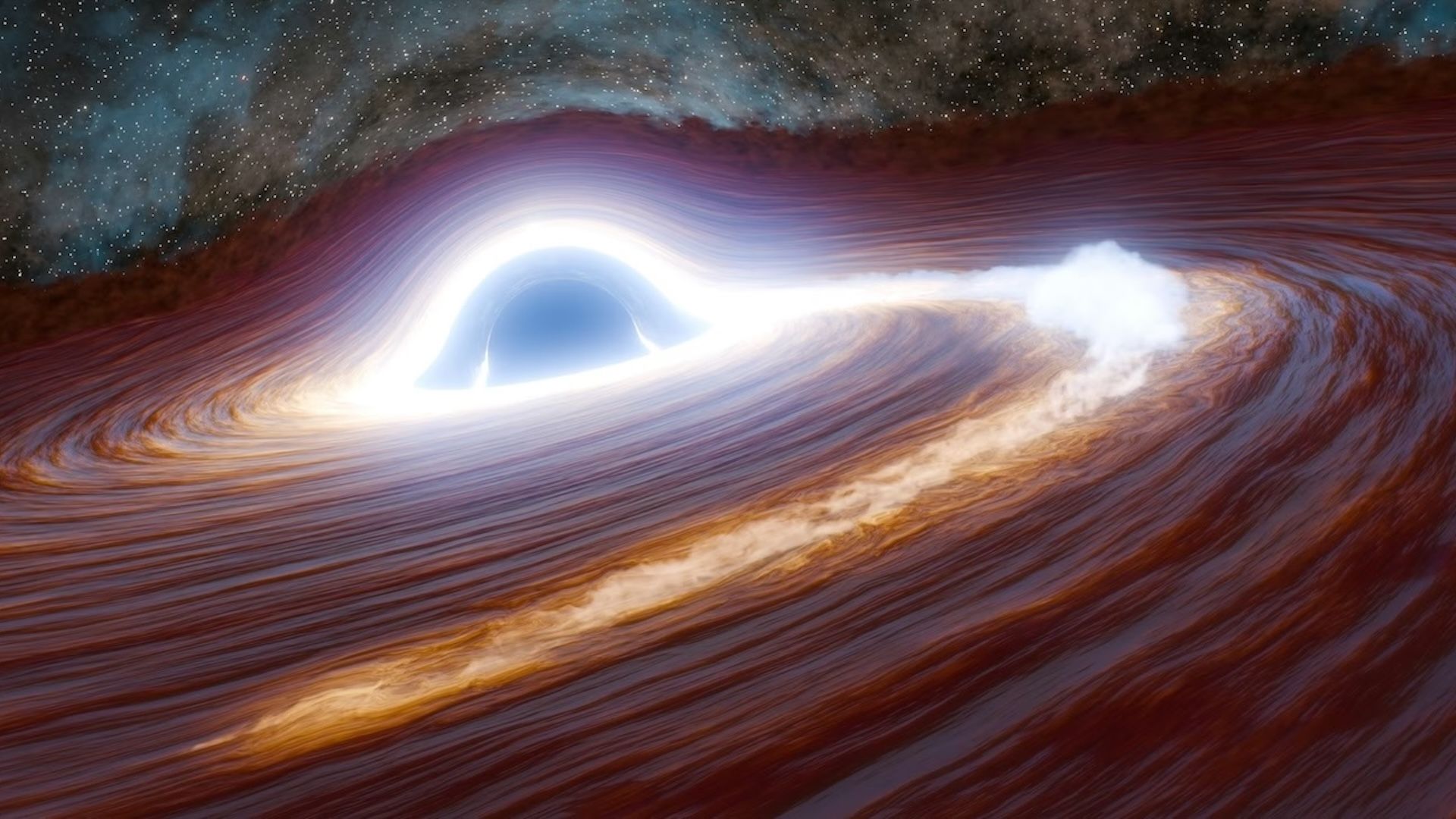
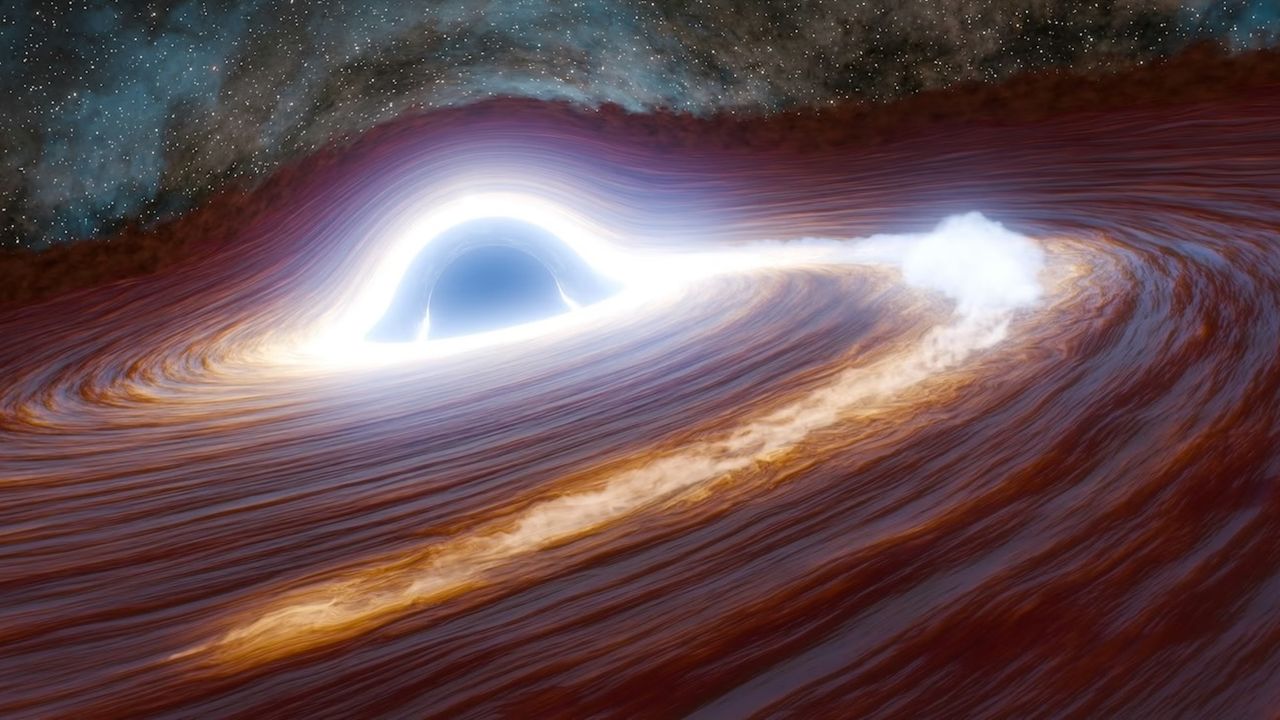
A supermassive black hole appears to have generated a record flare after gobbling a star at least 30 times more massive than the sun.

The event has yet to be confirmed as a tidal disruption event (TDE), which happens when a black hole devours a star (or similar object) that strays too close to the black hole’s gravity. But if verified, this TDE — called J2245+3743 — would be the most powerful and distant energy flare ever recorded from a supermassive black hole.

“If you convert our entire sun to energy, using Albert Einstein’s famous formula E = mc2, that’s how much energy has been pouring out from this flare since we began observing it,” K. E. Saavik Ford, an astronomer at the City University of New York (CUNY), the Borough of Manhattan Community College and the American Museum of Natural History and a member of the research team, said in a statement.


You may like

The findings, reported Nov. 4 in the journal Nature Astronomy, would easily override the previous candidate record-holder. Nicknamed “Scary Barbie” (a character from the 2023 live-action “Barbie” film) in 2023, after its classification as ZTF20abrbeie, that earlier flare from a different supermassive black hole was estimated to have swallowed a star only between three and 10 times the mass of the sun.

Very far, and very bright

The newly published event emerged from a huge feeding black hole, also known as an active galactic nucleus (AGN). The supermassive black hole is believed to be more than 500 million times more massive than the sun. It is also quite distant, at 10 billion light-years away. (For comparison, the universe is about 13.8 billion years old.)

As astronomers watched the black hole over several months, the flare shined up to 30 times brighter than other flares seen before, with the brightness of about 10 trillion suns at its peak. The peak luminosity also varied by fortyfold during the observation period.

“The energetics show this object is very far away and very bright,” lead author Matthew Graham, a research professor of astronomy at the California Institute of Technology (Caltech), said in the statement. “This is unlike any AGN we’ve ever seen.”

Get the world’s most fascinating discoveries delivered straight to your inbox.

Graham is also a project scientist for the Zwicky Transient Facility (ZTF), which first observed the event in 2018 from its site at the Palomar Observatory near San Diego. Several other telescopes in space and on Earth have been periodically watching the flare ever since.

When the research paper was written, the flare was still ongoing, although it was also fading. Graham said the flare is likely dimming because the star is not fully consumed yet, like “a fish only halfway down the whale’s gullet.”

The flare’s luminosity is even more remarkable when compared with the roughly 100 other TDEs recorded so far. Most of the flares are at a similar brightness scale as a black hole’s normal feeding activity, which makes them hard to spot. So J2245+3743’s brightness came as a surprise because the flare was easily visible above its black hole’s usual activity.

While the suspected massive star being shredded in the TDE would be a rare find, others are probably out there, the team said. The researchers plan to examine ZTF data for more events like this, and they said the newly completed Vera C. Rubin Observatory may spot some more as it scans the sky.


Source link

Share. Facebook Twitter Pinterest LinkedIn Tumblr Email
Previous ArticleHouse GOP civil war ignites over ‘ludicrous’ bill to defund NYC while Mamdani is mayor
Next Article Cornell reaches $60 million deal with Trump administration to restore funding
Editor
  • Website

Related Posts

Lifestyle

New robotic heart mimics common, mysterious condition to help researchers study it

July 11, 2026
Lifestyle

Canon EOS R6 III review: A wildlife wonder

July 10, 2026
Lifestyle

Medieval babies and adults buried together in Sweden were not related, archaeologists discover — raising big questions about early Christian burial practices

July 10, 2026
Add A Comment

Comments are closed.

Categories
  • Entertainment
  • Lifestyle
  • News
  • Sports
  • Tech
  • Travel
Recent Posts
  • New robotic heart mimics common, mysterious condition to help researchers study it
  • Canon EOS R6 III review: A wildlife wonder
  • Medieval babies and adults buried together in Sweden were not related, archaeologists discover — raising big questions about early Christian burial practices
  • NASA is creating a fifth state of matter on the ISS, thanks to an upgrade to a mini-fridge-sized quantum lab
  • New sodium metal battery design charges in just 4 minutes and retains its capacity for years
calendar
July 2026
M T W T F S S
 12345
6789101112
13141516171819
20212223242526
2728293031  
« Jun    
Recent Posts
  • New robotic heart mimics common, mysterious condition to help researchers study it
  • Canon EOS R6 III review: A wildlife wonder
  • Medieval babies and adults buried together in Sweden were not related, archaeologists discover — raising big questions about early Christian burial practices
About

Welcome to Baynard Media, your trusted source for a diverse range of news and insights. We are committed to delivering timely, reliable, and thought-provoking content that keeps you informed
and inspired

Categories
  • Entertainment
  • Lifestyle
  • News
  • Sports
  • Tech
  • Travel
Facebook X (Twitter) Pinterest WhatsApp
  • Contact Us
  • About Us
  • Privacy Policy
  • Disclaimer
  • UNSUBSCRIBE
© 2026 copyrights reserved

Type above and press Enter to search. Press Esc to cancel.