Close Menu
  • Home
  • UNSUBSCRIBE
  • News
  • Lifestyle
  • Tech
  • Entertainment
  • Sports
  • Travel
Facebook X (Twitter) WhatsApp
Trending
  • Arthritis drug shows antiviral effects against RSV, the leading cause of infant hospitalization
  • Daddy longlegs may be capturing and devouring frogs in the tropical forests of South America
  • Google wants to release 64 million bacteria-riddled mosquitoes across California and Florida. Here’s why scientists are enthusiastic.
  • ‘In an unrecoverable state’: NASA confirms MAVEN spacecraft is officially dead after loss of signal behind Mars
  • 2 rivers merged to form the Euphrates 3.6 million years ago, eventually leading to the Fertile Crescent
  • NASA confirms fireball meteor exploded over northeastern US with force of 230 tons of TNT
  • Astronauts could use lightning-like plasma jets to kill germs on the moon and Mars, demo hints
  • First whole-genome sequence of a Greenland shark holds clues to their extreme longevity
Facebook X (Twitter) WhatsApp
Baynard Media
  • Home
  • UNSUBSCRIBE
  • News
  • Lifestyle
  • Tech
  • Entertainment
  • Sports
  • Travel
Baynard Media
Home»News»Two greenish comets are streaking across the night sky this month
News

Two greenish comets are streaking across the night sky this month

EditorBy EditorOctober 11, 2025No Comments3 Mins Read
Share Facebook Twitter Pinterest LinkedIn Tumblr Reddit Telegram Email
Share
Facebook Twitter LinkedIn Pinterest Email

Two greenish-hued comets are swinging through the inner solar system this fall, offering a rare chance to spot them in the coming weeks.

The comets, named C/2025 A6 (Lemmon) and C/2025 R2 (SWAN), are visible from the Northern Hemisphere now as their orbits take them through our cosmic backyard on their journey around the sun.

Two comet appearances in the same month are very uncommon.

Both celestial objects can be seen with binoculars or small telescopes through the end of October. Comet Lemmon may be visible to the naked eye when it reaches its closest point to Earth, and is therefore at is brightest, on or around Oct. 21.

Already, some skywatchers have caught sight of these icy wanderers.

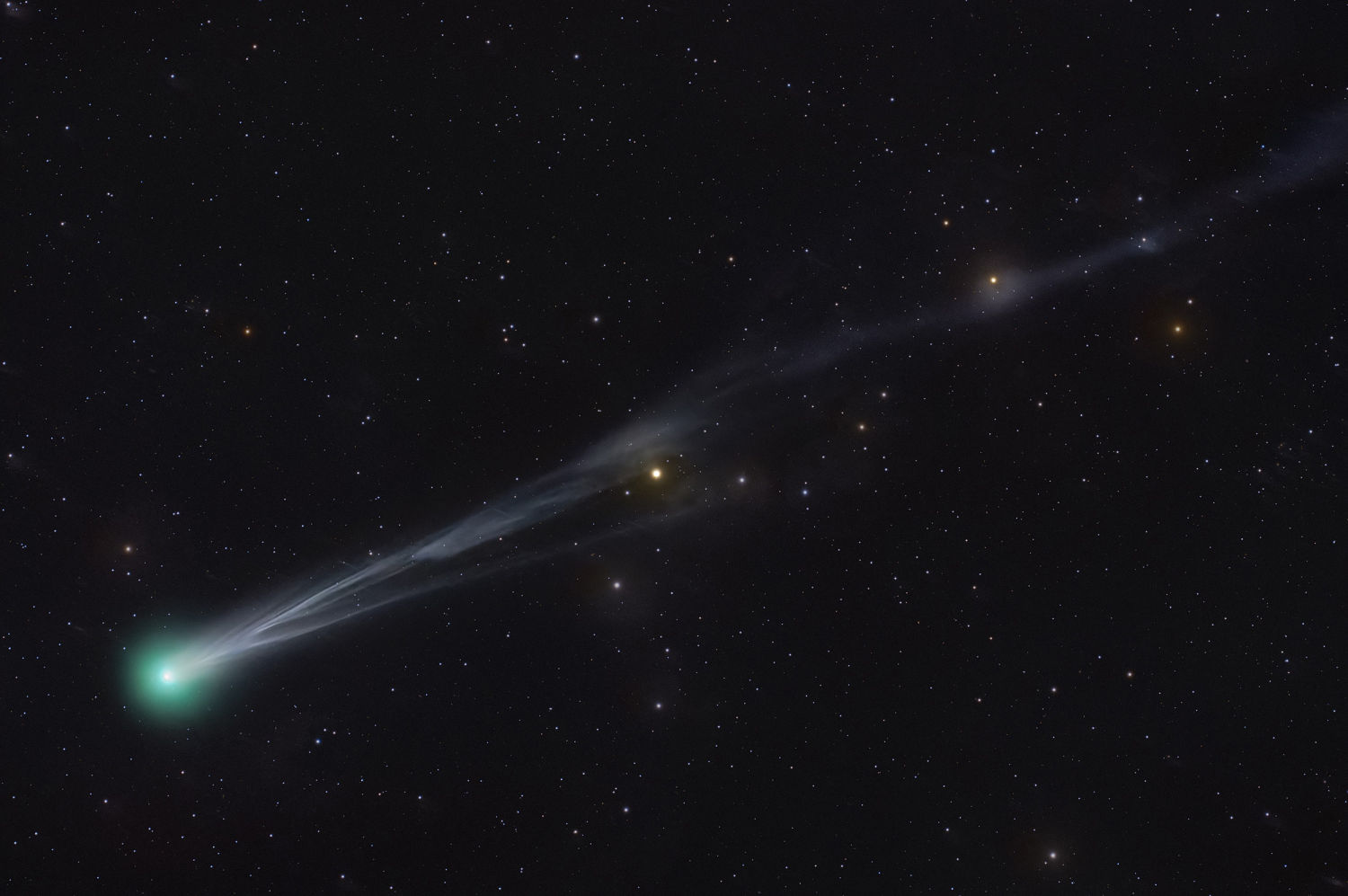
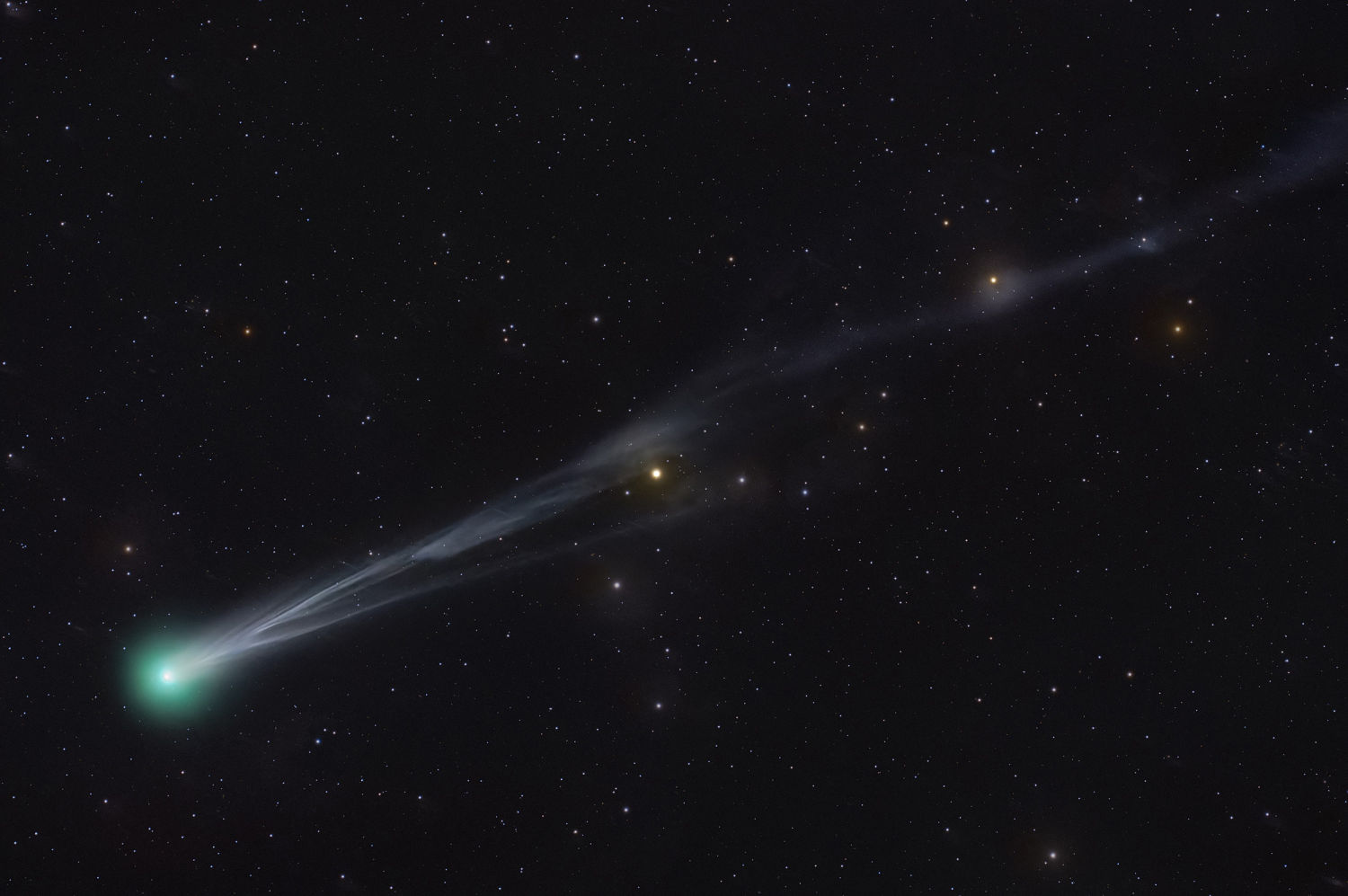
Astrophotographer Julien De Winter, a junior lecturer at the University of Mons in Belgium, photographed Comet Lemmon in late September from Texas, capturing its dramatic emerald glow and long tail.

The faint green color comes from the presence of carbon in the cloud of gas that surrounds the comet’s nucleus.

In the Northern Hemisphere from now until midmonth, Comet Lemmon will appear near the Big Dipper before the sun rises, according to EarthSky, a website devoted to skywatching and astronomy. It’s best to look northeast in the sky in the hours before dawn, slightly below the grouping of stars that make up the distinct bowl and handle of the Big Dipper.

In about a week, the comet will instead be visible in the evening sky, rising in the west. From that point through the end of the month, it may be possible to see it with the unaided eye, but these cosmic objects can be tricky to see.

Comet SWAN can be viewed in the evening sky through the end of the month. The best time to spot it will be roughly 90 minutes after sunset, facing southwest. This comet likely won’t be bright enough to see with the naked eye, so binoculars or a small telescope will be necessary.

In the coming days, Comet SWAN will appear higher and higher on the horizon after sunset and may get brighter before it reaches its closest point to Earth on or around Oct. 20.

Under ideal conditions — clear weather, dark skies and as little light pollution as possible — it may even be possible to see both comets on the same night around the end of the month.

Comet Lemmon was discovered in January by the Mount Lemmon Survey, which tracks near-Earth objects using telescopes located in the Santa Catalina Mountains in Arizona.

Comet SWAN’s discovery was even more recent: An amateur astronomer spotted it in early September when sifting through images from the SWAN instrument on NASA’s Solar & Heliospheric Observatory, which launched in 1995 on a mission to orbit and study the sun.

A different type of comet — one from outside our solar system — is also passing through the inner solar system this month. Comet 3I/ATLAS is only the third such interstellar visitor ever confirmed, and it was recently photographed by a spacecraft in orbit around Mars. The interstellar comet will make its closest approach to the sun on or around Oct. 30.

Source link

Share. Facebook Twitter Pinterest LinkedIn Tumblr Email
Previous ArticleDems slammed for ‘staggering’ silence after Virginia AG hopeful’s violent texts emerge
Next Article Derek Hough, Hayley Erbert’s Love Story
Editor
  • Website

Related Posts

News

Omar files new financial form in response to Trump, GOP critics

April 21, 2026
News

Ex-CENTCOM commanderwarns against ‘risky’ US ground op to seize Iran uranium

April 21, 2026
News

Santa Ana’s Upcoming Report on Police Firing on ICE Protesters Lacks Details

April 21, 2026
Add A Comment

Comments are closed.

Categories
  • Entertainment
  • Lifestyle
  • News
  • Sports
  • Tech
  • Travel
Recent Posts
  • Arthritis drug shows antiviral effects against RSV, the leading cause of infant hospitalization
  • Daddy longlegs may be capturing and devouring frogs in the tropical forests of South America
  • Google wants to release 64 million bacteria-riddled mosquitoes across California and Florida. Here’s why scientists are enthusiastic.
  • ‘In an unrecoverable state’: NASA confirms MAVEN spacecraft is officially dead after loss of signal behind Mars
  • 2 rivers merged to form the Euphrates 3.6 million years ago, eventually leading to the Fertile Crescent
calendar
June 2026
M T W T F S S
1234567
891011121314
15161718192021
22232425262728
2930  
« May    
Recent Posts
  • Arthritis drug shows antiviral effects against RSV, the leading cause of infant hospitalization
  • Daddy longlegs may be capturing and devouring frogs in the tropical forests of South America
  • Google wants to release 64 million bacteria-riddled mosquitoes across California and Florida. Here’s why scientists are enthusiastic.
About

Welcome to Baynard Media, your trusted source for a diverse range of news and insights. We are committed to delivering timely, reliable, and thought-provoking content that keeps you informed
and inspired

Categories
  • Entertainment
  • Lifestyle
  • News
  • Sports
  • Tech
  • Travel
Facebook X (Twitter) Pinterest WhatsApp
  • Contact Us
  • About Us
  • Privacy Policy
  • Disclaimer
  • UNSUBSCRIBE
© 2026 copyrights reserved

Type above and press Enter to search. Press Esc to cancel.