

NEWYou can now listen to Fox News articles!
The most consequential moments of the Trump–Xi summit last week did not occur at South Korea’s Gimhae International Airport. Statements about “stabilizing relations” and “reducing tensions” were predictable, almost perfunctory.
The real story unfolded in the weeks leading up to the summit – in the choreography, the pageantry and the unmistakable assertion of American power across the Indo-Pacific. By the time Xi Jinping sat across from Donald Trump, he was meeting a U.S. president who had already recommitted to America’s military preeminence in the region, reaffirmed its alliances, and reminded Beijing that the United States remains the indispensable Pacific power.
In the days before the summit, Trump delivered a series of moves that together amounted to a strategic message. When reporters aboard Air Force One asked about Taiwan, he replied simply, “There’s not that much to ask about it. Taiwan is Taiwan.”
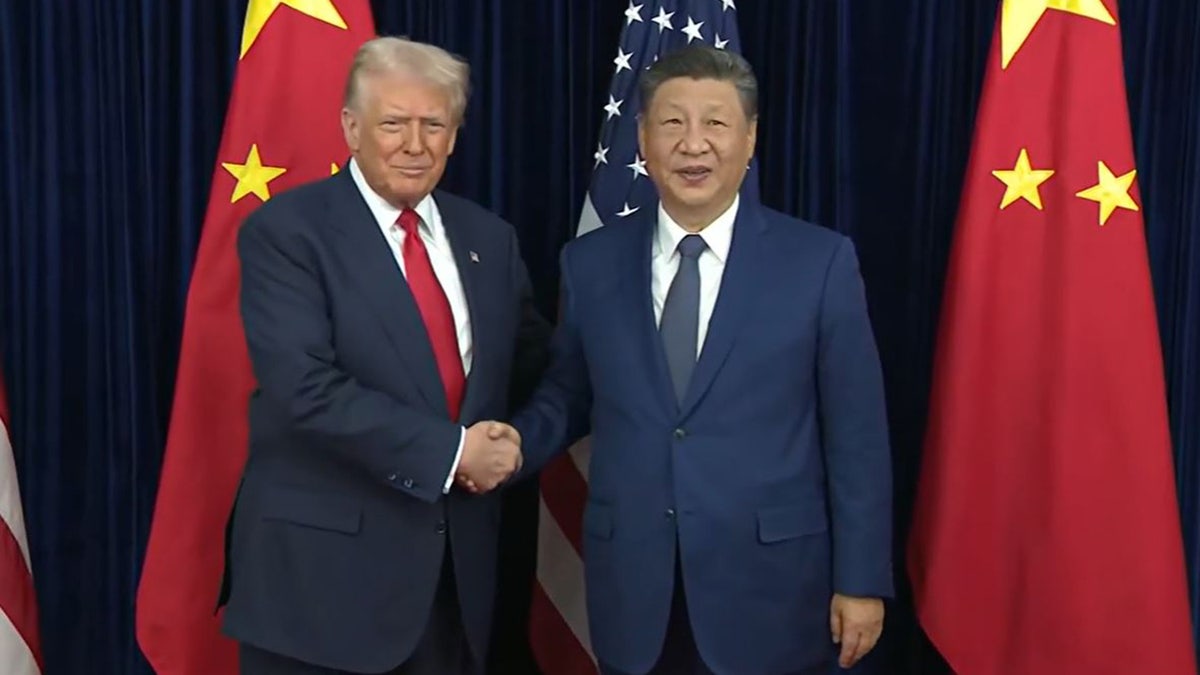
President Donald Trump and Chinese President Xi Jinping meet in South Korea, Thursday. (Fox News/Pool)
The remark – off-the-cuff but unmistakable in meaning – pushed back against speculation that his administration might soften on the issue in pursuit of a grand bargain with Beijing. Trump’s statement told Xi that the United States would not barter away the foundation of East Asian stability for a better trade deal. Since 1979, American policy toward Taiwan has relied on strategic ambiguity – but Trump’s phrasing underscored deterrence, not doubt.
TRUMP LEARNS HOW TO FEND OFF THE CHINESE THREAT LIKE HE IS READING SUN TZU
Then came a tangible demonstration of alliance power. The Trump administration announced a new partnership with a leading South Korean shipbuilder to co-produce nuclear-powered submarines and expand U.S. shipyard capacity – a deal expected to bring billions of dollars in investment and jobs to American facilities, including in Philadelphia and along the Gulf Coast.
For all the rhetoric about “America First,” this was alliance diplomacy in practice: fusing allied industrial bases to strengthen deterrence. At a time when China is out-building the U.S. Navy at a breathtaking pace, the U.S.–ROK shipbuilding initiative signals that Washington is no longer content to outsource maritime capacity to its competitors.
Equally deliberate was Trump’s decision to post on Truth Social about nuclear-weapons testing – announcing that the United States would resume limited tests to ensure readiness. The statement came in direct response to China’s accelerated nuclear expansion.
The Pentagon’s 2024 China Military Power Report estimated that Beijing had surpassed 600 operational nuclear warheads and was rapidly expanding its missile forces and fissile-material production capacity. In recent years, satellite imagery and open-source reporting have also suggested that China may be preparing renewed activity at its Lop Nur nuclear test site, reinforcing concerns that Beijing is edging toward a more aggressive testing posture.
TRUMP SCORES FOUR BIG WINS WITH XI, BUT HAS ONE BIG MISS
In that context, Trump’s post was less provocation than deterrent signaling – a reminder that the U.S. will not allow the balance of nuclear credibility to tilt unchallenged. The move ignited controversy but achieved its purpose: it reassured allies and warned adversaries that American nuclear deterrence is not theoretical.
Perhaps the clearest articulation of this posture came aboard the USS George Washington two days before the summit. Standing on the carrier’s deck alongside Japan’s prime minister, President Trump declared that “the U.S. military will win – every time.” The audience was not voters in the United States. The message was directed at Xi Jinping, the People’s Liberation Army, and America’s allies watching across the Indo-Pacific.
With the Japanese prime minister by his side – who described the carrier as a “symbol of protecting freedom and peace in this region” – the moment projected allied unity and deterrent resolve. It was as much a visual message as a verbal one: the United States and its partners were back in the business of winning, and Beijing would have to recalibrate its assumptions accordingly.
Taken together – the Taiwan statement, the South Korea shipbuilding accord, the nuclear-testing post, and the carrier speech – the president’s actions framed the summit before it even began.
CLICK HERE FOR MORE FOX NEWS OPINION
These were not the actions of a president declaring detente with Beijing. They told Xi that the United States would not arrive as a supplicant seeking stability at any price, nor should America First to be interpreted as “America Alone,” retreating to the Western Hemisphere.
Instead, President Trump positioned himself at the helm of an American-led order in the Indo-Pacific in which its two most important allies–Japan and South Korea– play leading roles. His message was not isolation but orchestration: America’s strength is amplified through partnership.
This approach marks an evolution from President Trump’s first term, when “burden-sharing” often meant brow-beating allies. Now his focus is on empowerment — accelerating allied shipbuilding, missile defense and joint exercises.
The summit’s scripted pleasantries – calls for dialogue and vows to “manage competition responsibly” – mattered less than the backdrop: a U.S. president reinforcing alliances, expanding shipbuilding and projecting confidence from “100,000 tons of diplomacy”–the deck of an aircraft carrier.
CLICK HERE TO GET THE FOX NEWS APP
President Trump will return to Beijing in April for a follow-up summit with Xi – a test of whether his current posture endures. As any student of “The Art of the Deal” knows, Trump’s instinct is to maximize leverage before negotiation.
The handshake between Trump and Xi captured that dynamic: a confident Trump leaning into Xi knowing weeks of U.S. maneuvers had strengthened America’s hand in its competition with China. Whether that grip represents a lasting commitment to Indo-Pacific leadership or merely a pause before the next deal remains to be seen.
CLICK HERE FOR MORE FROM ROGER ZAKHEIM
