Close Menu
  • Home
  • UNSUBSCRIBE
  • News
  • Lifestyle
  • Tech
  • Entertainment
  • Sports
  • Travel
Facebook X (Twitter) WhatsApp
Trending
  • OpenAI’s internal AI model just solved an 80-year-old math problem ‪—‬ and mathematicians verified it
  • Skeletal remains of Queen Elisenda, one of the most powerful rulers in medieval Europe, unearthed in Barcelona — along with several others who bore unexplained stab wounds
  • Tests that measure ‘biological age’ aren’t helpful for tracking your health, scientists say
  • Japan hits 6G key milestone with high-frequency speeds topping 100 Gbps
  • War has brought Iran’s water crisis to a breaking point: ‘Things will collapse unless there is meaningful structural change’
  • Fingal’s Cave: Scotland’s ‘cave of melody’ where eerie echoes bounce off pillars of solidified lava
  • Controversial ‘JuMBO’ planets discovered by James Webb telescope may not be an illusion after all
  • Scientists found the optimal robot body, and it has 20 legs ‪—‬ watch it scale walls and move through trees
Facebook X (Twitter) WhatsApp
Baynard Media
  • Home
  • UNSUBSCRIBE
  • News
  • Lifestyle
  • Tech
  • Entertainment
  • Sports
  • Travel
Baynard Media
Home»Lifestyle»Tiny AI chip modeled on the human brain set to boost battery life in smart devices — with lifespan in some rising up to 6 times
Lifestyle

Tiny AI chip modeled on the human brain set to boost battery life in smart devices — with lifespan in some rising up to 6 times

EditorBy EditorJanuary 13, 2025No Comments3 Mins Read
Share Facebook Twitter Pinterest LinkedIn Tumblr Reddit Telegram Email
Share
Facebook Twitter LinkedIn Pinterest Email

LAS VEGAS — The world’s first “neuromorphic chip” will be on shelves by next year — and it will extend smart devices’ battery life. The chip, which mimics the human brain’s architecture, is meant to enable artificial intelligence (AI) capabilities on power-limited smart devices.

“Smart” devices like lightbulbs, doorbells or smoke alarms that are Wi-Fi connected are built with sensors that make detections and send data to the cloud for processing.

But this process is power-hungry, Sumeet Kumar, CEO of processor company Innatera Nanosystems, told Live Science in an interview at CES 2025. And any AI processing these devices perform also requires an internet connection.

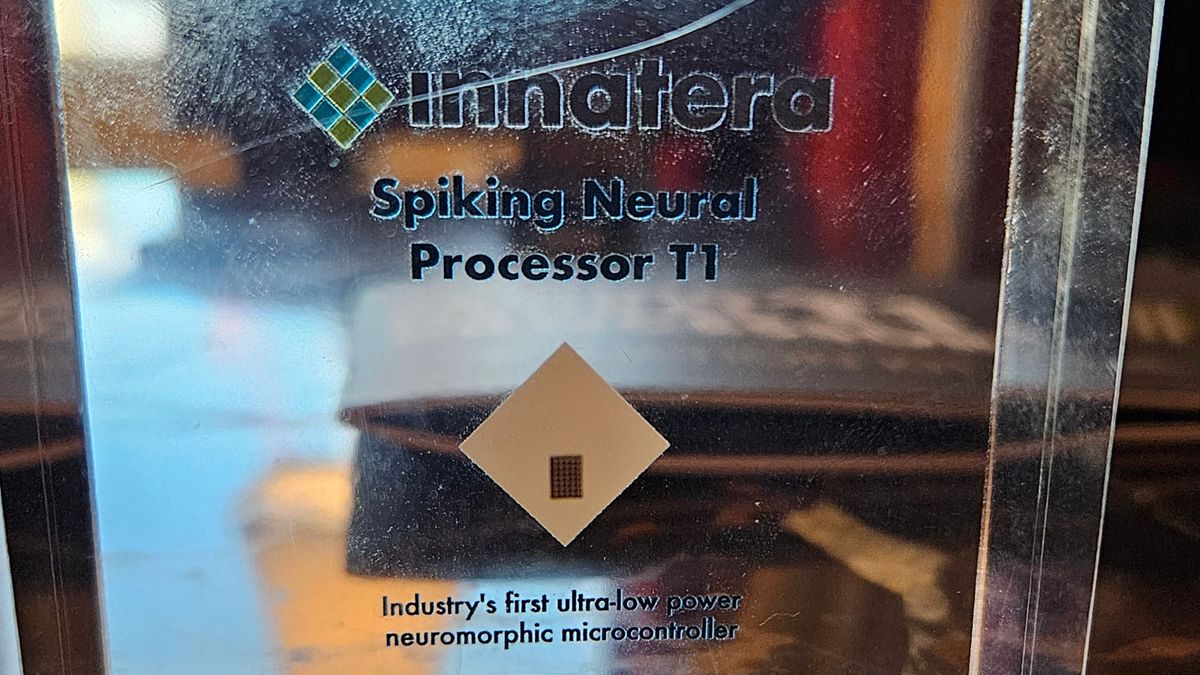
But the Spiking Neural Processor T1 should drastically slash the power consumption of future smart devices.

It works by analyzing sensor data in real time to identify patterns and potentially clean up the data coming out of the sensors — and no internet connection would be required.

Mimicking the brain

The device is a neuromorphic processor — meaning its architecture is arranged to mimic the brain’s pattern-recognition mechanisms. To draw an analogy, when you sense something — whether it’s a smell or a sound — different collections of neurons fire to identify it.

Similarly, in the chip, different groups of artificial neurons register spikes. The underlying principle is the spiking neural network (SNN) — where a neural network is a collection of machine learning algorithms and the spikes it produces are akin to the signals produced by brain cells.

Get the world’s most fascinating discoveries delivered straight to your inbox.

Related: Intel unveils largest-ever AI ‘neuromorphic computer’ that mimics the human brain

SNN algorithms also tend to be around 100 times smaller in terms of file size than conventional deep neural networks used in large language models.
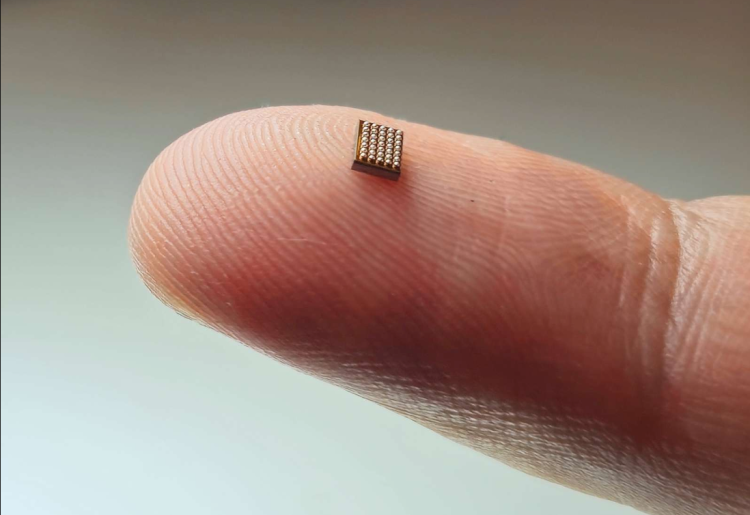
A tiny AI microchip sits on top of a finger.

The T1 chip can be used in a variety of smart home applications such as in detectors, alarms and sensors. (Image credit: press release)

Layers of computation

There are three fundamental layers in the T1 chip. The first is the SNN-based computing engine, which records a power dissipation of less than 1 milliwatt and latency, or delay, that’s typically under 1 millisecond for most applications, Kumar said. The second layer includes conventional deep neural networks, while the third layer includes a standard processor that handles how the system functions.

The T1, or similar chips, would increase battery life up to sixfold in some smart devices and scenarios, Kumar said. For example, a prototype of a smart doorbell built with the T1 processor that could detect the presence of a person using radar technology lasted 18 to 20 hours, versus one or two hours in a conventional Wi-Fi-based product that sends image and video data to servers.

Applications include smart lighting, any kind of detectors for people-counting, door-opening systems, and even earbuds — in which the T1 chip can theoretically isolate different sounds for noise cancellation. When used for any sound-based applications, the company claims there is an 80 to 100 times reduction in energy consumption as well as a 70 times reduction in latency.

The chip is being readied for mass production this year, with samples shipping to device manufacturers. Kumar expects the first products with the T1 neuromorphic chip to hit the shelves by 2026.

Source link

Share. Facebook Twitter Pinterest LinkedIn Tumblr Email
Previous ArticleThe Shark FlexStyle is $100 off and nearly at its lowest price ever
Next Article Tom Willis and Max Ojomoh in line for England call-ups for Six Nations opener against Ireland | Rugby Union News
Editor
  • Website

Related Posts

Lifestyle

OpenAI’s internal AI model just solved an 80-year-old math problem ‪—‬ and mathematicians verified it

May 30, 2026
Lifestyle

Skeletal remains of Queen Elisenda, one of the most powerful rulers in medieval Europe, unearthed in Barcelona — along with several others who bore unexplained stab wounds

May 29, 2026
Lifestyle

Tests that measure ‘biological age’ aren’t helpful for tracking your health, scientists say

May 29, 2026
Add A Comment

Comments are closed.

Categories
  • Entertainment
  • Lifestyle
  • News
  • Sports
  • Tech
  • Travel
Recent Posts
  • OpenAI’s internal AI model just solved an 80-year-old math problem ‪—‬ and mathematicians verified it
  • Skeletal remains of Queen Elisenda, one of the most powerful rulers in medieval Europe, unearthed in Barcelona — along with several others who bore unexplained stab wounds
  • Tests that measure ‘biological age’ aren’t helpful for tracking your health, scientists say
  • Japan hits 6G key milestone with high-frequency speeds topping 100 Gbps
  • War has brought Iran’s water crisis to a breaking point: ‘Things will collapse unless there is meaningful structural change’
calendar
May 2026
M T W T F S S
 123
45678910
11121314151617
18192021222324
25262728293031
« Apr    
Recent Posts
  • OpenAI’s internal AI model just solved an 80-year-old math problem ‪—‬ and mathematicians verified it
  • Skeletal remains of Queen Elisenda, one of the most powerful rulers in medieval Europe, unearthed in Barcelona — along with several others who bore unexplained stab wounds
  • Tests that measure ‘biological age’ aren’t helpful for tracking your health, scientists say
About

Welcome to Baynard Media, your trusted source for a diverse range of news and insights. We are committed to delivering timely, reliable, and thought-provoking content that keeps you informed
and inspired

Categories
  • Entertainment
  • Lifestyle
  • News
  • Sports
  • Tech
  • Travel
Facebook X (Twitter) Pinterest WhatsApp
  • Contact Us
  • About Us
  • Privacy Policy
  • Disclaimer
  • UNSUBSCRIBE
© 2026 copyrights reserved

Type above and press Enter to search. Press Esc to cancel.