Close Menu
  • Home
  • UNSUBSCRIBE
  • News
  • Lifestyle
  • Tech
  • Entertainment
  • Sports
  • Travel
Facebook X (Twitter) WhatsApp
Trending
  • Ancient squirrel poop from Arctic permafrost contains DNA from mammoths, bison, horses and big cats
  • The Milky Way returns: How to take breathtaking photos of our galaxy this summer
  • Intestinal parasite transformed into antitoxin factory that can live in the body in early study
  • Complete skin of an adult horse found with 10th-century woman and newborn in rare Siberian burial
  • ‘Geminid Symphony’ and ‘Galactic Gandalf’: See the breathtaking views of our home galaxy from the 2026 Milky Way Photographer of the Year contest
  • Japan’s ‘crawling’ moon robot LEV-2 passed its historic first lunar mission with flying colors
  • Artificial turf contains 400 chemicals tied to cancer and hormone disruption. But is it unsafe?
  • ‘Just defies belief’: 5 million-year-old whale graveyard stretches for 750 miles in the Indian Ocean
Facebook X (Twitter) WhatsApp
Baynard Media
  • Home
  • UNSUBSCRIBE
  • News
  • Lifestyle
  • Tech
  • Entertainment
  • Sports
  • Travel
Baynard Media
Home»Lifestyle»Thríhnúkagígur: The only volcano on Earth where you can descend into a magma chamber
Lifestyle

Thríhnúkagígur: The only volcano on Earth where you can descend into a magma chamber

EditorBy EditorApril 24, 2026No Comments3 Mins Read
Share Facebook Twitter Pinterest LinkedIn Tumblr Reddit Telegram Email
Share
Facebook Twitter LinkedIn Pinterest Email

QUICK FACTS

Name: Thríhnúkagígur, or Three Peaks Crater

Location: Southwest Iceland

Coordinates: 63.9984, -21.6989

Why it’s incredible: The volcano hosts the world’s only magma chamber that’s accessible to humans.

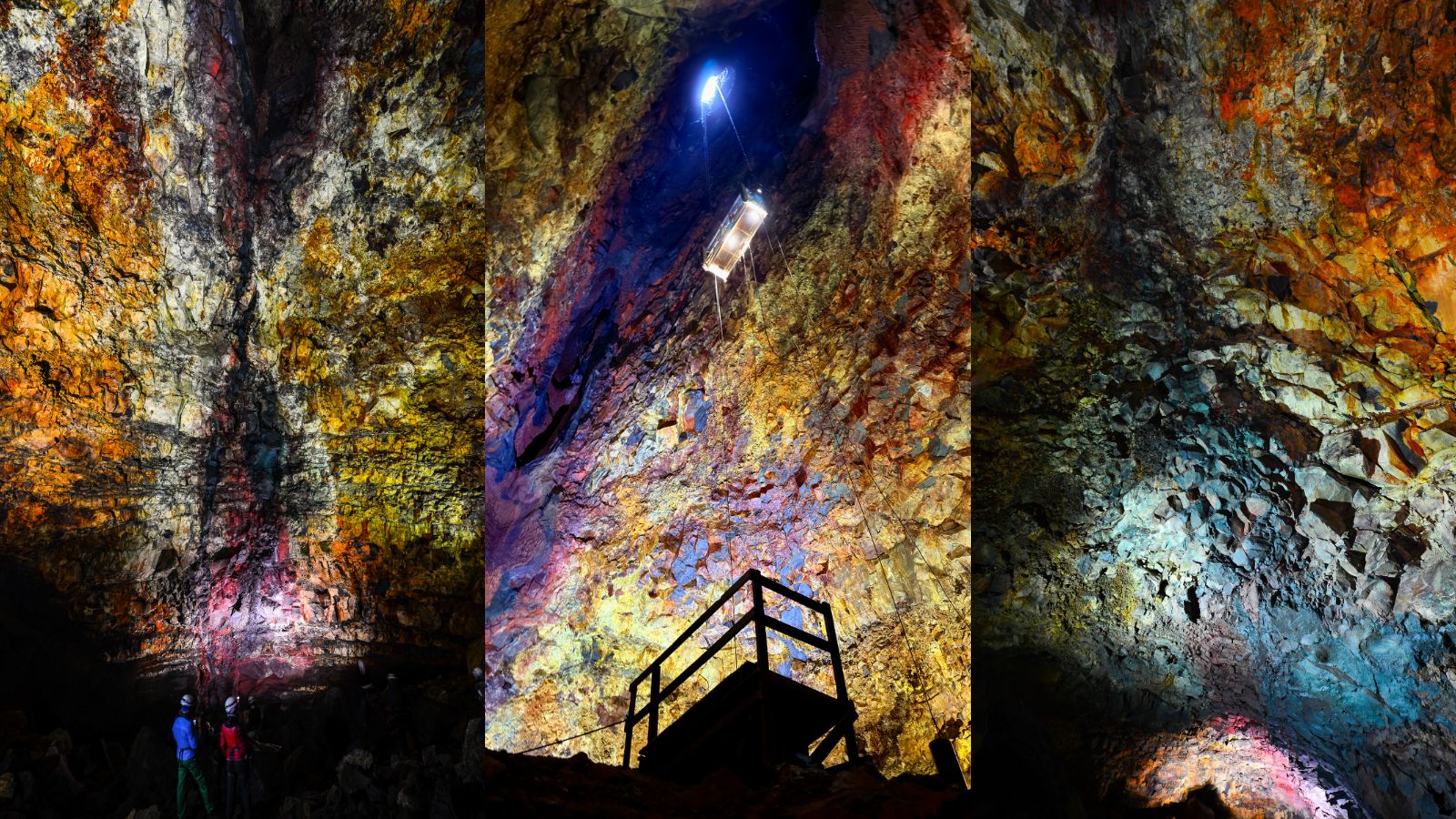
Thríhnúkagígur is a dormant volcano near Reykjavík whose last eruption 4,500 years ago left a hollow magma chamber with bronze-and-indigo-colored walls. It’s the only place in the world where people can climb into a volcano’s plumbing system and explore the cavern that held sizzling molten rock before an eruption.

Since 2012, visitors have been allowed to enter Thríhnúkagígur’s magma chamber via an open cable elevator that was built in 2010 for scientists. The chamber is about 700 feet (210 meters) deep, or more than double the height of the Statue of Liberty with the pedestal. Visitors are lowered to the bottom of the cave in a metal cage, and then they are free to roam the 33,600-square-foot (3,120 square meters) cave floor.

Volcanoes don’t usually have empty magma chambers beneath them. Typically, during an eruption, there comes a point when the pressure in the chamber isn’t high enough to eject any more liquid. The leftover magma slowly solidifies inside the chamber, filling the ground beneath the volcano.


You may like

Thríhnúkagígur is an exception, but researchers don’t really understand why. The magma that fed the most recent eruption seems to have disappeared, and scientists think it may have been sucked back down into Earth’s crust.

“It’s like somebody came and pulled the plug and all the magma ran down out of it,” Haraldur Sigurdsson, a volcanologist and professor emeritus of marine geology and geophysics at the University of Rhode Island, told Inside the Volcano, a company that organizes tours of Thríhnúkagígur.

The colors inside the chamber are attributed to microbes, but not much is known about the organisms that live there. Sulfur-rich gases likely painted some parts of the cave yellow and orange, while rocks falling off the walls formed the indigo and blue patches. Visitors occasionally see puffs of steam rising from corners of the chamber, but these are caused by water dripping onto lamps that illuminate the cave and are not signs of an impending eruption.

Evidence suggests Thríhnúkagígur has erupted three times over the past 50,000 years. The volcano presents three peaks at the surface — hence its name, which translates to “Three Peaks Crater.” They are similar in height ‪—‬ about 115 feet (35 m) tall ‪—‬ and they form a line, with about 660 feet (200 m) between each peak.
Get the world’s most fascinating discoveries delivered straight to your inbox.

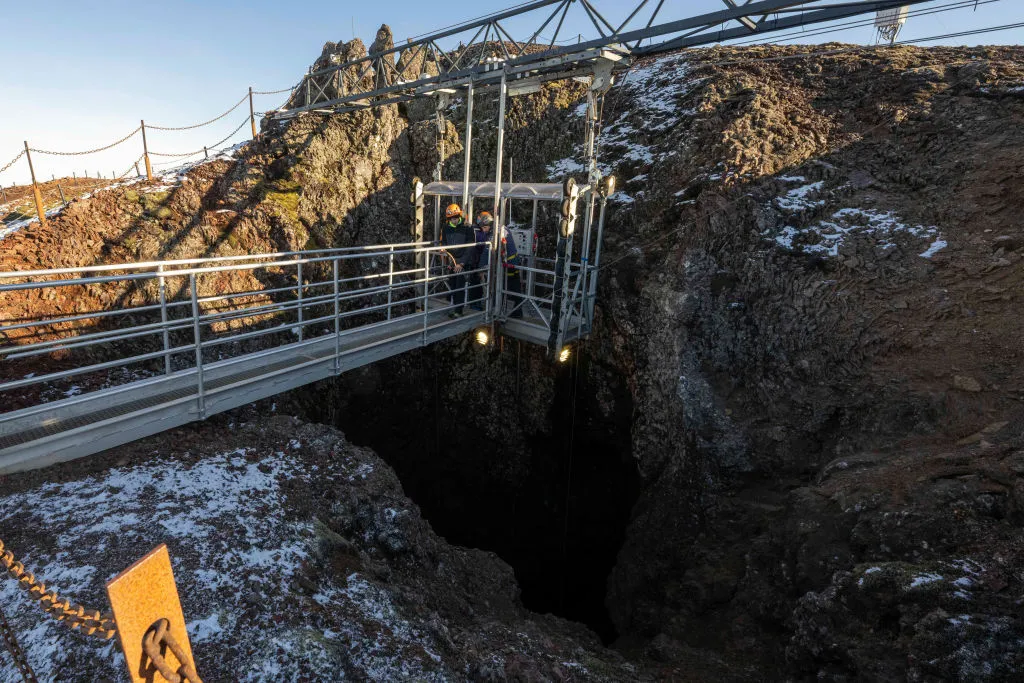
At the top of a volcano in Iceland, people stand in an elevator that will take them into the empty magma chamber below.

The opening where people can descend into the magma chamber is located atop one of Thríhnúkagígur’s three peaks. (Image credit: Jorge Castellanos/SOPA Images/LightRocket via Getty Images)

The youngest peak dates to the eruption 4,500 years ago. At the top sits the opening where scientists and tourists start their journey into the heart of the volcano. The next peak in the line formed 5,000 years ago, and it is partly encircled with solidified lava from the most recent eruption, according to Inside the Volcano. The oldest peak formed 50,000 years ago, when Iceland was covered with a thick ice sheet. It is composed of hyaloclastite, a volcanic rock characterized by sharp, glassy fragments that appear when lava comes into contact with water and ice.

It’s unlikely that Thríhnúkagígur will erupt anytime soon, even though the volcano sits within the Mid-Atlantic Ridge, a tear in Earth’s crust where the Eurasian and North American tectonic plates are separating, according to Inside the Volcano.

Discover more incredible places, where we highlight the fantastic history and science behind some of the most dramatic landscapes on Earth.

Source link

Share. Facebook Twitter Pinterest LinkedIn Tumblr Email
Previous ArticleClaude Mythos explained: Is Anthropic’s most powerful AI model really too dangerous to release to the public?
Next Article Building a massive dam between Alaska and Russia could prevent AMOC collapse, scientists say
Editor
  • Website

Related Posts

Lifestyle

Ancient squirrel poop from Arctic permafrost contains DNA from mammoths, bison, horses and big cats

June 11, 2026
Lifestyle

The Milky Way returns: How to take breathtaking photos of our galaxy this summer

June 11, 2026
Lifestyle

Intestinal parasite transformed into antitoxin factory that can live in the body in early study

June 11, 2026
Add A Comment

Comments are closed.

Categories
  • Entertainment
  • Lifestyle
  • News
  • Sports
  • Tech
  • Travel
Recent Posts
  • Ancient squirrel poop from Arctic permafrost contains DNA from mammoths, bison, horses and big cats
  • The Milky Way returns: How to take breathtaking photos of our galaxy this summer
  • Intestinal parasite transformed into antitoxin factory that can live in the body in early study
  • Complete skin of an adult horse found with 10th-century woman and newborn in rare Siberian burial
  • ‘Geminid Symphony’ and ‘Galactic Gandalf’: See the breathtaking views of our home galaxy from the 2026 Milky Way Photographer of the Year contest
calendar
June 2026
M T W T F S S
1234567
891011121314
15161718192021
22232425262728
2930  
« May    
Recent Posts
  • Ancient squirrel poop from Arctic permafrost contains DNA from mammoths, bison, horses and big cats
  • The Milky Way returns: How to take breathtaking photos of our galaxy this summer
  • Intestinal parasite transformed into antitoxin factory that can live in the body in early study
About

Welcome to Baynard Media, your trusted source for a diverse range of news and insights. We are committed to delivering timely, reliable, and thought-provoking content that keeps you informed
and inspired

Categories
  • Entertainment
  • Lifestyle
  • News
  • Sports
  • Tech
  • Travel
Facebook X (Twitter) Pinterest WhatsApp
  • Contact Us
  • About Us
  • Privacy Policy
  • Disclaimer
  • UNSUBSCRIBE
© 2026 copyrights reserved

Type above and press Enter to search. Press Esc to cancel.