

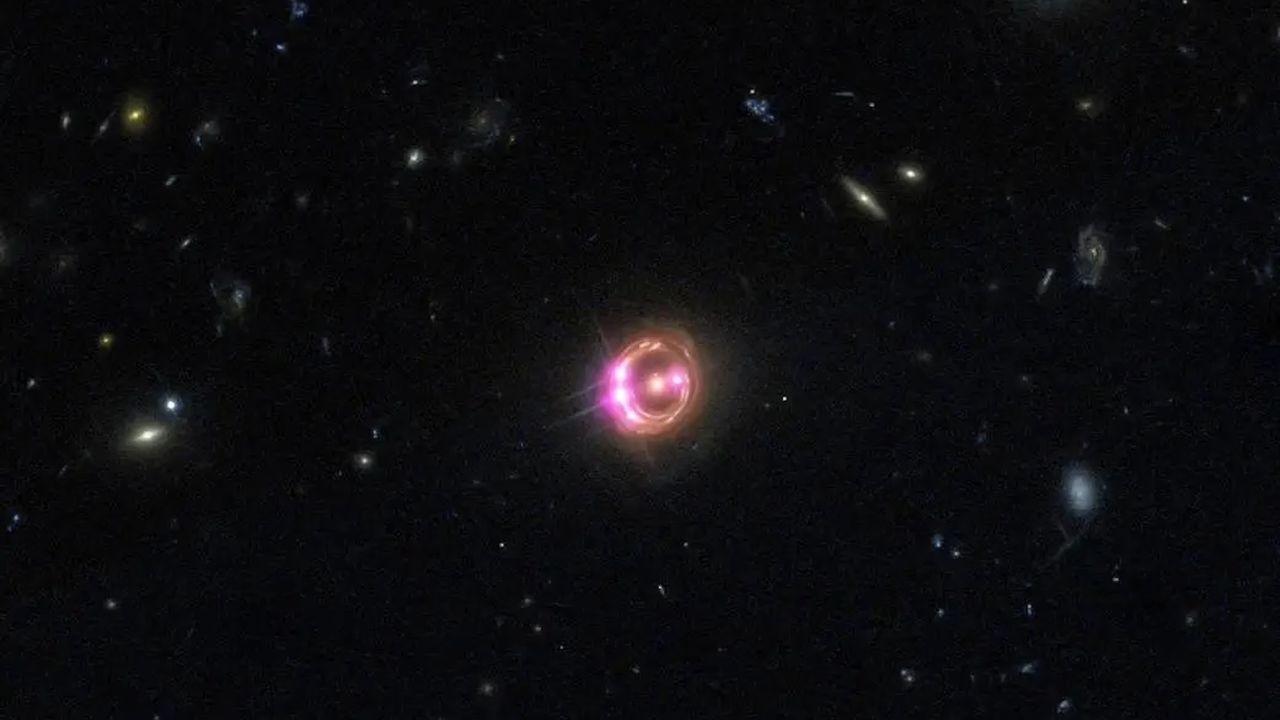
Black holes may be invisible, but their surroundings aren’t — and for the first time, astronomers have directly measured a superheated “corona” encircling one of these cosmic giants.
The supermassive black hole, RX J1131, sits about 6 billion light-years from Earth and spins at more than half the speed of light. While the monster itself remains hidden, it gorges on nearby gas and dust, heating it to millions of degrees and blazing as a quasar — one of the brightest objects in the universe. Its corona, a halo of superheated gas, spans about 50 astronomical units, about the size of our solar system.
This measurement was made possible by a rare cosmic alignment where a foreground galaxy, roughly 4 billion light-years from Earth, and its stars acted like two stacked magnifying glasses, creating a “double zoom” that sharpened the view of the black hole’s immediate surroundings.
“This is the first time such a measurement has been made,” Matus Rybak, a senior researcher at Leiden University in the Netherlands who led the study, told Live Science. “In principle, we found a new way to look at what’s happening very close to the black hole.”
The results, detailed in a preprint soon to appear in the journal Astronomy & Astrophysics, provide a new tool for probing extreme environments around black holes on scales far too small for even the best telescopes to resolve.
“This does not look right”
The foreground galaxy is so massive that its immense gravity bends and magnifies RX J1131’s light, creating four distinct images of the quasar through a phenomenon known as strong gravitational lensing. When Rybak’s team reanalyzed decade-old data collected by the Atacama Large Millimeter/submillimeter Array (ALMA) radio telescope in Chile, they noticed tiny flickers in the brightness of these images.
“Within a few days of looking at the data, we realized, ‘OK, this does not look right,'” Rybak recalled. “It is not even my main field of research, but it became like a pet project that we kept on pursuing.”
If the source of these variations came from around the black hole itself, all of the images would brighten and dim together. But follow-up observations in 2022, taken just a day apart, revealed that the images flickered independently of each other.
“That’s the smoking gun — it has to be something along the way,” Rybak said.
That “something” is microlensing, where individual stars in the foreground galaxy act as tiny lenses, briefly magnifying different parts of the quasar’s corona. Because the corona is so compact, these small-scale amplifications produced the independent flickering observed across the images, the authors noted in the new study.
Related: Stephen Hawking’s long-contested black hole theory finally confirmed — as scientists ‘hear’ 2 event horizons merge into one
“We saw this flickering in the data that we could not explain in any other way,” Rybak told Live Science. By analyzing these flickers, the team directly measured, for the first time, the corona’s solar-system-scale breadth — transforming an otherwise ordinary quasar into a unique cosmic laboratory.
A new window into black holes
Beyond allowing the researchers to map the corona, the new measurement offers a potential window into the magnetic fields surrounding black holes, the scientists noted in the study.
Previous research has shown that strong magnetic fields regulate how much gas falls in and how much gets expelled, essentially controlling how black holes grow over time. It’s extremely difficult to measure these fields directly, but theoretical models suggest a link between the corona’s millimeter-wave emission — light that comes from fast-moving electrons spiraling around magnetic field lines — its size and the magnetic-field strength.
“Understanding how these black holes grow is the main potential here,” Rybak said.
This measurement is particularly striking because millimeter-wave light was previously thought to be largely static, even over months or years. “But this was one of those moments when you realize, ‘No, things change, and they change a lot,'” Rybak said.
To follow up and compare the millimeter radiation across different wavelengths, the team also plans to collect additional data from NASA’s Chandra X-ray Observatory, the only X-ray telescope with sufficient spatial resolution to capture such tiny, lensed features. However, due to significant proposed budget cuts that drew strong backlash from the scientific community, the 26-year-old flagship telescope is unlikely to continue these observations.
Future progress will instead likely rely on ALMA, which is expanding into lower-frequency bands covering the wavelengths where black hole coronas shine brightest.
Complementing ALMA, the Vera C. Rubin Observatory will excel at high-resolution optical imaging, the standard method for discovering lensed quasars like RX J1131. The telescope, whose first images were revealed in June, is expected to uncover thousands of these systems and allow astronomers to study optical flickering with unprecedented precision. “Rubin would be the revolutionary tool to do this,” Rybak said.
With increasingly sensitive telescopes, astronomers are only beginning to explore the multitude of sources that flicker across the millimeter-wave sky.
“The exciting part is the things we don’t know about yet,” Rybak said.
