Close Menu
  • Home
  • UNSUBSCRIBE
  • News
  • Lifestyle
  • Tech
  • Entertainment
  • Sports
  • Travel
Facebook X (Twitter) WhatsApp
Trending
  • Strange mammal ancestor laid huge, leathery eggs —‬ and it was key to surviving the world’s worst mass extinction
  • Ancient process that created rare earth elements discovered — and it could help us locate desperately needed deposits
  • This humanoid robot does all your housework for you ‪—‬ and its makers say it’s ready for your home
  • ‘Nations need to prepare now’: Key Atlantic ocean current is much closer to collapse than scientists thought
  • Neanderthal toddlers grew faster than modern humans, probably because of the harsh environment they evolved in
  • NASA shuts off another Voyager 1 instrument as humanity’s most distant spacecraft prepares for risky ‘Big Bang’ maneuver to save power
  • Florida is facing its most intense drought in 15 years. Here’s how it got so bad and how long it will last.
  • New blood test aims to spot liver scarring when it’s still reversible and before it paves the way to cancer
Facebook X (Twitter) WhatsApp
Baynard Media
  • Home
  • UNSUBSCRIBE
  • News
  • Lifestyle
  • Tech
  • Entertainment
  • Sports
  • Travel
Baynard Media
Home»Lifestyle»These tiny robots can flow like water and harden to support the weight of a person
Lifestyle

These tiny robots can flow like water and harden to support the weight of a person

EditorBy EditorMay 2, 2025No Comments4 Mins Read
Share Facebook Twitter Pinterest LinkedIn Tumblr Reddit Telegram Email
Share
Facebook Twitter LinkedIn Pinterest Email

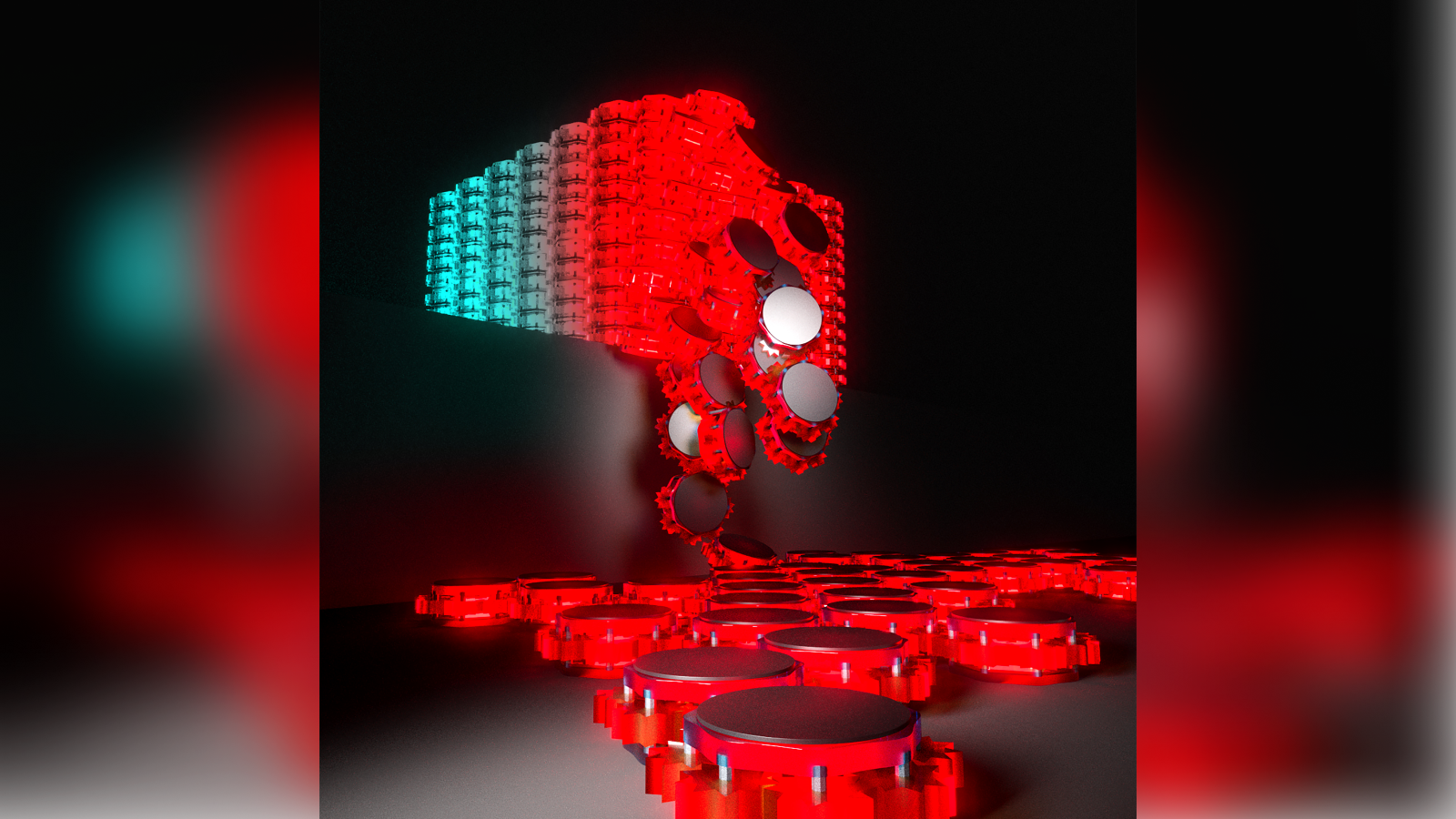
Swarms of hive mind-like robots can be induced to behave more like a material, new research has shown.

The robots in question are (mostly) cylindrical, with a diameter of just 2.75 inches (70 millimeters). The researchers at UC Santa Barbara and TU Dresden used 3D printing technology to manufacture the pieces from polylactic acid.

Each robot has a magnet in its base, yellow gears made out of polylactic acid, and a center with a ring of gears. Collectively, they can perform structure-forming and healing, and support 700 newtons (500 times the weight of a robot). The scientists outlined the structure in a study published Feb. 20 in the journal Science.

The robots move thanks to magnets located in the base. These allow the robots to “naturally stick together and remain cohesive,” according to the lead author of the study Matthew Devlin, Ph.D candidate at UCSB, in an email to Live Science.

“These robots are inspired by developing embryonic cells, which are cohesive and push and pull against each other to form the complex structures of life.”

The gears apply a force pattern that mirrors the behaviors of embryonic tissue cells, for the overall shape and structure to change within a hexagonal lattice structure. Footage provided by the team shows their work in action, with the robots self-organizing into a pattern similar to that of the cells within a honeycomb.

Related: Self-healing ‘living skin’ can make robots more humanlike — and it looks just as creepy as you’d expect

Get the world’s most fascinating discoveries delivered straight to your inbox.

Eight motorized gears enable intracellular forces to become tangential forces that move each unit. This allows the robots to push, pull, and move around one another no matter how narrow a space may be.

One of the team’s primary research goals was creating a material that could be rigid when the situation required it to be, but also adapt itself to assume a softer structure. They also set the goal of wanting the robots to not only take a shape they could maintain but also “selectively flow themselves into a new shape.”

An embryonic technology

A former professor at UC Santa Barbara, Otger Campàs, previously studied how embryos are physically shaped. The work by Campas, currently the director of the Physics of Life Excellence Cluster at TU Dresden, helped inform the team of researchers at his former institution when developing the robots.

Campas’s lab at UCSB had discovered a unique property of embryos — the ability to “sculpt themselves.”

“To sculpt themselves, cells in embryos can make the tissues switch between fluid and solid states; a phenomenon known as rigidity transitions in physics,” Campas said in an article featuring the research, titled “Material-like robotic collectives with spatiotemporal control of strength and shape” published in the journal Science.

Though the team successfully recreated the motions and state transitions of embryonic cells in its robots, Devlin shared with the Live Science team that what he found most fascinating about the experiment was not the change of state from solid to liquid, but the change of strength.

“By fluctuating the magnitude of the forces the gears are applying to each other, the robots can change whether they behave more like a liquid or solid,” Devlin said. He went on to say that his favorite demonstration of this feature occurs when the researcher can stand on the robots.

By completing of a proof-of-concept swarm, and following various simulations conducted by postdoctoral fellow Sangwoo Kim, the team was able to achieve its initial goal of creating and controlling robots to make them act like a material.

The team hopes to explore the scalability of the system, and wish to further study the phase transitions in active matter rather than through the robots. This will help define their hypotheses in order to apply the knowledge accrued in their upcoming research.

Source link

Share. Facebook Twitter Pinterest LinkedIn Tumblr Email
Previous Article18th-century monk’s anus was stuffed with wood chips and fabric to mummify him, researchers discover
Next Article Xiaomi Watch S4 smartwatch review: Affordable elegance
Editor
  • Website

Related Posts

Lifestyle

Strange mammal ancestor laid huge, leathery eggs —‬ and it was key to surviving the world’s worst mass extinction

April 22, 2026
Lifestyle

Ancient process that created rare earth elements discovered — and it could help us locate desperately needed deposits

April 22, 2026
Lifestyle

This humanoid robot does all your housework for you ‪—‬ and its makers say it’s ready for your home

April 22, 2026
Add A Comment

Comments are closed.

Categories
  • Entertainment
  • Lifestyle
  • News
  • Sports
  • Tech
  • Travel
Recent Posts
  • Strange mammal ancestor laid huge, leathery eggs —‬ and it was key to surviving the world’s worst mass extinction
  • Ancient process that created rare earth elements discovered — and it could help us locate desperately needed deposits
  • This humanoid robot does all your housework for you ‪—‬ and its makers say it’s ready for your home
  • ‘Nations need to prepare now’: Key Atlantic ocean current is much closer to collapse than scientists thought
  • Neanderthal toddlers grew faster than modern humans, probably because of the harsh environment they evolved in
calendar
April 2026
M T W T F S S
 12345
6789101112
13141516171819
20212223242526
27282930  
« Mar    
Recent Posts
  • Strange mammal ancestor laid huge, leathery eggs —‬ and it was key to surviving the world’s worst mass extinction
  • Ancient process that created rare earth elements discovered — and it could help us locate desperately needed deposits
  • This humanoid robot does all your housework for you ‪—‬ and its makers say it’s ready for your home
About

Welcome to Baynard Media, your trusted source for a diverse range of news and insights. We are committed to delivering timely, reliable, and thought-provoking content that keeps you informed
and inspired

Categories
  • Entertainment
  • Lifestyle
  • News
  • Sports
  • Tech
  • Travel
Facebook X (Twitter) Pinterest WhatsApp
  • Contact Us
  • About Us
  • Privacy Policy
  • Disclaimer
  • UNSUBSCRIBE
© 2026 copyrights reserved

Type above and press Enter to search. Press Esc to cancel.