Close Menu
  • Home
  • UNSUBSCRIBE
  • News
  • Lifestyle
  • Tech
  • Entertainment
  • Sports
  • Travel
Facebook X (Twitter) WhatsApp
Trending
  • NASA’s Perseverance rover finds record-breaking trove of carbon molecules at Bright Angel rock formation on Mars
  • Some of the last surviving Neanderthals were remarkably diverse ‪—‬ suggesting inbreeding didn’t doom them
  • 'This is the next jump in technology': World's first sub-1nm chip keeps Moore's Law alive a little longer
  • Scientists find thousands of earthquakes in a perfectly straight line in Alaska, revealing a hidden ‘microplate’
  • ‘You can’t patch your way out of it’: Cheap AI worm can spread between devices without human guidance — but how did scientists create it?
  • Diagnostic dilemma: After taking a medicine for years, a man suddenly had weird changes in his taste that made food disgusting
  • ‘A weird result from an already weird hominin’: Archaeologists discover all Homo naledi skeletons found in South African cave are female
  • China’s Einstein Probe detected a mysterious cosmic explosion — and scientists have no idea what caused it
Facebook X (Twitter) WhatsApp
Baynard Media
  • Home
  • UNSUBSCRIBE
  • News
  • Lifestyle
  • Tech
  • Entertainment
  • Sports
  • Travel
Baynard Media
Home»Lifestyle»These insects keep evolving to look like sticks. Why?
Lifestyle

These insects keep evolving to look like sticks. Why?

EditorBy EditorDecember 24, 2024No Comments3 Mins Read
Share Facebook Twitter Pinterest LinkedIn Tumblr Reddit Telegram Email
Share
Facebook Twitter LinkedIn Pinterest Email

Stick insects keep evolving to have the same strange body plans over and over again, scientists have discovered. This evolutionary blueprint has enabled researchers to predict the critters’ next developments.

Researchers identified just 20 distinct body types that hundreds of different stick insect species have independently evolved. These body types include the “tree lobsters,” which have lobster-like features; the “bark huggers,” which blend in with a tree; and the “large-headed sticks,” which have massive jaws or mandibles.

The same body types keep popping up all across the planet because many stick insect lineages have colonized similar environments and need the same features to survive. These similarities enable researchers to predict stick insect evolution, even when the critters have evolved independently from one another for tens of millions of years, according to the new study published Monday (Dec. 23) in the journal PNAS.

“What we’re really diving into here is the predictability of evolution,” study first author Romain Boisseau, a postdoctoral researcher studying stick insect evolution at the University of Lausanne in Switzerland, told Live Science. “If you have a similar lineage that invades a very similar environment you actually can predict where it’s going to go.”

Related: Plastic-eating mealworms native to Africa discovered

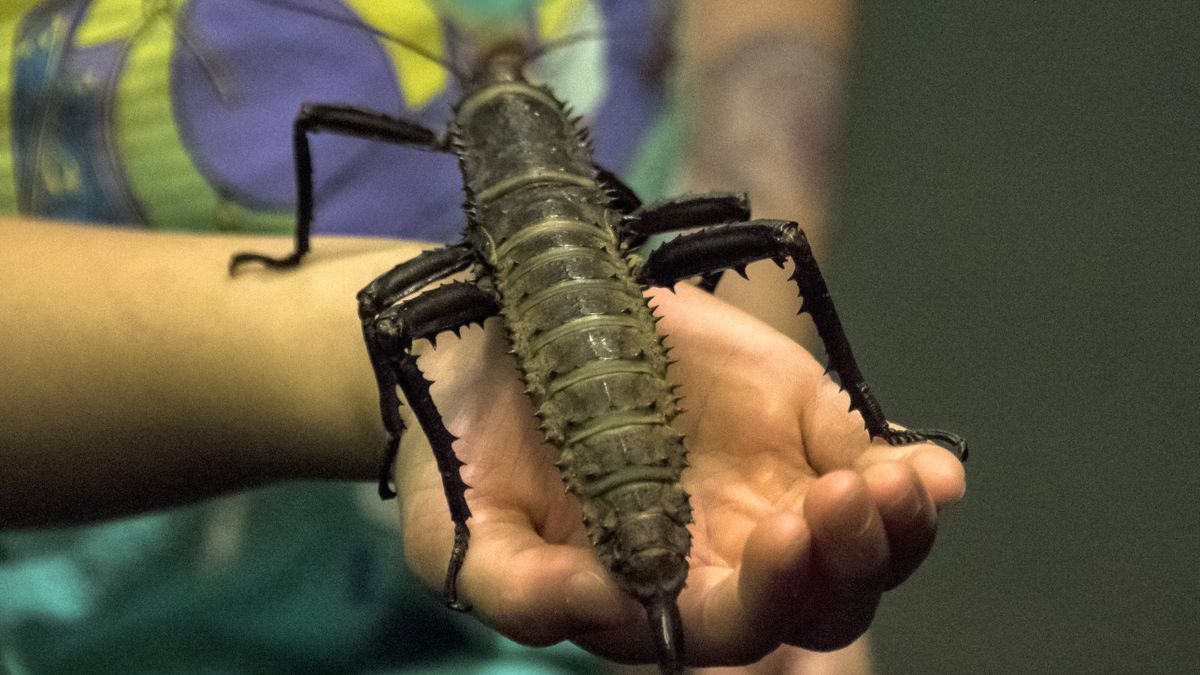
When different organisms evolve similar traits, it’s called convergent evolution. Previous research has highlighted a few examples of convergent evolution in stick insects. For example, a 2008 study published in the journal Proceedings of the Royal Society B found that Australia’s Lord Howe Island stick insects (Dryococelus australis) — once thought to be extinct — independently evolved the same “tree lobster” shape as New Guinea’s thorny devil stick insects (Eurycantha).

However, Boisseau noted that nobody had conducted a large-scale study of convergent evolution across multiple different stick insect lineages. To understand how common convergent evolution was, the team measured and compared features from 1,359 stick insects across 212 species.

Get the world’s most fascinating discoveries delivered straight to your inbox.

Boisseau and his colleagues found that 20 body plans — out of a total of 21 — had evolved at least twice in different regions, and that a broad stick-like appearance had evolved at least 10 separate times.

“In all these areas of the world it looks like many different body forms repeatedly evolved independently,” Boisseau said.

A giant prickly stick insect (Extatosoma tiaratum).

A giant prickly stick insect (Extatosoma tiaratum). (Image credit: Paul Starosta via Getty Images)

Stick insect camouflage

Habitat was a key factor in the evolution of the body plans. Boisseau noted that stick insects use camouflage as their main line of defense against predators, so when the predators and the habitat are similar, the same kind of camouflage is needed to survive.

The team also looked at how closely related the different stick insects were. A pattern emerged: stick insects with the same body plans shared an ancestor, even though that ancestor looked totally different. In other words, the stick insects followed similar evolutionary paths once they were separated from one another.

“They tend to basically follow the same trajectory,” Boisseau said. “That’s probably related to the fact that they’re genetically more similar. It’s potentially the same genes or the same mechanisms that are re-employed in these closely related species.”

Boisseau and his colleagues will now look more closely at the genetics of stick insects to learn what drives convergent evolution at the molecular level.

Source link

Share. Facebook Twitter Pinterest LinkedIn Tumblr Email
Previous ArticleESPN’s Randy Scott Tearfully Mourns Death of Colleague Zach Jones
Next Article Sky Sports’ big quiz of the year: Test your 2024 knowledge and see how much you can remember! | Golf News
Editor
  • Website

Related Posts

Lifestyle

NASA’s Perseverance rover finds record-breaking trove of carbon molecules at Bright Angel rock formation on Mars

June 25, 2026
Lifestyle

Some of the last surviving Neanderthals were remarkably diverse ‪—‬ suggesting inbreeding didn’t doom them

June 25, 2026
Lifestyle

'This is the next jump in technology': World's first sub-1nm chip keeps Moore's Law alive a little longer

June 25, 2026
Add A Comment

Comments are closed.

Categories
  • Entertainment
  • Lifestyle
  • News
  • Sports
  • Tech
  • Travel
Recent Posts
  • NASA’s Perseverance rover finds record-breaking trove of carbon molecules at Bright Angel rock formation on Mars
  • Some of the last surviving Neanderthals were remarkably diverse ‪—‬ suggesting inbreeding didn’t doom them
  • 'This is the next jump in technology': World's first sub-1nm chip keeps Moore's Law alive a little longer
  • Scientists find thousands of earthquakes in a perfectly straight line in Alaska, revealing a hidden ‘microplate’
  • ‘You can’t patch your way out of it’: Cheap AI worm can spread between devices without human guidance — but how did scientists create it?
calendar
June 2026
M T W T F S S
1234567
891011121314
15161718192021
22232425262728
2930  
« May    
Recent Posts
  • NASA’s Perseverance rover finds record-breaking trove of carbon molecules at Bright Angel rock formation on Mars
  • Some of the last surviving Neanderthals were remarkably diverse ‪—‬ suggesting inbreeding didn’t doom them
  • 'This is the next jump in technology': World's first sub-1nm chip keeps Moore's Law alive a little longer
About

Welcome to Baynard Media, your trusted source for a diverse range of news and insights. We are committed to delivering timely, reliable, and thought-provoking content that keeps you informed
and inspired

Categories
  • Entertainment
  • Lifestyle
  • News
  • Sports
  • Tech
  • Travel
Facebook X (Twitter) Pinterest WhatsApp
  • Contact Us
  • About Us
  • Privacy Policy
  • Disclaimer
  • UNSUBSCRIBE
© 2026 copyrights reserved

Type above and press Enter to search. Press Esc to cancel.