
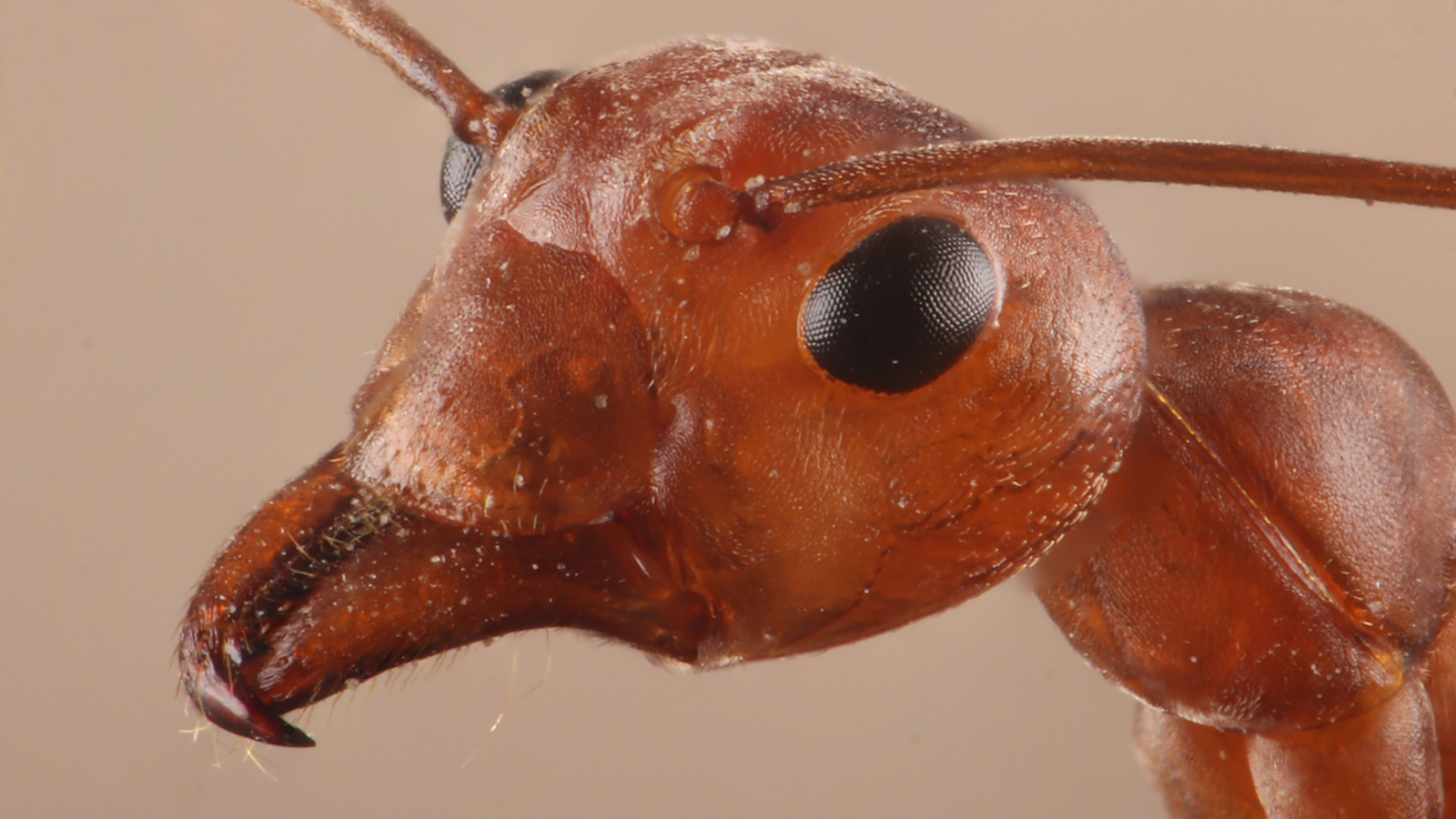
Zombies are among us. And these tiny undead creatures are everywhere. In this excerpt from “Rise of the Zombie Bugs“ (Johns Hopkins University Press, 2025), author Mindy Weisberger examines the very grizzly end for worker ants that get zombiefied by the decapitating fly Pseudacteon wasmanni.
Scientists first described the gruesome habits of ant decapitators in the phorid genus Pseudacteon more than 90 years ago, from observations among ant populations in Europe, South America, and the United States. A female fly begins by staking out a worker ant — carefully keeping her distance at first, as she is no bigger than her target’s head.
To scientists observing phorids in the field, “they appear as minute, fuzzy specks as they hover over host ants,” Lloyd Morrison, an ecologist for the National Park Service, wrote in a guide to insect parasitoids in North America.
Females don’t have a lot of time to be choosy about their hosts, as adult flies live only for about a week or less in the wild. When the female fly sees an opening, she darts in and lays an egg inside the ant’s thorax — one and done — in less than a second (analysis of the female reproductive system in the phorid fly Pseudacteon wasmanni revealed that eggs are torpedo-shaped and measure 130 micrometers long, or about 0.005 inches).
A single Pseudacteon female can produce from 200 to nearly 300 eggs, and in a single hour she may make more than 100 parasitizing attempts (though she only lays one egg per host).
Newly parasitized workers “frequently appear stunned after an oviposition strike,” U.S. Department of Agriculture entomologist Sanford Porter wrote in Florida Entomologist, and the ants “often stilt upon their legs for a few seconds to a minute before running away.”
These egg-laying attempts don’t all succeed; indeed most of them flop. In laboratory experiments, when Pseudacteon females tried to implant an egg in an unwilling ant, they failed at least 65% of the time. But when an egg does manage to end up inside an ant, its host enters the realm of the walking dead. Once the egg hatches, the ant has only a few weeks of life before it succumbs to the manipulations of its attacker, stumbling away from its home and family and then undergoing decapitation from the inside out.

Within days after hatching, the phorid larva migrates from the thorax into the ant’s head; little is known about how the parasitoid avoids being destroyed by the ant’s immune system, but one possibility is that moving quickly into the host’s head may help the larva evade an immune response. For the duration of the larva’s second instar — about two to three weeks — it makes itself comfortable in the ant’s head cavity, sipping on hemolymph.
This liquid nutrition is all the larva needs until it reaches its third instar. For an infected ant during those initial honeymoon weeks, despite carrying and nourishing a growing parasite inside its head, life is pretty much business as usual; the ant looks and behaves normally, according to scientists with the Louisiana State University (LSU) College of Agriculture.
Through “intensive observation” of ant parasitism by the phorid fly Pseudacteon tricuspis, LSU researchers found that a parasitized ant stayed with its nest mates until about 8 to 10 hours before the larva in its head was ready to pupate. It would then depart the nest on what appeared to be a normal foraging expedition, alongside its non-parasitized sisters. But for the zombified ant, this final excursion was a one-way trip.

Once the ant turned its back on the colony and walked away, it was on a death march. And the parasite was in the driver’s seat. “Parasitized ants were highly mobile after they left the nest and ultimately entered the thatch layer at the soil surface,” the scientists reported. “The term ‘zombie’ fire ant workers was coined to characterize the behavior while under parasitoid control.”
Finally, the phorid larva is ready for its metamorphosis. It releases an enzyme that degrades membranes in the wandering ant’s exoskeleton, causing the ant to stop walking and eventually collapse. The ant’s head loosens from the body, as does the first pair of legs; other legs may be affected, too. Its mandibles weaken, rendering it unable to bite or burrow. As for the larva, it indulges a new appetite for solid food; namely, ant head tissue. You can probably guess where this is headed; the ant’s hollowed-out, larvae-stuffed head falls off (the ant, unsurprisingly, is already dead by now, even though its legs are often still twitching as its head rolls away).
The parasitoid, however, is just fine. It finishes off the last of the tasty bits inside the decapitated ant head and pushes the mandibles out of the way — the ant’s no longer using them, after all — and then the larva wriggles into position so that its first three pupal segments are stuffed into the gap where the ant’s mouthparts used to be.
These segments harden and darken, becoming a tough, protective plate that’s roughly the same color as the ant’s exoskeleton, and two hairlike breathing “horns” extend from the pupa out on either side of the ant’s mouth opening. Other parasitoid insects keep their zombie host alive until the larva’s metamorphosis is over, but phorids pupate unguarded inside their dead hosts’ disembodied heads.
However, the exoskeleton of an ant’s head is extremely hard — tougher than other parts of its body — and therefore lends extra protection to the pupating larva, Brown says. Two to six weeks later, depending on air temperature and species size, the adult phorid fly is ready to pop out from inside the detached ant head, like the goddess Athena of legend springing fully grown from the head of her father, Zeus.
Only, this newborn is a lot smaller than an ancient Greek deity and has more legs than most. A few hours after emerging, the adult phorid fly is ready to mate — and continue its head-splitting reproductive cycle.
Excerpted from Rise of the Zombie Bugs: The Surprising Science of Parasitic Mind-Control by Mindy Weisberger. Copyright 2025. Published with permission of Johns Hopkins University Press
