Close Menu
  • Home
  • UNSUBSCRIBE
  • News
  • Lifestyle
  • Tech
  • Entertainment
  • Sports
  • Travel
Facebook X (Twitter) WhatsApp
Trending
  • Diagnostic dilemma: Viral infection caused woman not to recognize her own father
  • World’s first functioning nuclear clock could unlock new physics
  • ‘Is having two legs useful’ in space?: Astronaut John McFall explains what life in orbit might be like for the first physically disabled person in space
  • Wreck of World War II Japanese ‘hellship’ that sank with more than 1,000 Allied POWs on board discovered off the Philippines
  • Venus will disappear behind the moon in broad daylight Wednesday: How to watch the rare lunar occultation
  • 5,000-year-old burial of man with battered skull found in kiln in Germany — and he may have been a human sacrifice
  • A Texas-size chunk of winter sea ice is missing from Antarctica — and it’s probably not coming back
  • Earth-based telescope shares image of Artemis II capsule near the moon — one of the farthest photos of humans ever taken
Facebook X (Twitter) WhatsApp
Baynard Media
  • Home
  • UNSUBSCRIBE
  • News
  • Lifestyle
  • Tech
  • Entertainment
  • Sports
  • Travel
Baynard Media
Home»Lifestyle»‘The universe will get colder and deader from now on’: Euclid telescope confirms star formation has already peaked in the cosmos
Lifestyle

‘The universe will get colder and deader from now on’: Euclid telescope confirms star formation has already peaked in the cosmos

EditorBy EditorNovember 10, 2025No Comments5 Mins Read
Share Facebook Twitter Pinterest LinkedIn Tumblr Reddit Telegram Email
Share
Facebook Twitter LinkedIn Pinterest Email

A telescope tasked with making the largest-ever map of the universe has confirmed a harsh, if unsurprising, truth: Nothing lasts forever — not cold November rain, or even the cosmos itself.

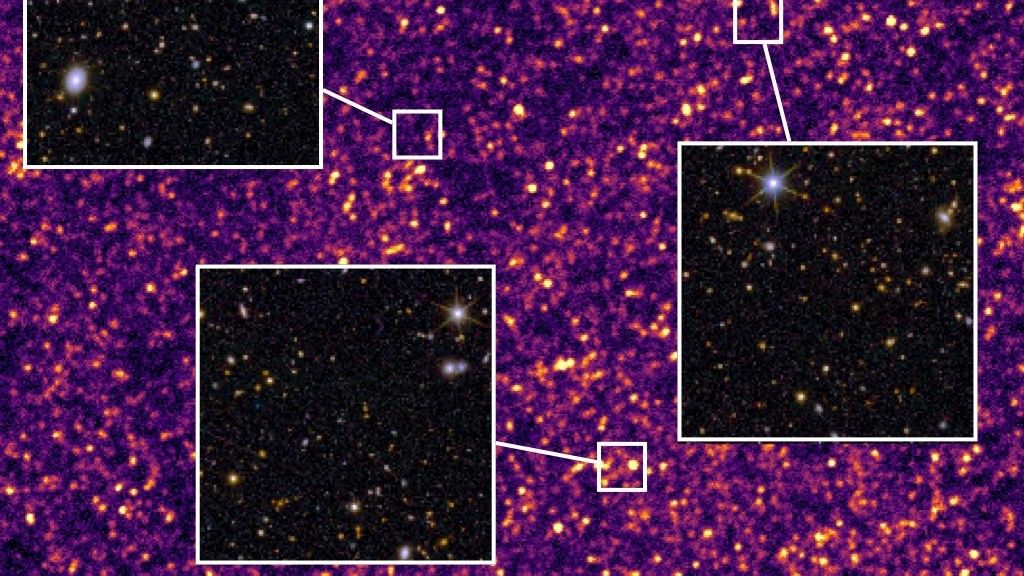
Using a vast catalog of observations from the European Space Agency’s (ESA) Euclid and Herschel space telescopes, a team of 175 researchers has taken the most comprehensive reading of the universe’s temperature ever recorded. By studying the heat emitted by stardust in more than 2 million galaxies, the team found that galaxies have grown slightly cooler and seen star formation rates slow down over the past 10 billion years of cosmic history.

According to the researchers, these small-but-clear downward trends hint that the universe’s peak days of growth are over. While the expiration date for the cosmos is still a mind-bogglingly long time away (somewhere between 33 billion and 1 quinvigintillion years — that’s 1 followed by 78 zeros — by recent estimates), the new findings suggest that, in terms of star formation rates, it’s all downhill from here.


You may like

“The Universe will just get colder and deader from now on,” study co-author Douglas Scott, a cosmologist at the University of British Columbia (UBC), said in a statement. “The amount of dust in galaxies and their dust temperatures have been decreasing for billions of years, which means we’re past the epoch of maximum star formation.”

The research has been submitted to the journal Astronomy and Astrophysics, and it’s available now as a non-peer-reviewed preprint.

A 3D map of the universe

This graphic provides an overview of the mosaic and zoomed in images released by ESA’s Euclid mission on 15 October 2024. On the top left, an all-sky map is visible with the location of Euclid’s mosaic on the Southern Sky highlighted in yellow.

This graphic provides an overview of the mosaic and zoomed in images released by ESA’s Euclid mission on October 15, 2024. On the top left, an all-sky map is visible with the location of Euclid’s mosaic on the Southern Sky highlighted in yellow. (Image credit: ESA/Euclid/Euclid Consortium/NASA, CEA Paris-Saclay, image processing by J.-C. Cuillandre, E. Bertin, G. Anselmi; ESA/Gaia/DPAC; ESA/Planck Collaboration)

In March, ESA’s recently activated Euclid telescope shared its first major data release, including observations of 26 million galaxies stretching more than 10.5 billion light-years into the cosmic distance. This was just the first phase of the telescope’s mission to build the largest-ever 3D map of the universe, with the ultimate goal of charting about 1.5 billion galaxies covering one-third of the night sky.

For their new study, the researchers looked at 2.6 million galaxies cataloged in Euclid’s first data release and combined them with archival observations from ESA’s Herschel Space Observatory, which was active from 2009 to 2013). While Euclid’s pair of onboard instruments are tuned to record visible and near-infrared light, Herschel’s instruments detected far-infrared light. Therefore, combining these data sets allowed the team to study the heat emitted by stardust across a wide range of wavelengths, offering the most comprehensive measurements of galactic temperatures ever taken.

Get the world’s most fascinating discoveries delivered straight to your inbox.

“By combining the data and having such a huge sample of galaxies … we can produce the most statistically robust calculations to date,” lead study author Ryley Hill, a postdoctoral research fellow at UBC, said in the statement.

The team found that the average temperature of galaxies has cooled only slightly over the past 10 billion years, falling by just 10 kelvins. While stars like the sun blaze at more than a million kelvins, galaxies are mostly made of empty space, meaning their average temperatures are far lower. The average galactic temperature of the earliest galaxies observed in the new survey was about 35 K (minus 396 F, or minus 238 C), the researchers found.

It’s a small change, but the heat of stardust directly correlates to star formation, the team noted. Hotter galaxies tend to have higher rates of star formation because they contain a greater number of hot, massive stars. By the same token, galaxies with less star formation tend to be cooler, on average. The team’s research further confirms this correlation and proves that star formation is slowly waning across the cosmos.

Dust to dust

Stunning purple and orange clouds in a vast field of space

Euclid’s visible-light view of the star nursery Messier 78, located 1,300 light-years away within the constellation Orion. The stunning image shows young stars forming between tendrils of gas and dust. (Image credit: ESA/Euclid/Euclid Consortium/NASA, image processing by J.-C. Cuillandre (CEA Paris-Saclay), G. Anselmi)

It may be a chore to deal with on Earth, but dust is crucial to the life cycle of stars. Stars form when clouds of gas and dust become so dense that they collapse under their own gravity, heating up and spinning in the process. If one of these collapsed clumps becomes hot and dense enough, nuclear fusion triggers in its core, forming a star. Eventually, when the star exhausts its supply of nuclear fuel billions of years later, it will explode in a supernova, spewing yet more dust into its neighborhood and allowing the next generation of stars to grow.

Galaxies can run out of star-forming material in a number of ways; they can be cut off from their gas supply during galaxy mergers, or see their star-forming matter violently expelled into space by supermassive black hole outbursts, to name a few. Eventually, a galaxy without sufficient star-forming material becomes quenched — starved of fuel, and doomed to smolder out.

The new results hint that our universe is well on its way to being totally quenched — but, again, not for an unfathomably long time. Earth’s sun will exhaust its fuel and explode long before the Milky Way galaxy runs dry, and more massive objects like black holes will live on for many eons after that. In the meantime, the new research offers the most precise probe yet of some of the key conditions of galaxies throughout the universe — measurements that will be essential in Euclid’s quest to build the ultimate map of our cosmos.

Source link

Share. Facebook Twitter Pinterest LinkedIn Tumblr Email
Previous ArticleSyrian president al-Sharaa to visit White House after sanctions lift
Next Article Trump pardons Rudy Giuliani and others involved in bid to overturn 2020 election, pardon attorney says
Editor
  • Website

Related Posts

Lifestyle

Diagnostic dilemma: Viral infection caused woman not to recognize her own father

June 17, 2026
Lifestyle

World’s first functioning nuclear clock could unlock new physics

June 17, 2026
Lifestyle

‘Is having two legs useful’ in space?: Astronaut John McFall explains what life in orbit might be like for the first physically disabled person in space

June 17, 2026
Add A Comment

Comments are closed.

Categories
  • Entertainment
  • Lifestyle
  • News
  • Sports
  • Tech
  • Travel
Recent Posts
  • Diagnostic dilemma: Viral infection caused woman not to recognize her own father
  • World’s first functioning nuclear clock could unlock new physics
  • ‘Is having two legs useful’ in space?: Astronaut John McFall explains what life in orbit might be like for the first physically disabled person in space
  • Wreck of World War II Japanese ‘hellship’ that sank with more than 1,000 Allied POWs on board discovered off the Philippines
  • Venus will disappear behind the moon in broad daylight Wednesday: How to watch the rare lunar occultation
calendar
June 2026
M T W T F S S
1234567
891011121314
15161718192021
22232425262728
2930  
« May    
Recent Posts
  • Diagnostic dilemma: Viral infection caused woman not to recognize her own father
  • World’s first functioning nuclear clock could unlock new physics
  • ‘Is having two legs useful’ in space?: Astronaut John McFall explains what life in orbit might be like for the first physically disabled person in space
About

Welcome to Baynard Media, your trusted source for a diverse range of news and insights. We are committed to delivering timely, reliable, and thought-provoking content that keeps you informed
and inspired

Categories
  • Entertainment
  • Lifestyle
  • News
  • Sports
  • Tech
  • Travel
Facebook X (Twitter) Pinterest WhatsApp
  • Contact Us
  • About Us
  • Privacy Policy
  • Disclaimer
  • UNSUBSCRIBE
© 2026 copyrights reserved

Type above and press Enter to search. Press Esc to cancel.