Close Menu
  • Home
  • UNSUBSCRIBE
  • News
  • Lifestyle
  • Tech
  • Entertainment
  • Sports
  • Travel
Facebook X (Twitter) WhatsApp
Trending
  • New robotic heart mimics common, mysterious condition to help researchers study it
  • Canon EOS R6 III review: A wildlife wonder
  • Medieval babies and adults buried together in Sweden were not related, archaeologists discover — raising big questions about early Christian burial practices
  • NASA is creating a fifth state of matter on the ISS, thanks to an upgrade to a mini-fridge-sized quantum lab
  • New sodium metal battery design charges in just 4 minutes and retains its capacity for years
  • Quantum computing wielded to create extremely rare material critical to nuclear fusion
  • Scientists build tiny ‘diving suit’ for cockroaches, turning them into search-and-rescue cyborgs
  • Physicists develop the first working model of quantum mechanics using only ‘real’ numbers
Facebook X (Twitter) WhatsApp
Baynard Media
  • Home
  • UNSUBSCRIBE
  • News
  • Lifestyle
  • Tech
  • Entertainment
  • Sports
  • Travel
Baynard Media
Home»Lifestyle»The powerful software can reduce the time needed to simulate reactions with large molecules from weeks to just minutes.
Lifestyle

The powerful software can reduce the time needed to simulate reactions with large molecules from weeks to just minutes.

EditorBy EditorFebruary 24, 2026No Comments4 Mins Read
Share Facebook Twitter Pinterest LinkedIn Tumblr Reddit Telegram Email
Share
Facebook Twitter LinkedIn Pinterest Email

A powerful quantum chemistry engine is now available that can help scientists tackle complex chemical problems. The new technology could drastically speed up research in drug discovery, materials science and other fields, the system’s developer, QDX, claims.

The Extreme-scale Electronic Structure System (EXESS) can perform more than 1 quintillion calculations per second to address questions in quantum chemistry, QDX representatives said in a statement.

Quantum chemistry calculations play a major role in the development of new medicines and materials. For example, researchers use quantum chemistry simulations to understand how drugs interact with molecular binding sites in the body. That understanding can help researchers modify the drug molecule to optimize the speed and efficiency of that binding.


You may like

But traditionally, the modeling of quantum chemistry “takes up an absolutely mammoth amount” of computing power, Loong Wang, CEO of QDX, told Live Science. “It’s actually, in many situations, genuinely faster to synthesize a compound and test it over the course of several weeks than to try and do a calculation on that compound.”

The amount of computing power needed scales exponentially with the number of atoms in the system. Accurately solving problems with large molecules such as proteins, which can contain thousands of atoms, quickly becomes untenable. The purpose of EXESS, Wang said, is to “make quantum chemistry actually fast enough to use in practice.”

EXESS operates 3,000 to 4,000 times faster than many other quantum chemistry software packages, QDX says, opening up calculations with large molecules like proteins. There’s no single innovation driving that huge increase, and it runs on conventional hardware — so no quantum computing is needed. Instead, Wang and his colleagues optimized many individual components of the software, which together increase the speed and scale of the computations.

“There are calculations that would, in principle, take about a month that actually take closer to 12 minutes”

Loong Wang, CEO of QDX

One way the team sped up calculations was by finding ways to run multiple operations at the same time. Many quantum chemistry algorithms are designed to operate in sequential steps. But even with extraordinary computing power, “nine chefs can’t cook a recipe in one-ninth of the time,” Wang said. The team found ways to alter the algorithms or theoretical approaches to enable more processes to be run in tandem, like “an industrial kitchen where you’re just cranking out recipes,” Wang added.

Get the world’s most fascinating discoveries delivered straight to your inbox.

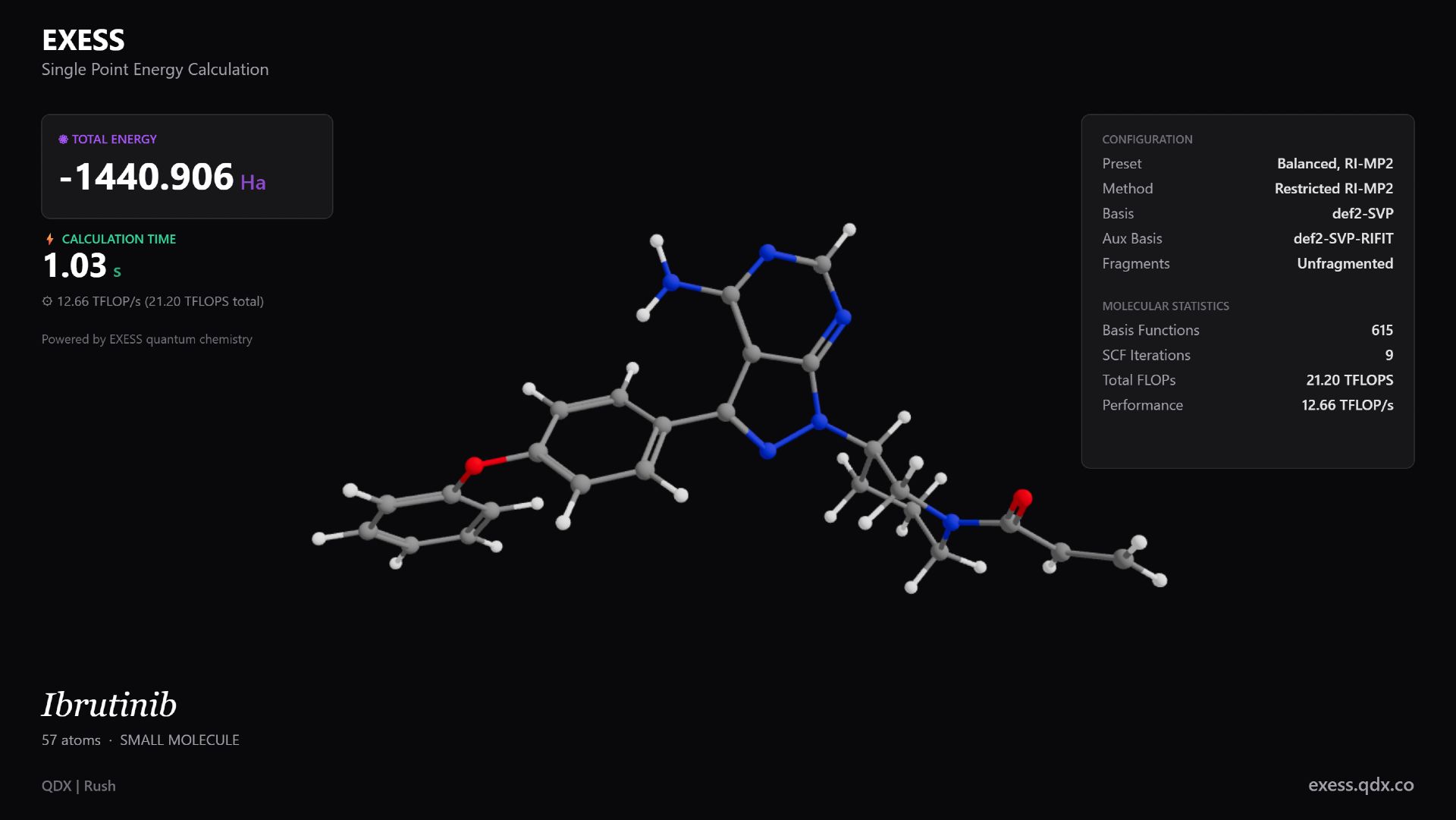
A scientific figure on a black background two charts of molecules' energy calculations.

Two graphs show a single energy point calculation from EXESS. (Image credit: QDX)

For example, the team implemented a technique known as molecular fragmentation, which breaks down a problem into smaller fragments, computes those fragments at the same time, and then stitches those pieces back together. That enabled them to speed up large calculations by running many smaller calculations at once.

“There are calculations that would, in principle, take about a month that actually take closer to 12 minutes” when run using EXESS, Wang told Live Science.

QDX is currently focused on using EXESS for drug discovery, finding and optimizing interactions between medicines and the body or better understanding how existing drugs function and why people develop resistances to them. But the company is offering free access for approved research projects. A limited version of the software is also available to the general public.

“I hope that people do stuff that we’re not presently doing, and I don’t mean that from a competitive standpoint,” Wang said. “We have a couple of problems that we’re choosing to focus on that we think are really interesting. But what we really want to see is people focus on the other 99% of problems that exist, and see what they do with it, and see whether in some of those areas, we might be surprised at how quantum chemistry can help make a difference.”

Source link

Share. Facebook Twitter Pinterest LinkedIn Tumblr Email
Previous ArticleBest gaming deal: save $60 on the 49-inch Westinghouse curved monitor
Next Article US Supreme Court Declines to Hear Huntington Beach Case
Editor
  • Website

Related Posts

Lifestyle

New robotic heart mimics common, mysterious condition to help researchers study it

July 11, 2026
Lifestyle

Canon EOS R6 III review: A wildlife wonder

July 10, 2026
Lifestyle

Medieval babies and adults buried together in Sweden were not related, archaeologists discover — raising big questions about early Christian burial practices

July 10, 2026
Add A Comment

Comments are closed.

Categories
  • Entertainment
  • Lifestyle
  • News
  • Sports
  • Tech
  • Travel
Recent Posts
  • New robotic heart mimics common, mysterious condition to help researchers study it
  • Canon EOS R6 III review: A wildlife wonder
  • Medieval babies and adults buried together in Sweden were not related, archaeologists discover — raising big questions about early Christian burial practices
  • NASA is creating a fifth state of matter on the ISS, thanks to an upgrade to a mini-fridge-sized quantum lab
  • New sodium metal battery design charges in just 4 minutes and retains its capacity for years
calendar
July 2026
M T W T F S S
 12345
6789101112
13141516171819
20212223242526
2728293031  
« Jun    
Recent Posts
  • New robotic heart mimics common, mysterious condition to help researchers study it
  • Canon EOS R6 III review: A wildlife wonder
  • Medieval babies and adults buried together in Sweden were not related, archaeologists discover — raising big questions about early Christian burial practices
About

Welcome to Baynard Media, your trusted source for a diverse range of news and insights. We are committed to delivering timely, reliable, and thought-provoking content that keeps you informed
and inspired

Categories
  • Entertainment
  • Lifestyle
  • News
  • Sports
  • Tech
  • Travel
Facebook X (Twitter) Pinterest WhatsApp
  • Contact Us
  • About Us
  • Privacy Policy
  • Disclaimer
  • UNSUBSCRIBE
© 2026 copyrights reserved

Type above and press Enter to search. Press Esc to cancel.