Close Menu
  • Home
  • UNSUBSCRIBE
  • News
  • Lifestyle
  • Tech
  • Entertainment
  • Sports
  • Travel
Facebook X (Twitter) WhatsApp
Trending
  • ‘We’re the best servants anyone could dream of!’: AI superintelligence has no need to enslave humans because we’re already bowing to it
  • Glowing ring of plankton surrounding New Zealand islands linked to deadly underwater plateau — Earth from space
  • Omar files new financial form in response to Trump, GOP critics
  • New study confirms lobsters feel pain, driving scientists to call for a ban on boiling them alive
  • Ex-CENTCOM commanderwarns against ‘risky’ US ground op to seize Iran uranium
  • Santa Ana’s Upcoming Report on Police Firing on ICE Protesters Lacks Details
  • Stephen Hawking’s black hole information paradox could be solved — if the universe has 7 dimensions
  • Nancy Sinatra calls Trump’s use of Frank Sinatra’s ‘My Way’ a ‘sacrilege’
Facebook X (Twitter) WhatsApp
Baynard Media
  • Home
  • UNSUBSCRIBE
  • News
  • Lifestyle
  • Tech
  • Entertainment
  • Sports
  • Travel
Baynard Media
Home»Lifestyle»‘The most shameful form of execution’: Han warriors found dismembered in 2,100-year-old mass grave in Mongolia
Lifestyle

‘The most shameful form of execution’: Han warriors found dismembered in 2,100-year-old mass grave in Mongolia

EditorBy EditorMarch 15, 2025No Comments4 Mins Read
Share Facebook Twitter Pinterest LinkedIn Tumblr Reddit Telegram Email
Share
Facebook Twitter LinkedIn Pinterest Email

An ancient mass grave excavated in southern Mongolia contains the bodies of dismembered Han warriors who fought the nomadic Xiongnu people in the second century B.C., a chemical analysis reveals.

The discovery adds new information about soldiers’ lives and their gruesome deaths to a significant period in Chinese history.

“Execution by dismemberment was the most shameful form of execution,” study co-author Alexey Kovalev, a researcher at the Institute of Archaeology of the Russian Academy of Sciences, told Live Science in an email. “It was done by enemies so that the souls of these people could never be reborn.”

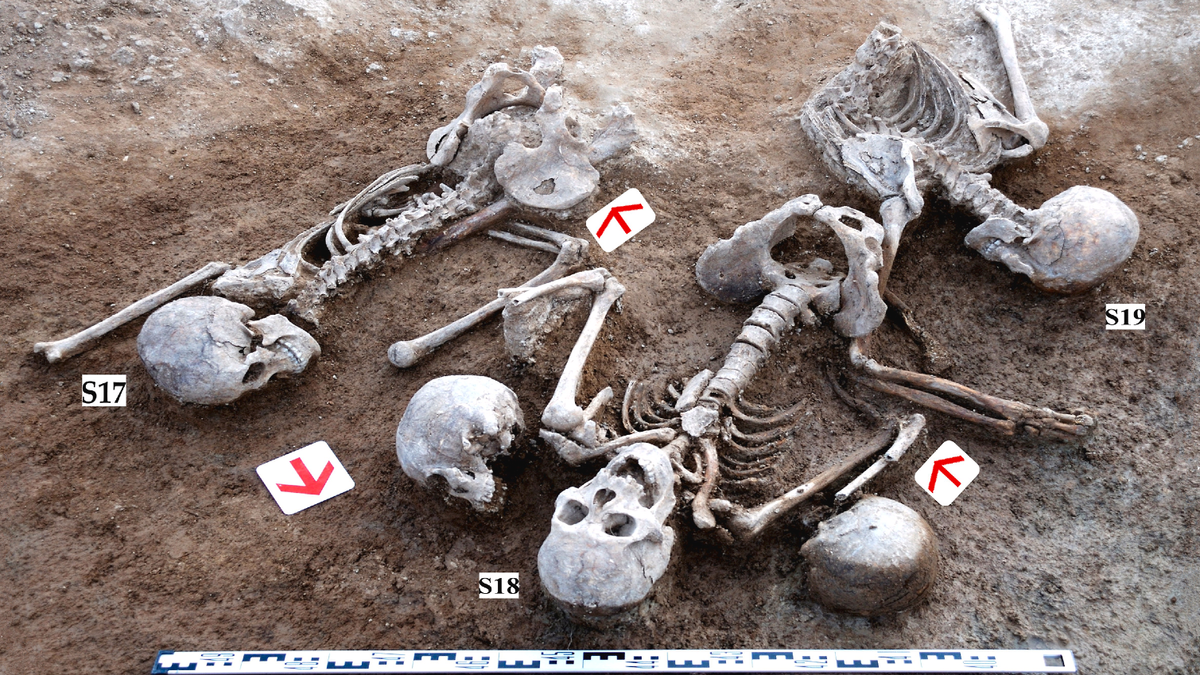
Kovalev and a team of researchers studied more than two dozen complete and partial skeletons recovered from a mass grave at the archaeological site of Bayanbulag, a fortress built by the Han Empire in 104 B.C. just north of the Great Wall of China to protect against the encroaching Xiongnu Empire.

In a study published online last month in the Journal of Archaeological Science, the researchers used genomic and isotope analyses to figure out who was buried in the grave and where they came from.

Most of the bodies were piled up in a layer in the middle of a pit, the researchers found, which was initially the result of clay mining before it was turned into a makeshift mass grave. They identified a total of 17 skulls, all of which were from adult men. Most of the skeletons also showed signs of dismemberment, decapitation or amputation by sword, and at least two men were buried in a kneeling position.

Related: Ancient DNA reveals mysterious origins of the Huns who sacked Rome

Get the world’s most fascinating discoveries delivered straight to your inbox.

Bird's-eye-view of the excavation of a mass grave in Mongolia; dozens of skeletons of Han warriors are in the grave, along with several artifacts. Measuring sticks are placed in the foreground to show scale.

Aerial view of the excavation at the Bayanbulag archaeological site in Mongolia. (Image credit: Ma et al. / Journal of Archaeological Science / CC BY-NC 4.0)

Ancient DNA analysis of 14 of the skeletons revealed that the people were more genetically similar to present-day Han and northern Chinese people rather than to the Xiongnu and other ancient Siberians. Similarly, strontium isotope analysis — which measures variations in the element to reveal where a person grew up — of the skeletons showed that the men came to Bayanbulug from elsewhere, presumably as soldiers who directly participated in a battle.

The Han-Xiongnu Wars were fought over the course of two centuries (133 B.C. to A.D. 89). Battles between the Chinese civilization and the nomadic Xiongnu erupted on the Mongolian Plateau, and the northern Chinese built fortifications against the Xiongnu incursion, some of which were eventually incorporated into the Great Wall. But this is the first study to examine a grave of Han soldiers killed by the enemy and buried by their comrades, the researchers wrote.

“It is significant that all the small pieces of severed arms and legs, severed heads and other pieces of human bodies were collected for burial,” Kovalev said. “According to the beliefs of the Chinese, it is necessary to bury the body of the deceased in full integrity. Those who buried these soldiers tried to make them feel good in the afterlife.”

But not everyone could be buried intact. One man was decapitated, but his head was never found; presumably, it was taken away by the Xiongnu as proof of victory over the Han. “Who exactly killed the Han soldiers buried in the mass grave, we can only guess based on the context,” Kovalev said.

Michael Rivera, a bioarchaeologist at the University of Hong Kong who was not involved in the study, told Live Science by email that the research impressively combines historical context with genetic, archaeological and isotopic analyses.

“The individuals in this burial were a diverse group of men from across Northeast Asia fighting in this conflict,” Rivera said, and “we can see which side of the battle these individuals represented.”

Further work needs to be done to fully understand the Bayanbulag mass grave, Kovalev said, particularly in the absence of information about funeral customs for ordinary people in this time period. “Now we are studying such a grave for the first time, and for the first time, we can reconstruct this ritual,” he said.

Source link

Share. Facebook Twitter Pinterest LinkedIn Tumblr Email
Previous ArticleAppeals court allows Trump to enforce ban on DEI programs for now
Next Article Johns Hopkins to let more than 2,000 staff go after Trump’s USAID cuts
Editor
  • Website

Related Posts

Lifestyle

‘We’re the best servants anyone could dream of!’: AI superintelligence has no need to enslave humans because we’re already bowing to it

April 21, 2026
Lifestyle

Glowing ring of plankton surrounding New Zealand islands linked to deadly underwater plateau — Earth from space

April 21, 2026
Lifestyle

New study confirms lobsters feel pain, driving scientists to call for a ban on boiling them alive

April 21, 2026
Add A Comment

Comments are closed.

Categories
  • Entertainment
  • Lifestyle
  • News
  • Sports
  • Tech
  • Travel
Recent Posts
  • ‘We’re the best servants anyone could dream of!’: AI superintelligence has no need to enslave humans because we’re already bowing to it
  • Glowing ring of plankton surrounding New Zealand islands linked to deadly underwater plateau — Earth from space
  • Omar files new financial form in response to Trump, GOP critics
  • New study confirms lobsters feel pain, driving scientists to call for a ban on boiling them alive
  • Ex-CENTCOM commanderwarns against ‘risky’ US ground op to seize Iran uranium
calendar
April 2026
M T W T F S S
 12345
6789101112
13141516171819
20212223242526
27282930  
« Mar    
Recent Posts
  • ‘We’re the best servants anyone could dream of!’: AI superintelligence has no need to enslave humans because we’re already bowing to it
  • Glowing ring of plankton surrounding New Zealand islands linked to deadly underwater plateau — Earth from space
  • Omar files new financial form in response to Trump, GOP critics
About

Welcome to Baynard Media, your trusted source for a diverse range of news and insights. We are committed to delivering timely, reliable, and thought-provoking content that keeps you informed
and inspired

Categories
  • Entertainment
  • Lifestyle
  • News
  • Sports
  • Tech
  • Travel
Facebook X (Twitter) Pinterest WhatsApp
  • Contact Us
  • About Us
  • Privacy Policy
  • Disclaimer
  • UNSUBSCRIBE
© 2026 copyrights reserved

Type above and press Enter to search. Press Esc to cancel.