Close Menu
  • Home
  • UNSUBSCRIBE
  • News
  • Lifestyle
  • Tech
  • Entertainment
  • Sports
  • Travel
Facebook X (Twitter) WhatsApp
Trending
  • New robotic heart mimics common, mysterious condition to help researchers study it
  • Canon EOS R6 III review: A wildlife wonder
  • Medieval babies and adults buried together in Sweden were not related, archaeologists discover — raising big questions about early Christian burial practices
  • NASA is creating a fifth state of matter on the ISS, thanks to an upgrade to a mini-fridge-sized quantum lab
  • New sodium metal battery design charges in just 4 minutes and retains its capacity for years
  • Quantum computing wielded to create extremely rare material critical to nuclear fusion
  • Scientists build tiny ‘diving suit’ for cockroaches, turning them into search-and-rescue cyborgs
  • Physicists develop the first working model of quantum mechanics using only ‘real’ numbers
Facebook X (Twitter) WhatsApp
Baynard Media
  • Home
  • UNSUBSCRIBE
  • News
  • Lifestyle
  • Tech
  • Entertainment
  • Sports
  • Travel
Baynard Media
Home»Lifestyle»‘The fate of Earth depends on a delicate balance’: Our planet may survive the death of the sun after all, new models hint
Lifestyle

‘The fate of Earth depends on a delicate balance’: Our planet may survive the death of the sun after all, new models hint

EditorBy EditorJune 28, 2026No Comments4 Mins Read
Share Facebook Twitter Pinterest LinkedIn Tumblr Reddit Telegram Email
Share
Facebook Twitter LinkedIn Pinterest Email

Earth may survive the fiery death of the sun, even as our star engulfs the innermost planets, a new study using state-of-the-art models suggests.

The findings offer a potential alternative fate for our planet, which was thought to face certain death as the sun engulfs it in a thermonuclear inferno billions of years from now. As a yellow dwarf star, the sun is expected to have a relatively calm, 10 billion-year life. But in about 5 billion years, it will run out of hydrogen to fuse in its core and begin fusing hydrogen in its shell, causing it to expand enormously into a red giant star and then an even larger “AGB star,” before it ultimately dies as a white dwarf.

Now, in a Letter to the Editor published June 19 in the journal Astronomy & Astrophysics, astronomers used stellar evolution models and observed a nearby dying star to reassess Earth’s ultimate, potentially fiery fate.

Solar tug of war

When the sun enters its later life stages, Earth will be at the mercy of two competing forces — a fate shared by countless worlds throughout the unimaginably immense span of cosmic time.

As the sun expands to potentially hundreds of times its current size, the increased tidal forces will pull Earth toward our rapidly ballooning, sputtering star. Yet the surging sun will also lose its puffed-up outer layers into space through stellar wind. As it sheds much of its mass and becomes lighter, its gravitational grip will weaken, allowing our planet to escape outward into the depths of the solar system, the models show.


You may like

“The fate of Earth depends on a delicate balance between these two effects,” Mats Esseldeurs, a doctoral candidate at KU Leuven’s Institute of Astronomy in Belgium and first author of the study, said in a statement. “If tidal interactions dominate, Earth is engulfed. If mass loss dominates, Earth escapes to a wider orbit.”

Previous research only muddies the issue. Studies have made different assumptions about solar mass loss, tidal forces and planetary interactions that may occur as the inner solar system evolves. As a result, it’s uncertain if Earth will survive both of the sun’s giant phases before our star shrivels into a tiny-but-dense stellar corpse called a white dwarf.

Get the world’s most fascinating discoveries delivered straight to your inbox.

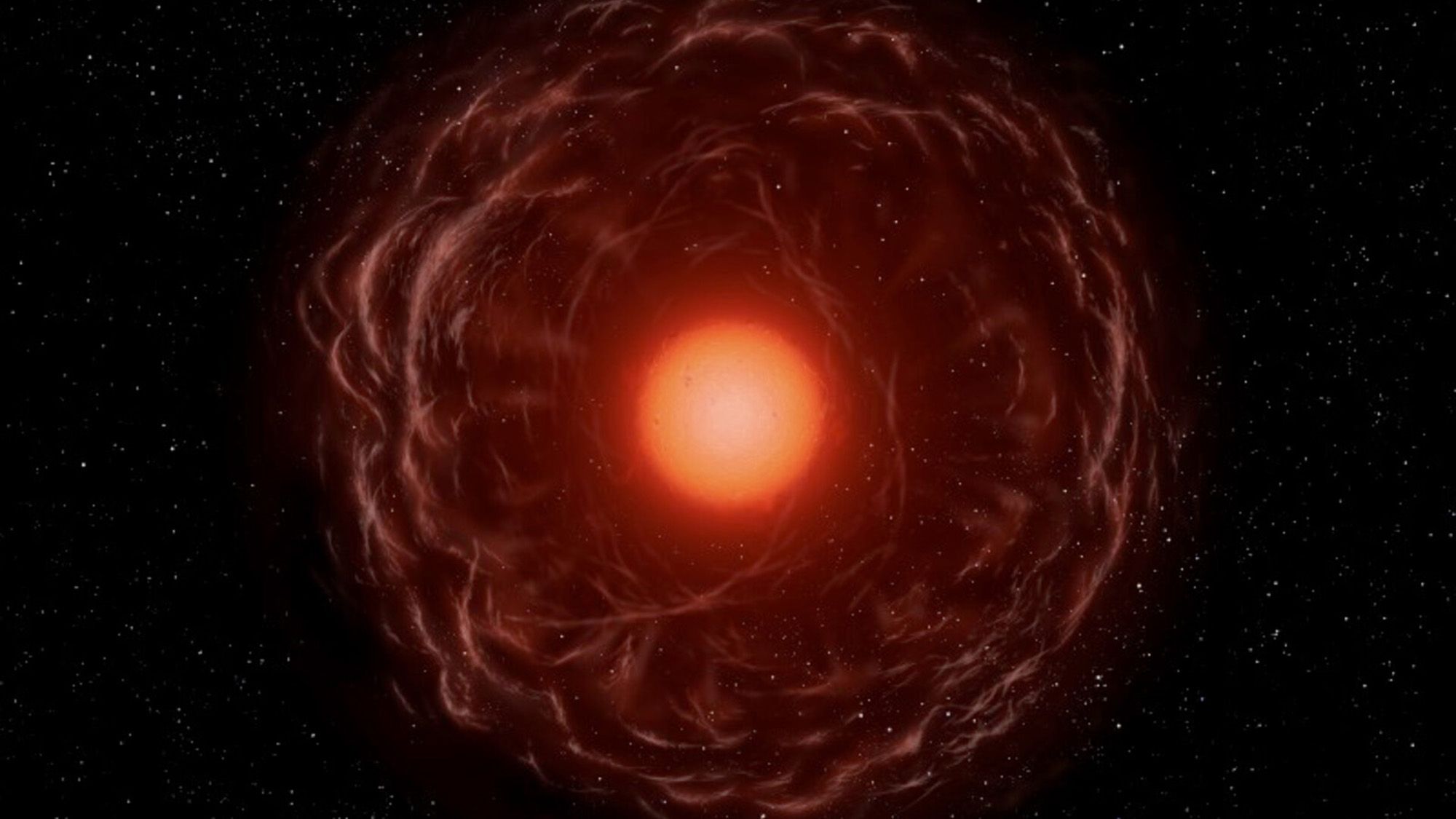
In a glimmer of hope, astronomers have discovered intact worlds around white dwarfs. On the other hand, some white dwarf systems are littered with the rocky remnants of their destroyed planetary children. So the researchers observed the formerly sunlike, dying giant star L2 Puppis, located 200 light-years away in the “poop deck” constellation Puppis, to glimpse our solar future. L2 Puppis may be losing up to one-millionth of a solar mass per year, according to previous estimates, expelling a dusty disk that’s thought to harbor a planet 12 to 16 times the mass of Jupiter.

L2 Puppis dying star

A view of L2 Puppis, a dying star.

(Image credit: ESO)

Additionally, the researchers performed state-of-the-art gravitational calculations “based on the internal structure and dynamics of evolved stars,” modeling the orbital evolution of the inner solar system and the sun’s lifespan from its infancy to its final phase as a “burned out” white dwarf.

So long, Mercury and Venus

Based on observations of L2 Puppis’ mass loss, combined with the updated stellar evolution models, the researchers projected that Earth will survive as it shifts to just outside the expanding sun’s radius.


What to read next

“The largest uncertainty no longer comes from the tidal calculations, but from how much mass the future sun will lose,” Esseldeurs said in the statement. “Observations of sun-like giant stars currently point towards Earth’s survival, but we need better observations before we can be certain.”

Four images showing different phases of the sun in the solar system

A schematic illustration showing the late stages of the sun, approximately 5 billion years from now, as it exhausts the hydrogen supply in its core and expands to potentially hundreds of times its current size. Simulations suggest Mercury and Venus will be engulfed, but Earth may escape to a safe orbit.

(Image credit: KU Leuven)

But even if Earth survives, our solar system siblings will not be spared; the simulations suggest Mercury and Venus will be engulfed by the hellish blaze of our dying star.

Additional stellar observations and improved models will help elucidate our planet’s fate. For example, the European Space Agency’s PLATO mission, a space telescope that aims to search for Earth-like planets around sunlike stars, will launch next year. It will likely detect planets around aging stars, thus providing a more accurate account of this potentially doomed population.


See how much you know about the sun with our sun quiz!

Source link

Share. Facebook Twitter Pinterest LinkedIn Tumblr Email
Previous ArticleBullseye! Enormous ‘bow and arrow’ galaxy is unlike anything radio astronomers have ever seen — Space photo of the week
Next Article Our brains aren’t wired to handle this much bad news. But ‘looking away is not the fix,’ expert says.
Editor
  • Website

Related Posts

Lifestyle

New robotic heart mimics common, mysterious condition to help researchers study it

July 11, 2026
Lifestyle

Canon EOS R6 III review: A wildlife wonder

July 10, 2026
Lifestyle

Medieval babies and adults buried together in Sweden were not related, archaeologists discover — raising big questions about early Christian burial practices

July 10, 2026
Add A Comment

Comments are closed.

Categories
  • Entertainment
  • Lifestyle
  • News
  • Sports
  • Tech
  • Travel
Recent Posts
  • New robotic heart mimics common, mysterious condition to help researchers study it
  • Canon EOS R6 III review: A wildlife wonder
  • Medieval babies and adults buried together in Sweden were not related, archaeologists discover — raising big questions about early Christian burial practices
  • NASA is creating a fifth state of matter on the ISS, thanks to an upgrade to a mini-fridge-sized quantum lab
  • New sodium metal battery design charges in just 4 minutes and retains its capacity for years
calendar
July 2026
M T W T F S S
 12345
6789101112
13141516171819
20212223242526
2728293031  
« Jun    
Recent Posts
  • New robotic heart mimics common, mysterious condition to help researchers study it
  • Canon EOS R6 III review: A wildlife wonder
  • Medieval babies and adults buried together in Sweden were not related, archaeologists discover — raising big questions about early Christian burial practices
About

Welcome to Baynard Media, your trusted source for a diverse range of news and insights. We are committed to delivering timely, reliable, and thought-provoking content that keeps you informed
and inspired

Categories
  • Entertainment
  • Lifestyle
  • News
  • Sports
  • Tech
  • Travel
Facebook X (Twitter) Pinterest WhatsApp
  • Contact Us
  • About Us
  • Privacy Policy
  • Disclaimer
  • UNSUBSCRIBE
© 2026 copyrights reserved

Type above and press Enter to search. Press Esc to cancel.