
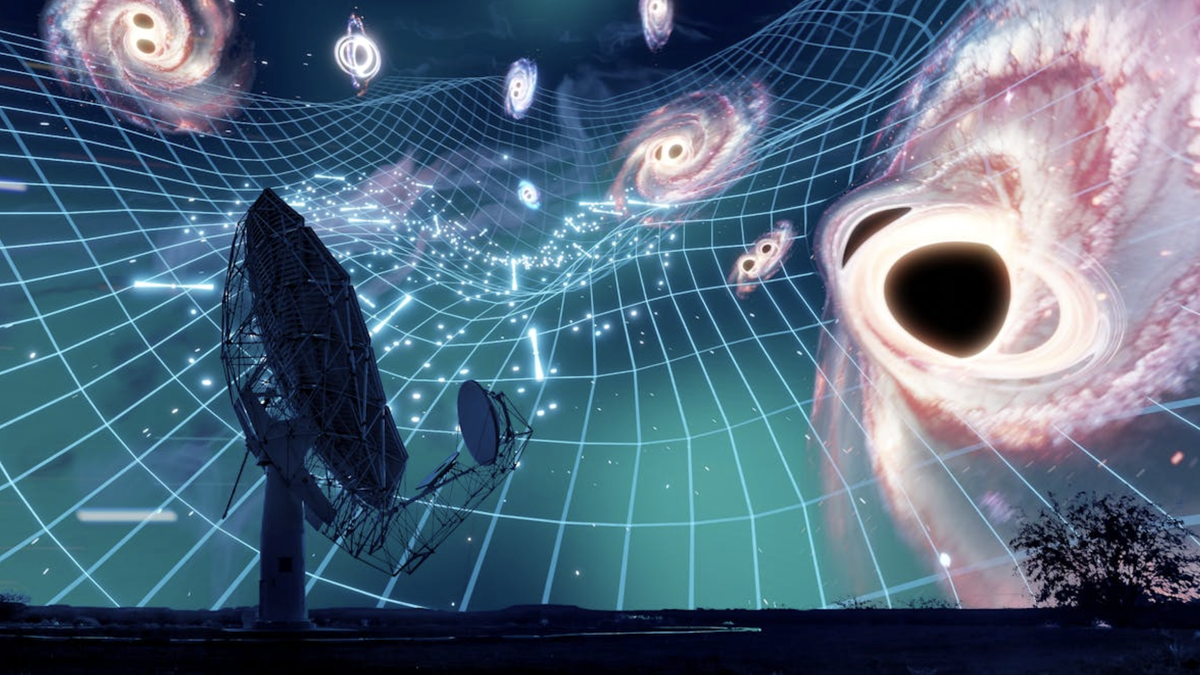
Using the largest gravitational wave detector ever made, we have confirmed earlier reports that the fabric of the universe is constantly vibrating. This background rumble is likely caused by collisions between the enormous black holes that reside in the hearts of galaxies.
The results from our detector — an array of rapidly spinning neutron stars spread across the galaxy — show this “gravitational wave background” may be louder than previously thought. We have also made the most detailed maps yet of gravitational waves across the sky, and found an intriguing “hot spot” of activity in the Southern Hemisphere.
Our research is published today in three papers in the Monthly Notices of the Royal Astronomical Society.
Ripples in space and time
Gravitational waves are ripples in the fabric of space and time. They are created when incredibly dense and massive objects orbit or collide with each other.
The densest and most massive objects in the universe are black holes, the remnants of dead stars. One of the only ways to study black holes is by searching for the gravitational waves they emit when they move near each other.
Related: The universe is rippling with a faint ‘gravitational wave background’ created by colliding black holes, huge international study suggests
Just like light, gravitational waves are emitted in a spectrum. The most massive black holes emit the slowest and most powerful waves — but to study them, we need a detector the size of our galaxy.
The high-frequency gravitational waves created by collisions between relatively small black holes can be picked up with Earth-based detectors, and they were first observed in 2015. However, evidence for the existence of the slower, more powerful waves wasn’t found until last year.
Several groups of astronomers around the world have assembled galactic-scale gravitational wave detectors by closely observing the behaviour of groups of particular kinds of stars. Our experiment, the MeerKAT Pulsar Timing Array, is the largest of these galactic-scale detectors.
Today we have announced further evidence for low-frequency gravitational waves, but with some intriguing differences from earlier results. In just a third of the time of other experiments, we’ve found a signal that hints at a more active universe than anticipated.
We have also been able to map the cosmic architecture left behind by merging galaxies more accurately than ever before.
Black holes, galaxies and pulsars
At the centre of most galaxies, scientists believe, lives a gargantuan object known as a supermassive black hole. Despite their enormous mass — billions of times the mass of our Sun — these cosmic giants are difficult to study.
Astronomers have known about supermassive black holes for decades, but only directly observed one for the first time in 2019.
When two galaxies merge, the black holes at their centers begin to spiral towards each other. In this process they send out slow, powerful gravitational waves that give us an opportunity to study them.
We do this using another group of exotic cosmic objects: pulsars. These are extremely dense stars made mainly of neutrons, which may be around the size of a city but twice as heavy as the Sun.
Pulsars spin hundreds of times a second. As they rotate, they act like lighthouses, hitting Earth with pulses of radiation from thousands of light years away. For some pulsars, we can predict when that pulse should hit us to within nanoseconds.
Our gravitational wave detectors make use of this fact. If we observe many pulsars over the same period of time, and we’re wrong about when the pulses hit us in a very specific way, we know a gravitational wave is stretching or squeezing the space between the Earth and the pulsars.
However, instead of seeing just one wave, we expect to see a cosmic ocean full of waves criss-crossing in all directions — the echoing ripples of all the galactic mergers in the history of the universe. We call this the gravitational wave background.
A surprisingly loud signal — and an intriguing ‘hot spot’
To detect the gravitational wave background, we used the MeerKAT radio telescope in South Africa. MeerKAT is one of the most sensitive radio telescopes in the world.
As part of the MeerKAT Pulsar Timing Array, it has been observing a group of 83 pulsars for about five years, precisely measuring when their pulses arrive at Earth. This led us to find a pattern associated with a gravitational wave background, only it’s a bit different from what other experiments have found.
The pattern, which represents how space and time between Earth and the pulsars is changed by gravitational waves passing between them, is more powerful than expected.
This might mean there are more supermassive black holes orbiting each other than we thought. If so, this raises more questions — because our existing theories suggest there should be fewer supermassive black holes than we seem to be seeing.
The size of our detector, and the sensitivity of the MeerKAT telescope, means we can assess the background with extreme precision. This allowed us to create the most detailed maps of the gravitational wave background to date. Mapping the background in this way is essential for understanding the cosmic architecture of our universe.
It may even lead us to the ultimate source of the gravitational wave signals we observe. While we think it’s likely the background emerges from the interactions of these colossal black holes, it could also stem from changes in the early, energetic universe following the Big Bang — or perhaps even more exotic events.

The maps we’ve created show an intriguing “hot spot” of gravitational wave activity in the Southern Hemisphere sky. This kind of irregularity supports the idea of a background created by supermassive black holes rather than other alternatives.
However, creating a galactic-sized detector is incredibly complex, and it’s too early to say if this is genuine or a statistical anomaly.
To confirm our findings, we are working to combine our new data with results from other international collaborations under the banner of the International Pulsar Timing Array.
This edited article is republished from The Conversation under a Creative Commons license. Read the original article.
