

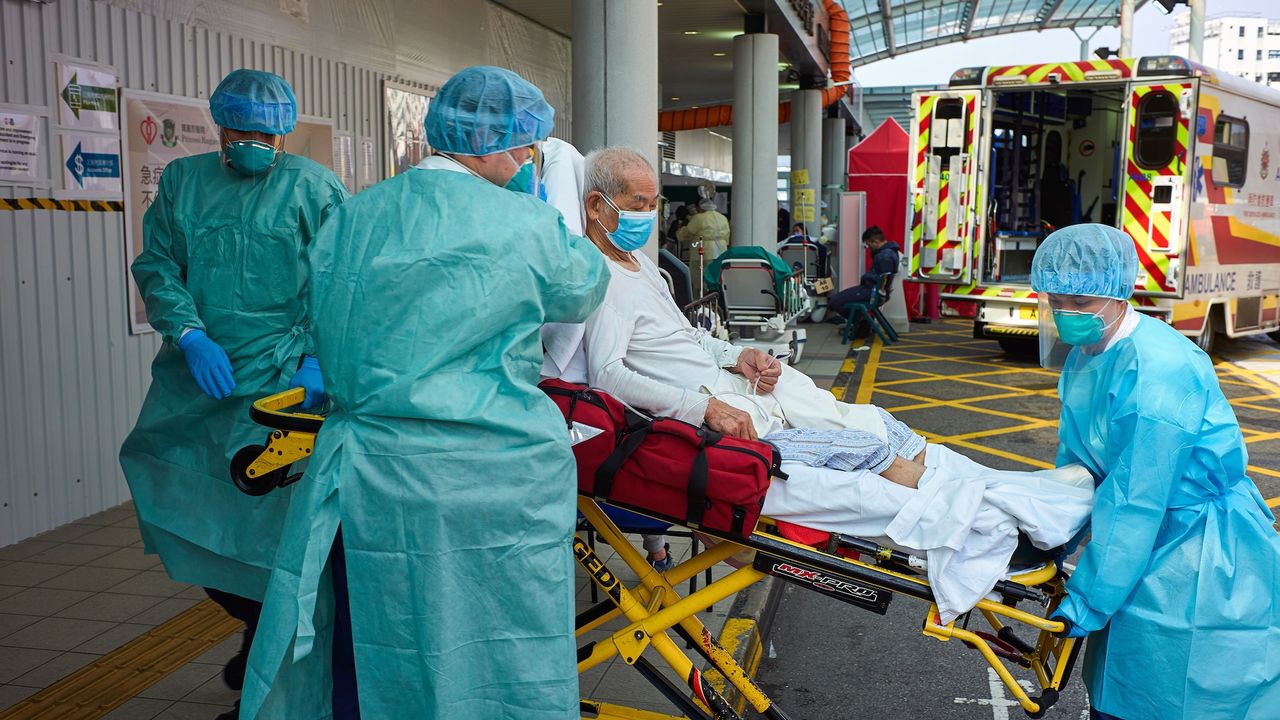
The COVID-19 pandemic altered life as we know it and claimed millions of lives in the process, and yet, the next pandemic might be even worse. A new book, called “The Big One: How We Must Prepare for Future Deadly Pandemics” (Little Brown Spark, 2025), describes a theoretical-but-plausible scenario in which a new and deadlier coronavirus emerges and quickly spreads around the world, despite public health officials’ best efforts to stop it.
In the text, Michael Osterholm, founding director of the Center for Infectious Disease Research and Policy (CIDRAP) at the University of Minnesota, and award-winning author Mark Olshaker discuss lessons we should take away from past pandemics in order to mitigate the harms that a “SARS-3” could wreck on the global population. The following is an excerpt from the book.
Even if you are lucky enough not to contract the airborne virus, someone you know and care about most likely will. But even beyond that, a pandemic would so severely affect the global supply chain that both ordinary and durable goods, food, medicine, and the staples of everyday life would be in short supply or not available. There would be major shortages in all countries of a wide range of commodities, not only food, but also soap, paper, light bulbs, and gasoline, as well as parts for cars, airplanes, trains, military equipment, municipal water pumps, and electrical generation plants. Even coffins to bury the dead would be in short supply. With Covid, we saw just how connected the world’s economies are.
The message here: When it comes to fighting microbes, America First only goes so far. In the United States, most of our critical and, in many cases, lifesaving generic drugs come from China and India, both of which would be prime targets for viral spread, resulting in shutdown of manufacturing plants. We have been advocating for years for this type of pharmaceutical manufacturing to be reestablished in the United States and other countries we can count on, as a matter of national security. But that would necessarily involve some form of government subsidy, since the profit margin on most generics is extremely thin, and even overseas, companies are getting out of the business. This means that as consolidation in China and India has occurred, it has created a gaping vulnerability for the United States and the Western world.
Unlike many fields these days, ethics remains a vital and integral component of medicine and public health, and thus there is compelling reason to regard the rest of the world with the same compassion and empathy we feel for our own people.
“The Big One,” 2025
The truism that no one is completely safe until everyone is safe is a truism because it happens to be true. In the words of the late Nobel laureate Dr. Joshua Lederberg, whom we quoted at the beginning of Chapter One, “Bacteria and viruses know nothing of national sovereignties. . . . No matter how selfish our motives, we can no longer be indifferent to the suffering of others. The microbe that felled one child in a distant continent yesterday can reach yours today and seed a global pandemic tomorrow.”
Or, as the poet John Donne wrote, “Never send to know for whom the bell tolls; it tolls for thee.”
Accordingly, in preparing for the Big One, we must not let the same thing happen that occurred with Covid, where high-income nations ended up with plenty of vaccine — often more than they could use — while low- and middle-income countries had very little, despite COVAX’s [a global initiative aimed at ensuring equitable access to COVID-19 vaccines] good intentions. Not only must we develop new and effective vaccines; we must also, by international agreement and cooperation, plan for a means to scale up manufacturing to meet global need, along with an efficient system to transport and distribute them, even if a cold chain requirement is involved. We will need an international approach to public funding that will pay for the excess production capacity required during a pandemic.
Unlike many fields these days, ethics remains a vital and integral component of medicine and public health, and thus there is compelling reason to regard the rest of the world with the same compassion and empathy we feel for our own people. But on a practical level, there is nothing particularly altruistic about sharing vaccine with low- and middle-income countries in sufficient quantities to protect their populations. It is simply self-interest. Now that the globe can be circumnavigated in less than 48 hours, distance provides no protection from infectious diseases. While someone in a remote village in the Western Pacific or sub-Saharan Africa is sick with a novel airborne respiratory virus, people on the other side of the world may be in imminent danger, a fundamental fact of nature in our modern world.
We realize how unlikely this level of global cooperation is in reality, given the state of international relations and each country’s natural tendency to keep critical drugs and vaccines for its own people. That probability, however, doesn’t make this any less important. Manufacturing countries must have the capability and capacity to turn out vaccine stocks for the rest of the world, and there should be international dialogue and planning for the mechanics of how vaccine stocks would be allocated.
Even in the United States, there will not be sufficient antivirals to meet the need for at least several months. Assuming effective antivirals even exist for whatever the pandemic virus turns out to be, we will have to figure out who gets priority among those who are seriously ill. Healthcare workers and first responders? Political and business leaders? The elderly and immunocompromised? Essential workers and drivers? Each cohort will have its advocates. It is far better to struggle with the ethical issues involved in determining such priorities now, in a public forum, rather than waiting until the crisis occurs.
Another issue is that while SARS-CoV-2 [the virus behind COVID-19] primarily affected the elderly and immunocompromised with severe disease, that wouldn’t necessarily be true of the next pandemic. Keep in mind that in the 1918 influenza [pandemic], more than half the people killed were 18 to 40 years old and largely healthy. These deaths were likely caused by a virus-induced response of the victim’s immune system — a cytokine storm, as we described in Chapter Four — that led to acute respiratory distress syndrome (ARDS). In other words, in the process of fighting the disease, these healthy individuals’ robust immune systems overreacted, severely damaging the lungs and resulting in death. Today, the medical establishment around the world is not much better prepared to treat tens of millions of cases of ARDS than it was more than a century ago.
And even though the SARS coronavirus, for example, infected only about 8,000 people in 2003 before it was brought to a halt, about 10% of them died, showing that our thought experiment for SARS-3 is not far-fetched.
