Close Menu
  • Home
  • UNSUBSCRIBE
  • News
  • Lifestyle
  • Tech
  • Entertainment
  • Sports
  • Travel
Facebook X (Twitter) WhatsApp
Trending
  • Tracking Air Wisconsin’s sale to CSI Aviation, an ICE contractor
  • Average Height by Country: Updated in 2024
  • Trump targets drug imports with tariffs up to 100%
  • Orange County Supervisors Confront Themselves
  • In photos: Artemis II’s historic launch for the moon
  • Florida AG warns social media firms face billions in fines over kids ban
  • Arizona girl who went missing 32 years ago found alive
  • Best Places To Live in South America: Top 10
Facebook X (Twitter) WhatsApp
Baynard Media
  • Home
  • UNSUBSCRIBE
  • News
  • Lifestyle
  • Tech
  • Entertainment
  • Sports
  • Travel
Baynard Media
Home»Lifestyle»Striking images capture an antibiotic slaying bacteria in real time
Lifestyle

Striking images capture an antibiotic slaying bacteria in real time

EditorBy EditorOctober 5, 2025No Comments3 Mins Read
Share Facebook Twitter Pinterest LinkedIn Tumblr Reddit Telegram Email
Share
Facebook Twitter LinkedIn Pinterest Email

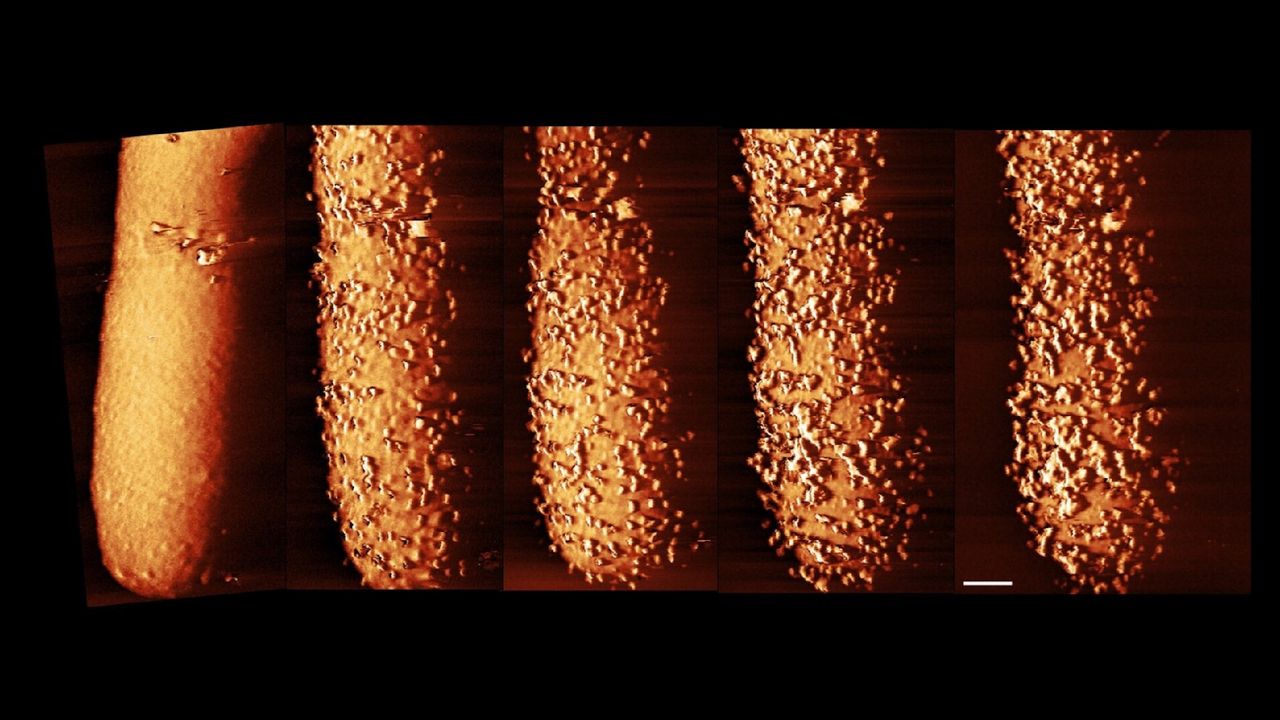
Scientists have released new images showing, in incredible detail, antibiotics defeating disease-causing bacteria by piercing the microbes’ membranes and infiltrating their innards.

The antibiotics, called polymyxins, were observed forcing the armored membranes around Escherichia coli bacterial cells to grow bumps and bulges. The bacteria then shed their outer membranes, leaving space for the antibiotic to enter the cells.

“It was incredible seeing the effect of the antibiotic at the bacterial surface in real-time,” study co-author Carolina Borrelli, a doctoral student studying biophysics and microbiology at University College London (UCL), said in a statement.


You may like

Gram-negative bacteria are a broad class of microorganisms that have two membranes surrounding each cell; the two membranes sandwich a cell wall. E. coli, Salmonella, and Shigella — a type of bacteria that causes dysentery — are all examples of gram-negative bacteria.

Polymyxins can help treat infections caused by gram-negative bacteria that have gained resistance to other antibiotic drugs; they work by targeting the outer of the bacteria’s two membranes, which act as a kind of armor that keeps antibiotics out. But exactly how the antibiotics slip past this armor isn’t well understood.

“Polymyxins are an important line of defense against Gram-negative bacteria, which cause many deadly drug-resistant infections,” study co-author Bart Hoogenboom, a biophysicist at UCL, said in the statement. “It is important we understand how they work.”

In the new study, published Sept. 29 in the journal Nature Microbiology, the team of researchers captured images of the antibiotic in action. Using a technique known as atomic force microscopy, the scientists passed a tiny needle back and forth over the bacteria to map out their shapes. This let them see how the bacteria changed as the polymyxin attacked.

Get the world’s most fascinating discoveries delivered straight to your inbox.

Polymyxins forced E. coli to quickly grow tiny bumps and protrusions on its outer membrane, the team found. As these bumps grew, the bacteria shed its armor, leaving gaps in that outer membrane through which antibiotics could enter and kill the cell.

“Our images of the bacteria directly show how much polymyxins can compromise the bacterial armor,” Borrelli said. “It is as if the cell is forced to produce ‘bricks’ for its outer wall at such a rate that this wall becomes disrupted, allowing the antibiotic to infiltrate.”

Importantly, the polymyxins can only target bacteria that are actively growing, not those that have gone into a dormant state. Bacteria sometimes enter a state of dormancy to deal with difficult conditions, surviving years without eating, growing or reproducing, only to wake back up when conditions are more favorable. While dormant, bacteria can’t grow their outer membrane armor, so the antibiotic couldn’t ramp up production the same way it could in actively growing bacteria.

“Our next challenge is to use these findings to make the antibiotics more effective,” Hoogenboom said. “One strategy might be to combine polymyxin treatment — counterintuitively — with treatments that promote armor production and/or wake up ‘sleeping’ bacteria so these cells can be eliminated too.”

This article is for informational purposes only and is not meant to offer medical advice.

Source link

Share. Facebook Twitter Pinterest LinkedIn Tumblr Email
Previous ArticleThune says some Democrats seek ‘off-ramp’ as government shutdown reaches day 5
Next Article Mark Sanchez arrested after stabbed during altercation
Editor
  • Website

Related Posts

Lifestyle

Average Height by Country: Updated in 2024

April 3, 2026
Lifestyle

In photos: Artemis II’s historic launch for the moon

April 3, 2026
Lifestyle

Best Places To Live in South America: Top 10

April 2, 2026
Add A Comment

Comments are closed.

Categories
  • Entertainment
  • Lifestyle
  • News
  • Sports
  • Tech
  • Travel
Recent Posts
  • Tracking Air Wisconsin’s sale to CSI Aviation, an ICE contractor
  • Average Height by Country: Updated in 2024
  • Trump targets drug imports with tariffs up to 100%
  • Orange County Supervisors Confront Themselves
  • In photos: Artemis II’s historic launch for the moon
calendar
April 2026
M T W T F S S
 12345
6789101112
13141516171819
20212223242526
27282930  
« Mar    
Recent Posts
  • Tracking Air Wisconsin’s sale to CSI Aviation, an ICE contractor
  • Average Height by Country: Updated in 2024
  • Trump targets drug imports with tariffs up to 100%
About

Welcome to Baynard Media, your trusted source for a diverse range of news and insights. We are committed to delivering timely, reliable, and thought-provoking content that keeps you informed
and inspired

Categories
  • Entertainment
  • Lifestyle
  • News
  • Sports
  • Tech
  • Travel
Facebook X (Twitter) Pinterest WhatsApp
  • Contact Us
  • About Us
  • Privacy Policy
  • Disclaimer
  • UNSUBSCRIBE
© 2026 copyrights reserved

Type above and press Enter to search. Press Esc to cancel.