Close Menu
  • Home
  • UNSUBSCRIBE
  • News
  • Lifestyle
  • Tech
  • Entertainment
  • Sports
  • Travel
Facebook X (Twitter) WhatsApp
Trending
  • OpenAI’s internal AI model just solved an 80-year-old math problem ‪—‬ and mathematicians verified it
  • Skeletal remains of Queen Elisenda, one of the most powerful rulers in medieval Europe, unearthed in Barcelona — along with several others who bore unexplained stab wounds
  • Tests that measure ‘biological age’ aren’t helpful for tracking your health, scientists say
  • Japan hits 6G key milestone with high-frequency speeds topping 100 Gbps
  • War has brought Iran’s water crisis to a breaking point: ‘Things will collapse unless there is meaningful structural change’
  • Fingal’s Cave: Scotland’s ‘cave of melody’ where eerie echoes bounce off pillars of solidified lava
  • Controversial ‘JuMBO’ planets discovered by James Webb telescope may not be an illusion after all
  • Scientists found the optimal robot body, and it has 20 legs ‪—‬ watch it scale walls and move through trees
Facebook X (Twitter) WhatsApp
Baynard Media
  • Home
  • UNSUBSCRIBE
  • News
  • Lifestyle
  • Tech
  • Entertainment
  • Sports
  • Travel
Baynard Media
Home»Lifestyle»SPHEREx first images: New NASA telescope ‘opens its eyes on the universe,’ revealing stunning debut image of the cosmos
Lifestyle

SPHEREx first images: New NASA telescope ‘opens its eyes on the universe,’ revealing stunning debut image of the cosmos

EditorBy EditorApril 2, 2025No Comments3 Mins Read
Share Facebook Twitter Pinterest LinkedIn Tumblr Reddit Telegram Email
Share
Facebook Twitter LinkedIn Pinterest Email

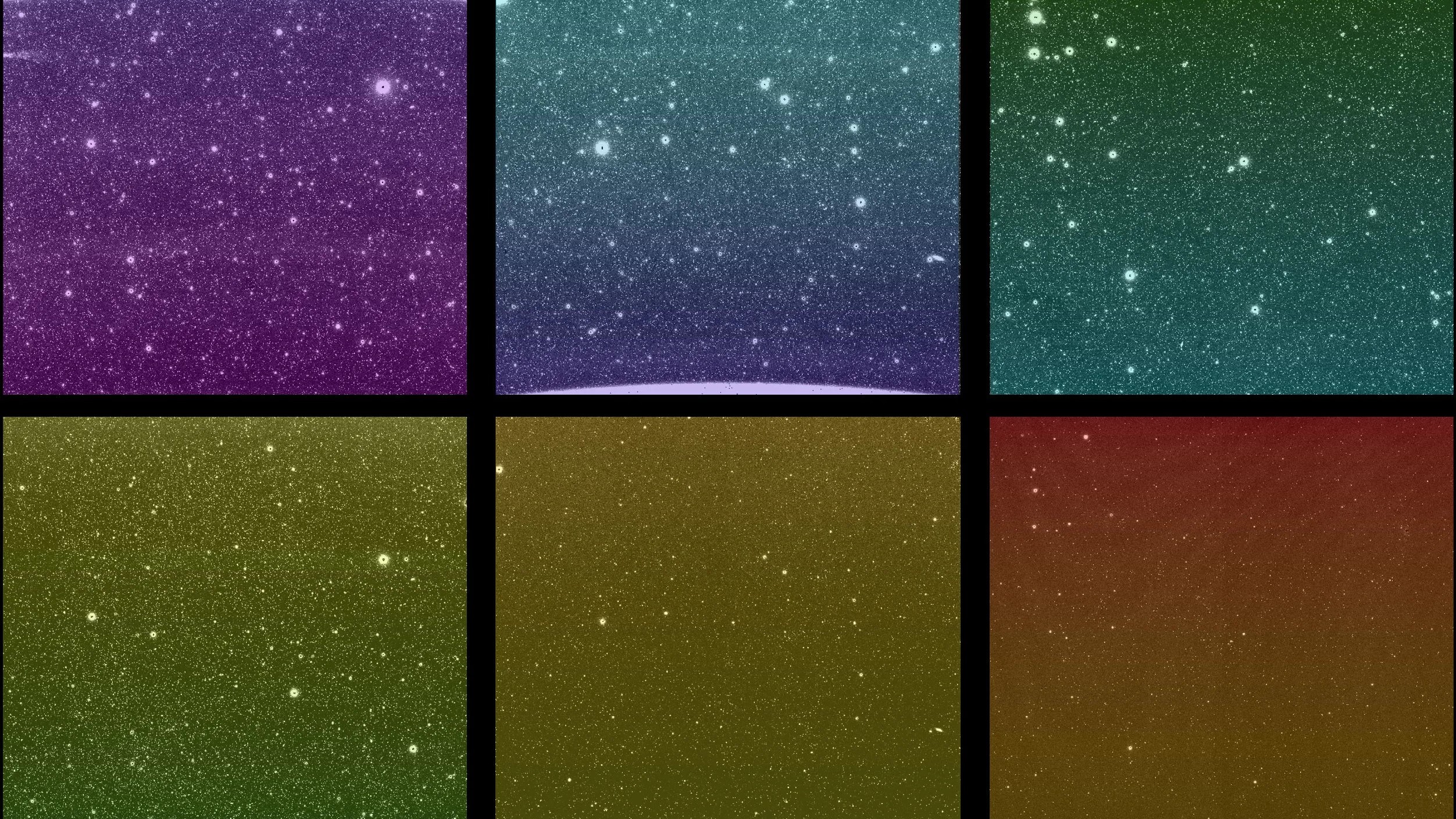
A new NASA space telescope has turned on its detectors for the first time, capturing its first light in images that contain tens of thousands of galaxies and stars.

The Spectro-Photometer for the History of the Universe, Epoch of Reionization, and Ices Explorer (SPHEREx) arrived in orbit atop a SpaceX Falcon 9 rocket on March 11.

The six released images, collected by the space telescope on March 27, were each snapped by three different detectors. The top three images span the telescope’s complete field of view, and are captured again in the bottom three which are colored differently to represent varying ranges of infrared wavelengths.

Within each image’s full field of view — an area roughly 20 times wider than the full moon — roughly 100,000 light sources from stars, galaxies, and nebulas can be glimpsed.

“Our spacecraft has opened its eyes on the universe,” Olivier Doré, a SPHEREx project scientist at Caltech and NASA’s Jet Propulsion Laboratory, said in a statement. “It’s performing just as it was designed to.”

Related: Euclid space telescope: ESA’s groundbreaking mission to study dark matter and dark energy

Costing a total of $488 million to build and launch, the new telescope has been in development for roughly a decade, and is set to map the universe by observing both optical and infrared light. It will orbit Earth 14.5 times a day, completing 11,000 orbits during its lifetime to filter infrared light from distant gas and dust clouds using a technique called spectroscopy.

Get the world’s most fascinating discoveries delivered straight to your inbox.

Once it is fully online in April, SPHEREX will scan the entire night sky a total of four times using 102 separate infrared color sensors, enabling it to collect data from more than 450 million galaxies during its planned two-year operation. This amounts to roughly 600 exposures a day, according to NASA.

This dataset will give scientists key insights into some of the biggest questions in cosmology, enabling astronomers to study galaxies at various stages in their evolution; trace the ice floating in empty space to see how life may have begun; and even understand the period of rapid inflation the universe underwent immediately after the Big Bang.

SPHEREx’s wide panorama view makes it the perfect complement for the James Webb Space Telescope, flagging regions of interest for the latter to study with greater depth and resolution.

After lofting it to space, NASA scientists and engineers have performed a nail-biting series of checks on the new telescope. This includes ensuring that its sensitive infrared equipment is cooling down to its final temperature of around minus 350 degrees Fahrenheit (minus 210 degrees Celsius) and that the telescope is set to the right focus — something that cannot be adjusted in space.

Based on these stunning preliminary images, it appears that everything has worked out.

“This is the high point of spacecraft checkout; it’s the thing we wait for,” Beth Fabinsky, SPHEREx deputy project manager at JPL, said in the statement. “There’s still work to do, but this is the big payoff. And wow! Just wow!”

Source link

Share. Facebook Twitter Pinterest LinkedIn Tumblr Email
Previous ArticleHistoric 1-in-1,000-year flood expected to strike central US this week, forecasters warn
Next Article Your brain starts eating itself during a marathon, study finds
Editor
  • Website

Related Posts

Lifestyle

OpenAI’s internal AI model just solved an 80-year-old math problem ‪—‬ and mathematicians verified it

May 30, 2026
Lifestyle

Skeletal remains of Queen Elisenda, one of the most powerful rulers in medieval Europe, unearthed in Barcelona — along with several others who bore unexplained stab wounds

May 29, 2026
Lifestyle

Tests that measure ‘biological age’ aren’t helpful for tracking your health, scientists say

May 29, 2026
Add A Comment

Comments are closed.

Categories
  • Entertainment
  • Lifestyle
  • News
  • Sports
  • Tech
  • Travel
Recent Posts
  • OpenAI’s internal AI model just solved an 80-year-old math problem ‪—‬ and mathematicians verified it
  • Skeletal remains of Queen Elisenda, one of the most powerful rulers in medieval Europe, unearthed in Barcelona — along with several others who bore unexplained stab wounds
  • Tests that measure ‘biological age’ aren’t helpful for tracking your health, scientists say
  • Japan hits 6G key milestone with high-frequency speeds topping 100 Gbps
  • War has brought Iran’s water crisis to a breaking point: ‘Things will collapse unless there is meaningful structural change’
calendar
May 2026
M T W T F S S
 123
45678910
11121314151617
18192021222324
25262728293031
« Apr    
Recent Posts
  • OpenAI’s internal AI model just solved an 80-year-old math problem ‪—‬ and mathematicians verified it
  • Skeletal remains of Queen Elisenda, one of the most powerful rulers in medieval Europe, unearthed in Barcelona — along with several others who bore unexplained stab wounds
  • Tests that measure ‘biological age’ aren’t helpful for tracking your health, scientists say
About

Welcome to Baynard Media, your trusted source for a diverse range of news and insights. We are committed to delivering timely, reliable, and thought-provoking content that keeps you informed
and inspired

Categories
  • Entertainment
  • Lifestyle
  • News
  • Sports
  • Tech
  • Travel
Facebook X (Twitter) Pinterest WhatsApp
  • Contact Us
  • About Us
  • Privacy Policy
  • Disclaimer
  • UNSUBSCRIBE
© 2026 copyrights reserved

Type above and press Enter to search. Press Esc to cancel.