Close Menu
  • Home
  • UNSUBSCRIBE
  • News
  • Lifestyle
  • Tech
  • Entertainment
  • Sports
  • Travel
Facebook X (Twitter) WhatsApp
Trending
  • Science news this week: Ötzi the Iceman used to make sourdough, Italian teenagers discover Roman villa under school, Google plans to release 64 million mosquitos, and RIP to NASA’s Maven probe
  • Coming El Niño will be the strongest ever recorded, new forecast predicts
  • World’s largest scorpion had 6-inch pincers, and prowled UK land and waters 415 million years ago
  • Arthritis drug shows antiviral effects against RSV, the leading cause of infant hospitalization
  • Daddy longlegs may be capturing and devouring frogs in the tropical forests of South America
  • Google wants to release 64 million bacteria-riddled mosquitoes across California and Florida. Here’s why scientists are enthusiastic.
  • ‘In an unrecoverable state’: NASA confirms MAVEN spacecraft is officially dead after loss of signal behind Mars
  • 2 rivers merged to form the Euphrates 3.6 million years ago, eventually leading to the Fertile Crescent
Facebook X (Twitter) WhatsApp
Baynard Media
  • Home
  • UNSUBSCRIBE
  • News
  • Lifestyle
  • Tech
  • Entertainment
  • Sports
  • Travel
Baynard Media
Home»Lifestyle»Space photo of the week: Violent galaxies seen ‘jousting’ near the dawn of time
Lifestyle

Space photo of the week: Violent galaxies seen ‘jousting’ near the dawn of time

EditorBy EditorMay 25, 2025No Comments3 Mins Read
Share Facebook Twitter Pinterest LinkedIn Tumblr Reddit Telegram Email
Share
Facebook Twitter LinkedIn Pinterest Email

Quick facts

What it is: Two galaxies colliding in the early universe

Where it is: 11 billion light-years away, in the constellation Cetus

When it was shared: May 21, 2025

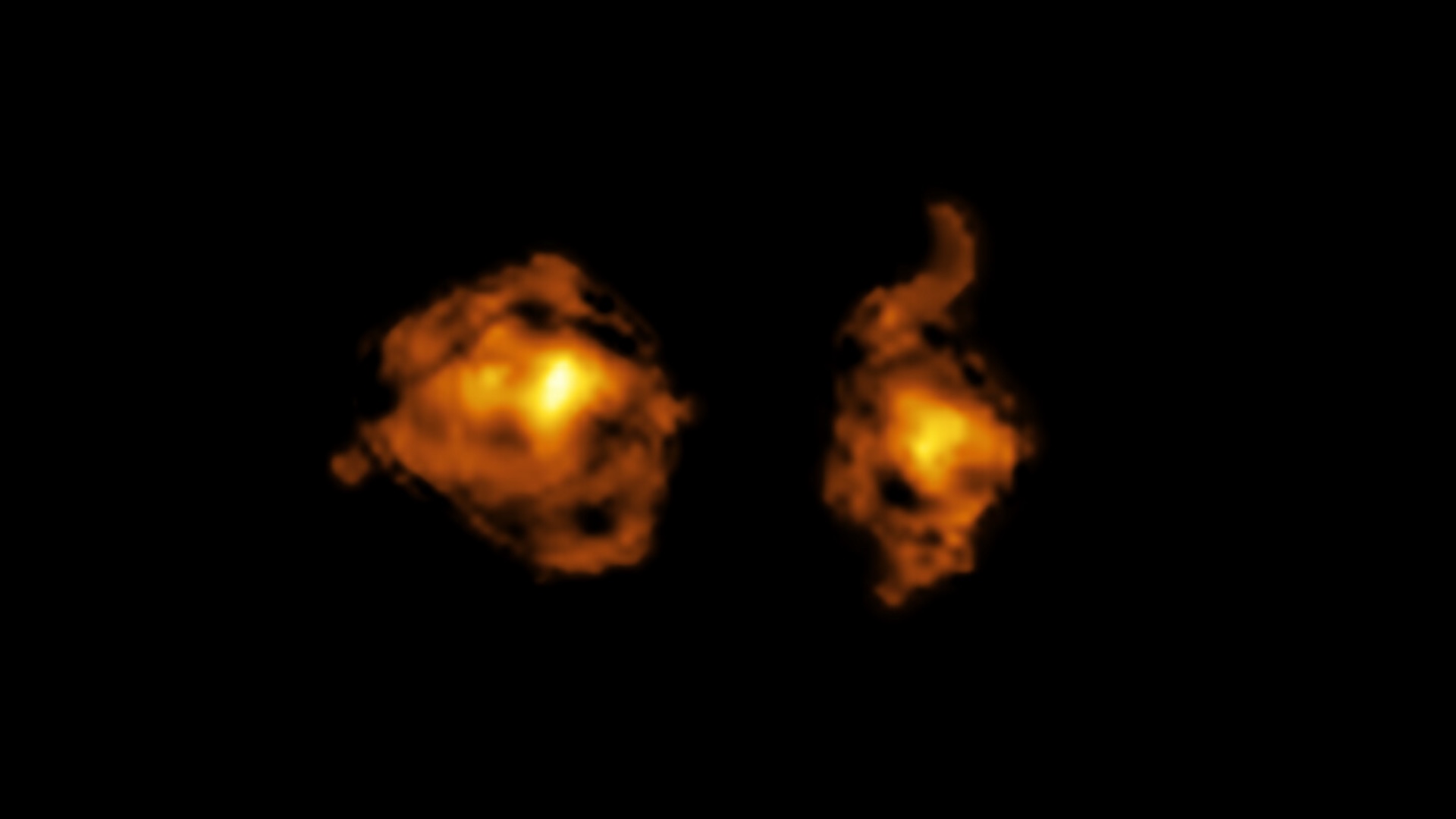
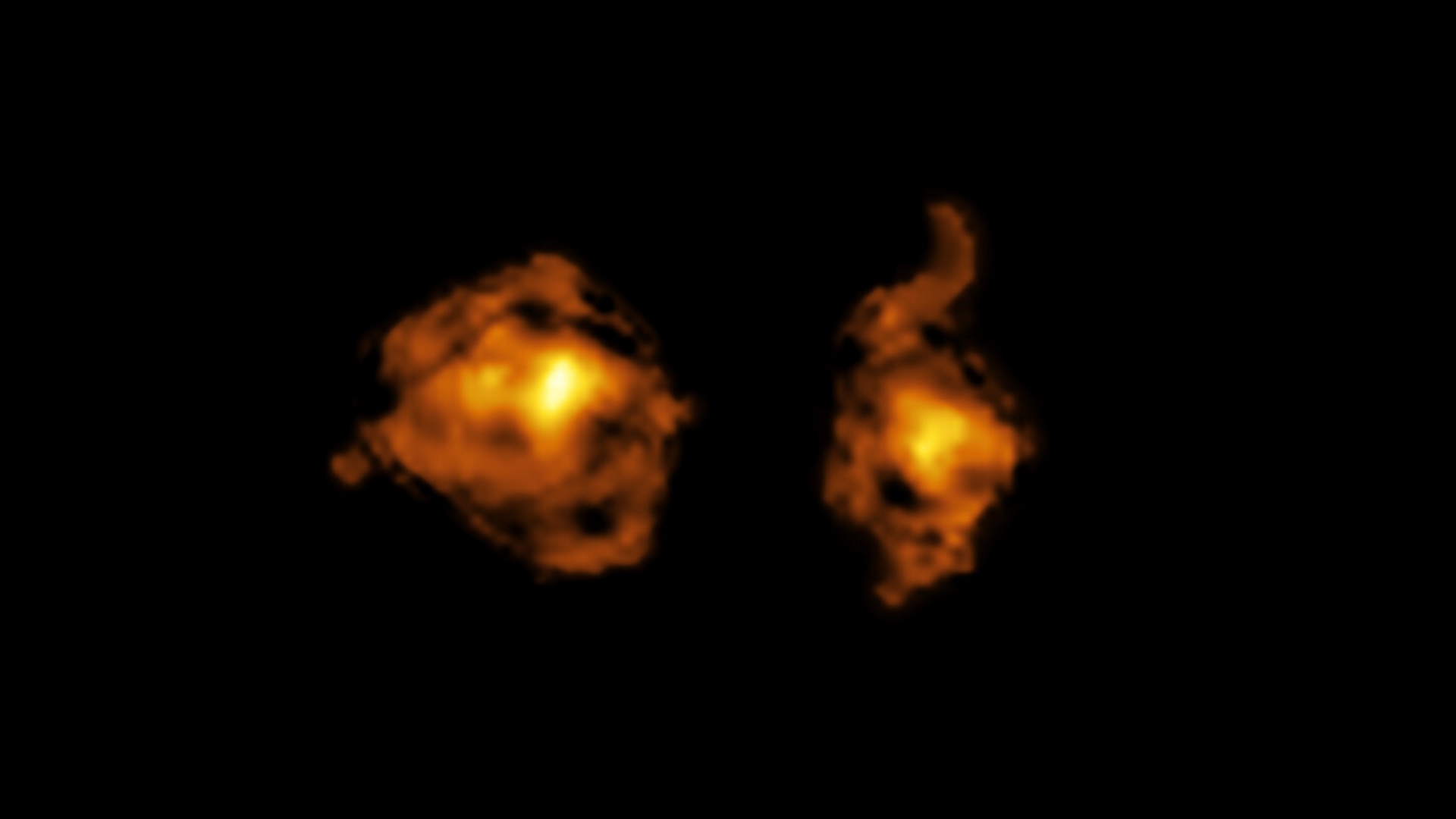
If you get up before sunrise any day this month, you’ll see bright Venus rising in the east. Just below it, in the constellation Cetus (The Whale), something spectacularly violent is happening in the distant background: a “cosmic joust” between two giant galaxies.

There, 11 billion light-years from Earth and close to the beginning of the universe itself, two galaxies are moving toward each other at speeds of 310 miles per second (500 kilometers per second), destined to collide before retreating and colliding again and again.

Captured by the European Southern Observatory’s Very Large Telescope and Atacama Large Millimeter/submillimeter Array in Chile and published this week in Nature, the image is unique because one of the galaxies is a quasar, in which a supermassive black hole consumes so much gas and dust that it produces a glowing disk at the center of a galaxy. According to the European Space Agency, quasars are among the most luminous objects in the known universe, typically emitting thousands of times more light than the entire Milky Way.


You may like

This quasar, J012555.11−012925.00, is shown on the right of the image. As the galaxy on the right collides with the galaxy on the left, it pierces its clouds of gas and dust with intense radiation — hence the comparison to the medieval sport of jousting — inhibiting the galaxy’s ability to form new stars. The collision between these two galaxies leaves the one on the left in a much worse state.

It’s the first time astronomers have witnessed such a collision.

“Here we see for the first time the effect of a quasar’s radiation directly on the internal structure of the gas in an otherwise regular galaxy,” Sergey Balashev, co-lead of the study and a researcher at the Ioffe Institute in St. Petersburg, Russia, said in a statement. The observations indicate that the spear of radiation from the quasar leaves intact only the densest regions of gas and dust, which are likely too small to form stars.

Related: Cotton candy clouds shine in one of Hubble’s most beautiful images ever

Get the world’s most fascinating discoveries delivered straight to your inbox.

Not surprisingly, the depletion of the companion galaxy leaves the quasar stronger, which provides new fuel to the supermassive black hole powering the quasar. “These mergers are thought to bring huge amounts of gas to supermassive black holes residing in galaxy centers,” Balashev said.

In addition to this spectacular image, the European Southern Observatory published videos on YouTube that explain the science, zoom in on the galactic collision, and give an artist’s impression of the violent event.

For more sublime space images, check out our Space Photo of the Week archives.

Source link

Share. Facebook Twitter Pinterest LinkedIn Tumblr Email
Previous ArticleThere’s 90,000 tons of nuclear waste in the US. How and where is it stored?
Next Article How long can human sperm survive?
Editor
  • Website

Related Posts

Lifestyle

Science news this week: Ötzi the Iceman used to make sourdough, Italian teenagers discover Roman villa under school, Google plans to release 64 million mosquitos, and RIP to NASA’s Maven probe

June 6, 2026
Lifestyle

Coming El Niño will be the strongest ever recorded, new forecast predicts

June 6, 2026
Lifestyle

World’s largest scorpion had 6-inch pincers, and prowled UK land and waters 415 million years ago

June 6, 2026
Add A Comment

Comments are closed.

Categories
  • Entertainment
  • Lifestyle
  • News
  • Sports
  • Tech
  • Travel
Recent Posts
  • Science news this week: Ötzi the Iceman used to make sourdough, Italian teenagers discover Roman villa under school, Google plans to release 64 million mosquitos, and RIP to NASA’s Maven probe
  • Coming El Niño will be the strongest ever recorded, new forecast predicts
  • World’s largest scorpion had 6-inch pincers, and prowled UK land and waters 415 million years ago
  • Arthritis drug shows antiviral effects against RSV, the leading cause of infant hospitalization
  • Daddy longlegs may be capturing and devouring frogs in the tropical forests of South America
calendar
June 2026
M T W T F S S
1234567
891011121314
15161718192021
22232425262728
2930  
« May    
Recent Posts
  • Science news this week: Ötzi the Iceman used to make sourdough, Italian teenagers discover Roman villa under school, Google plans to release 64 million mosquitos, and RIP to NASA’s Maven probe
  • Coming El Niño will be the strongest ever recorded, new forecast predicts
  • World’s largest scorpion had 6-inch pincers, and prowled UK land and waters 415 million years ago
About

Welcome to Baynard Media, your trusted source for a diverse range of news and insights. We are committed to delivering timely, reliable, and thought-provoking content that keeps you informed
and inspired

Categories
  • Entertainment
  • Lifestyle
  • News
  • Sports
  • Tech
  • Travel
Facebook X (Twitter) Pinterest WhatsApp
  • Contact Us
  • About Us
  • Privacy Policy
  • Disclaimer
  • UNSUBSCRIBE
© 2026 copyrights reserved

Type above and press Enter to search. Press Esc to cancel.