Close Menu
  • Home
  • UNSUBSCRIBE
  • News
  • Lifestyle
  • Tech
  • Entertainment
  • Sports
  • Travel
Facebook X (Twitter) WhatsApp
Trending
  • Hantavirus-carrying rodents are expected to expand their range, climate models find
  • Physicists find evidence that the universe isn’t perfectly uniform, potentially unraveling 100-year-old model of cosmology
  • Once-in-a-century ‘super’ El Niño in the cards as ocean temperatures reach near record highs in April
  • Goodbye PCOS: Polycystic ovary syndrome is getting a new name that doctors say better reflects the underlying disease
  • Microplastics absorb heat in the atmosphere and contribute to global warming — as if they weren’t bad enough
  • ‘Insect apocalypse’ is already fueling malnutrition in some regions, first-of-its-kind study reveals
  • Hantavirus LIVE: American passengers from cruise head to specialized facilities in Nebraska
  • New ‘trick’ fixes major flaw in neutral-atom quantum computers — inching us closer to a superpowerful system
Facebook X (Twitter) WhatsApp
Baynard Media
  • Home
  • UNSUBSCRIBE
  • News
  • Lifestyle
  • Tech
  • Entertainment
  • Sports
  • Travel
Baynard Media
Home»Lifestyle»Space photo of the week: The last view of the ‘Great Comet of 2025’ for half a million years
Lifestyle

Space photo of the week: The last view of the ‘Great Comet of 2025’ for half a million years

EditorBy EditorMarch 2, 2025No Comments4 Mins Read
Share Facebook Twitter Pinterest LinkedIn Tumblr Reddit Telegram Email
Share
Facebook Twitter LinkedIn Pinterest Email

What it is: Comet C/2024 G3 (ATLAS)

Where it is: In the night sky over Chile, somewhere in the inner solar system

When it was shared: Feb. 12, 2025

Why it’s so special: Nicknamed the “Great Comet of 2025,” Comet C/2024 G3 (ATLAS) is currently the brightest comet predicted to be visible from Earth all year. Discovered on April 5, 2024 by the Asteroid Terrestrial-impact Last Alert System (ATLAS), it is a nonperiodic comet that’s traveling on an orbit that won’t bring it back to the sun’s neighborhood for hundreds of thousands of years.

Comet C/2024 G3 reached perihelion — the closest point to the sun in its orbit — on Jan. 13, 2025. At this point, it was roughly 8 million miles (13 million kilometers) from the sun, well within Mercury’s orbit. That day, the comet’s brightness peaked at magnitude -3.8, as reported by the Comet Observation Database (COBS). (In astronomy, a lower magnitude means a brighter object. For comparison, Venus, which is currently visible at night in the ongoing “parade of planets” — has a magnitude of -4.8 right now, according to theskylive.com.) Observers in the Southern Hemisphere could see the Great Comet before and after perihelion, while for Northern Hemisphere viewers, it was visible in the daytime sky only around perihelion.

Related: Watch potential ‘city-killer’ asteroid 2024 YR4 as it hurtles through space

Following perihelion, the comet showed signs of disintegration but still put on a dazzling display of bright tails. As it heads toward the edge of the solar system, it will slowly start to fade. And if the comet’s remains survive, it’s expected to be visible from Earth again in about 600,000 years, according to long-term orbital calculations by the JPL Horizons On-Line Ephemeris System. Recently, according to COBS, the comet’s brightness has reduced to greater than magnitude 8, which is considered extremely faint.

Get the world’s most fascinating discoveries delivered straight to your inbox.

a photograph of a large comet at sunset with the silhouette of mountains visible

Another view of comet C/2024 G3 (ATLAS) taken over the mountains of Chile at dusk. (Image credit: CTIO/NOIRLab/NSF/AURA/C. Briceño)

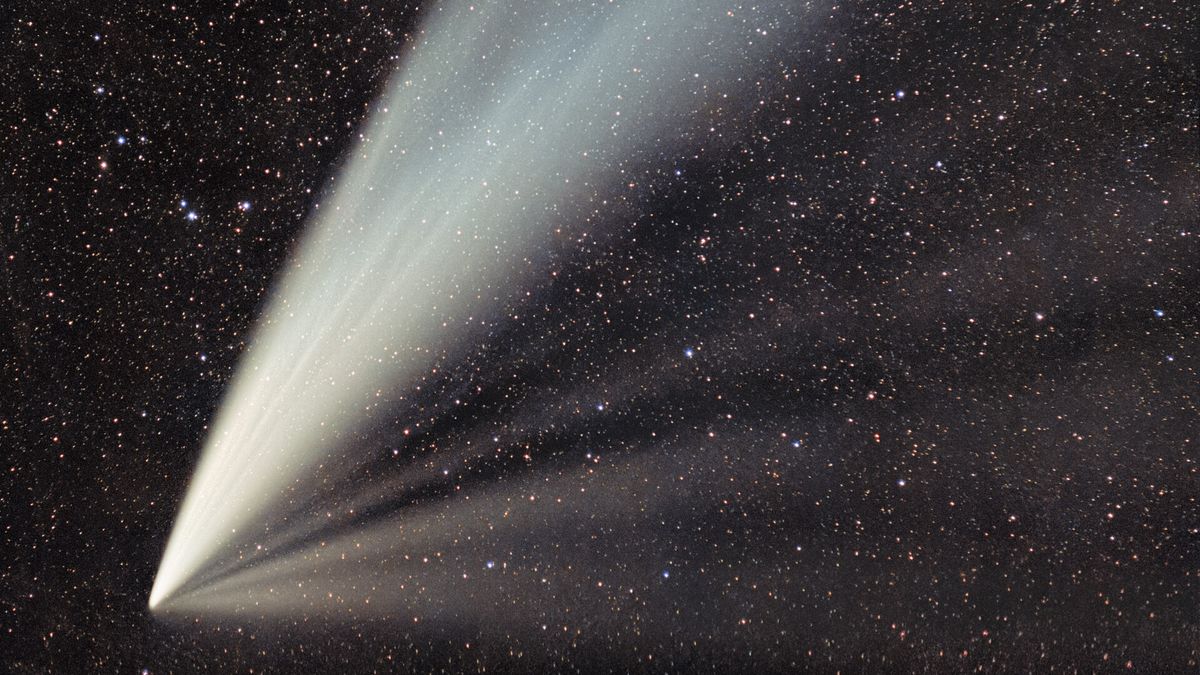
This captivating picture shows the once-in-a-lifetime comet as seen over the town of Andacollo, Chile, on Jan. 24, 2025. The comet was beautifully captured by César Briceño, director of the Southern Astrophysical Research Telescope. Briceño used a mirrorless DSLR camera with an 85mm lens at ISO 1600 to get 10 separate images, each exposed for 30 seconds, which were then stacked to create this stunning view.

The image reveals how the comet’s appearance has changed due to its proximity to the sun. One of the most noticeable features is the vaporized material of the comet’s frozen-solid core, known as the nucleus, which gives the comet a unique shape. As the comet gets close to the sun, it gets warmed up and its icy material transforms from solid to gas. This process creates long tails and an atmosphere around the nucleus, called the coma.

The diffuse coma in the lower-left corner shines brightly, hiding the nucleus. Twin tails are seen emerging from the nucleus. A dust trail made up of heavier dust particles that are lit by reflected sunlight makes up the upper stream of tails. The lower stream is composed of gases that glow from ionization. This tail points in a different direction than the first one because it’s influenced by the sun’s magnetic field, which makes it line up with the solar wind, the stream of charged particles emanating from the sun.

While faint trails of artificial satellites photobomb the view, the surreal starry backdrop makes the comet truly stand out. Another breathtaking image, which Briceño captured the same night, presents the showstopper against the backdrop of the Chilean mountains near the sea, showcasing a clear sky at dusk.

Source link

Share. Facebook Twitter Pinterest LinkedIn Tumblr Email
Previous ArticleFederal workers fight back as Trump dismantles their work: ‘They’ve radicalized me’
Next Article Israel halts all aid entry into Gaza as U.S. lifts partial arms embargo
Editor
  • Website

Related Posts

Lifestyle

Hantavirus-carrying rodents are expected to expand their range, climate models find

May 12, 2026
Lifestyle

Physicists find evidence that the universe isn’t perfectly uniform, potentially unraveling 100-year-old model of cosmology

May 12, 2026
Lifestyle

Once-in-a-century ‘super’ El Niño in the cards as ocean temperatures reach near record highs in April

May 12, 2026
Add A Comment

Comments are closed.

Categories
  • Entertainment
  • Lifestyle
  • News
  • Sports
  • Tech
  • Travel
Recent Posts
  • Hantavirus-carrying rodents are expected to expand their range, climate models find
  • Physicists find evidence that the universe isn’t perfectly uniform, potentially unraveling 100-year-old model of cosmology
  • Once-in-a-century ‘super’ El Niño in the cards as ocean temperatures reach near record highs in April
  • Goodbye PCOS: Polycystic ovary syndrome is getting a new name that doctors say better reflects the underlying disease
  • Microplastics absorb heat in the atmosphere and contribute to global warming — as if they weren’t bad enough
calendar
May 2026
M T W T F S S
 123
45678910
11121314151617
18192021222324
25262728293031
« Apr    
Recent Posts
  • Hantavirus-carrying rodents are expected to expand their range, climate models find
  • Physicists find evidence that the universe isn’t perfectly uniform, potentially unraveling 100-year-old model of cosmology
  • Once-in-a-century ‘super’ El Niño in the cards as ocean temperatures reach near record highs in April
About

Welcome to Baynard Media, your trusted source for a diverse range of news and insights. We are committed to delivering timely, reliable, and thought-provoking content that keeps you informed
and inspired

Categories
  • Entertainment
  • Lifestyle
  • News
  • Sports
  • Tech
  • Travel
Facebook X (Twitter) Pinterest WhatsApp
  • Contact Us
  • About Us
  • Privacy Policy
  • Disclaimer
  • UNSUBSCRIBE
© 2026 copyrights reserved

Type above and press Enter to search. Press Esc to cancel.