Close Menu
  • Home
  • UNSUBSCRIBE
  • News
  • Lifestyle
  • Tech
  • Entertainment
  • Sports
  • Travel
Facebook X (Twitter) WhatsApp
Trending
  • Why does metal stick together in space?
  • Faster ‘biological aging’ in young adults may help explain rise in early-onset cancers, study hints
  • Computer scientists are rushing to tame tame AI’s voracious appetite for energy
  • Our brains aren’t wired to handle this much bad news. But ‘looking away is not the fix,’ expert says.
  • ‘The fate of Earth depends on a delicate balance’: Our planet may survive the death of the sun after all, new models hint
  • Bullseye! Enormous ‘bow and arrow’ galaxy is unlike anything radio astronomers have ever seen — Space photo of the week
  • IBM creates first sub-1nm computer chip — cramming 100 billion transistors into a tiny fingernail-sized space
  • New chip harnesses quantum computing’s biggest weakness — and tries to turn it into a strength
Facebook X (Twitter) WhatsApp
Baynard Media
  • Home
  • UNSUBSCRIBE
  • News
  • Lifestyle
  • Tech
  • Entertainment
  • Sports
  • Travel
Baynard Media
Home»Lifestyle»Space photo of the week: JWST and MeerKAT unite to expose the chaotic heart of the Milky Way like never before
Lifestyle

Space photo of the week: JWST and MeerKAT unite to expose the chaotic heart of the Milky Way like never before

EditorBy EditorApril 6, 2025No Comments3 Mins Read
Share Facebook Twitter Pinterest LinkedIn Tumblr Reddit Telegram Email
Share
Facebook Twitter LinkedIn Pinterest Email

What it is: Sagittarius C (Sgr C) region of the Milky Way.

Where it is: 25,000 light-years from the solar system in the constellation Sagittarius.

When it was shared: April 2, 2025

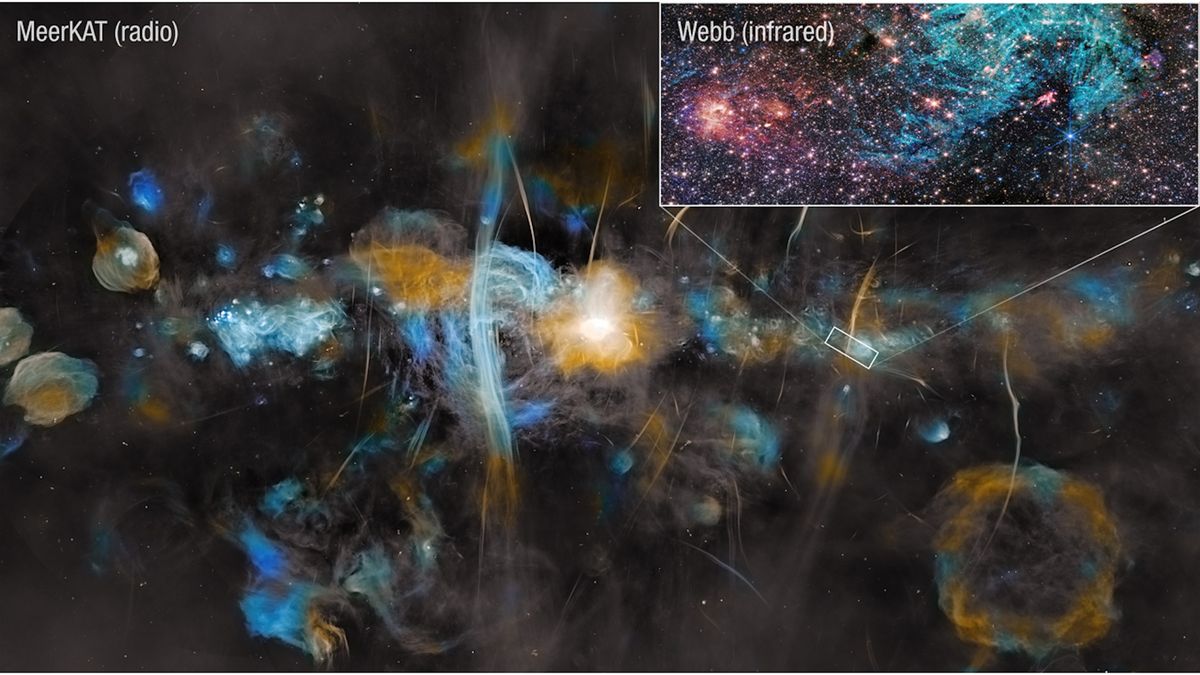
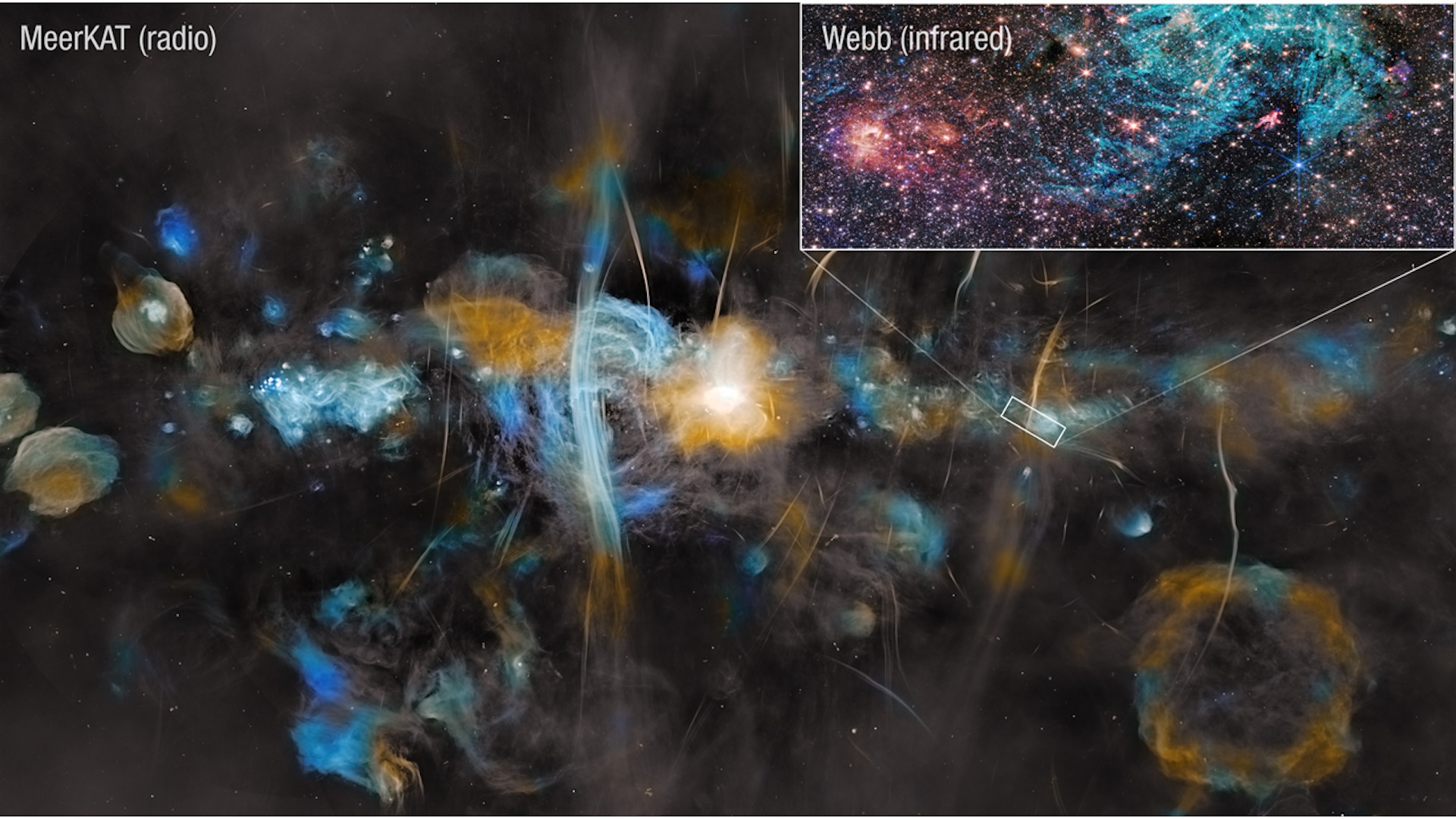
Why it’s so special: The Milky Way often appears as a reddish, pinkish and bluish-white arc across the night sky, but this new super-long exposure image from South Africa’s ground-based MeerKAT radio telescope shows our home galaxy in a completely new way.

Colored in blue, cyan, yellow and white, the main image — whose many bubbles of color are remnants of supernovas — span 1,000 light-years of the Milky Way.

The new radio image helps to put in context the inset infrared image by the James Webb Space Telescope from 2023 of Sagittarius C (Sgr C). This is a 44 light-year-wide region about 200 light-years from the Milky Way’s central supermassive black hole, Sagittarius A*, where stars are being formed.

JWST’s image revealed more than 500,000 stars, but in this Central Molecular Zone — an extreme environment — stars are not being formed as quickly as astronomers expect. One reason may be the strong magnetic fields around that supermassive black hole, which are shaping the filaments seen by MeerKAT and JWST. These magnetic fields may also be strong enough to resist the gravity that causes dense clouds of gas and dust to collapse to create stars, thus suppressing star formation in Sgr C.

Get the world’s most fascinating discoveries delivered straight to your inbox.

“A big question in the Central Molecular Zone of our galaxy has been, if there is so much dense gas and cosmic dust here, and we know that stars form in such clouds, why are so few stars born here?” said John Bally, an astrophysicist at the University of Colorado Boulder and one of the principal investigators of a related paper published April 2 in The Astrophysical Journal. “Now, for the first time, we are seeing directly that strong magnetic fields may play an important role in suppressing star formation, even at small scales,” Bally said in a NASA statement.

MeerKAT is a radio telescope made up of 64 dishes in South Africa’s Karoo region. It will eventually form part of a far larger radio telescope called the Square Kilometre Array, the world’s largest and most sensitive radio telescope that will also use more than 130,000 Christmas tree-shaped antennas on the traditional lands of the Wajarri Yamaji, in Murchison, Western Australia.

For more sublime space images, check out our Space Photo of the Week archives.

Source link

Share. Facebook Twitter Pinterest LinkedIn Tumblr Email
Previous ArticleRedmi Watch 5 review | Live Science
Next Article Dell XPS 13 9345 (2024) review: Exceptionally sleek with a blockbuster battery life
Editor
  • Website

Related Posts

Lifestyle

Why does metal stick together in space?

June 29, 2026
Lifestyle

Faster ‘biological aging’ in young adults may help explain rise in early-onset cancers, study hints

June 29, 2026
Lifestyle

Computer scientists are rushing to tame tame AI’s voracious appetite for energy

June 28, 2026
Add A Comment

Comments are closed.

Categories
  • Entertainment
  • Lifestyle
  • News
  • Sports
  • Tech
  • Travel
Recent Posts
  • Why does metal stick together in space?
  • Faster ‘biological aging’ in young adults may help explain rise in early-onset cancers, study hints
  • Computer scientists are rushing to tame tame AI’s voracious appetite for energy
  • Our brains aren’t wired to handle this much bad news. But ‘looking away is not the fix,’ expert says.
  • ‘The fate of Earth depends on a delicate balance’: Our planet may survive the death of the sun after all, new models hint
calendar
June 2026
M T W T F S S
1234567
891011121314
15161718192021
22232425262728
2930  
« May    
Recent Posts
  • Why does metal stick together in space?
  • Faster ‘biological aging’ in young adults may help explain rise in early-onset cancers, study hints
  • Computer scientists are rushing to tame tame AI’s voracious appetite for energy
About

Welcome to Baynard Media, your trusted source for a diverse range of news and insights. We are committed to delivering timely, reliable, and thought-provoking content that keeps you informed
and inspired

Categories
  • Entertainment
  • Lifestyle
  • News
  • Sports
  • Tech
  • Travel
Facebook X (Twitter) Pinterest WhatsApp
  • Contact Us
  • About Us
  • Privacy Policy
  • Disclaimer
  • UNSUBSCRIBE
© 2026 copyrights reserved

Type above and press Enter to search. Press Esc to cancel.