Close Menu
  • Home
  • UNSUBSCRIBE
  • News
  • Lifestyle
  • Tech
  • Entertainment
  • Sports
  • Travel
Facebook X (Twitter) WhatsApp
Trending
  • ‘The fate of Earth depends on a delicate balance’: Our planet may survive the death of the sun after all, new models hint
  • Bullseye! Enormous ‘bow and arrow’ galaxy is unlike anything radio astronomers have ever seen — Space photo of the week
  • IBM creates first sub-1nm computer chip — cramming 100 billion transistors into a tiny fingernail-sized space
  • New chip harnesses quantum computing’s biggest weakness — and tries to turn it into a strength
  • How did the Romans build such straight roads?
  • AI images are more convincing than ever — infiltrating journals and undermining trust in science
  • Climate change is driving capuchin monkey mothers to abandon their infants
  • ‘The Romans were probably never going to go away’: In new ‘Almost History’ podcast, listen to how history might have played out if Carthage had defeated the Roman Republic
Facebook X (Twitter) WhatsApp
Baynard Media
  • Home
  • UNSUBSCRIBE
  • News
  • Lifestyle
  • Tech
  • Entertainment
  • Sports
  • Travel
Baynard Media
Home»Lifestyle»Space photo of the week: James Webb and Hubble telescopes unite to solve ‘impossible’ planet mystery
Lifestyle

Space photo of the week: James Webb and Hubble telescopes unite to solve ‘impossible’ planet mystery

EditorBy EditorFebruary 2, 2025No Comments3 Mins Read
Share Facebook Twitter Pinterest LinkedIn Tumblr Reddit Telegram Email
Share
Facebook Twitter LinkedIn Pinterest Email

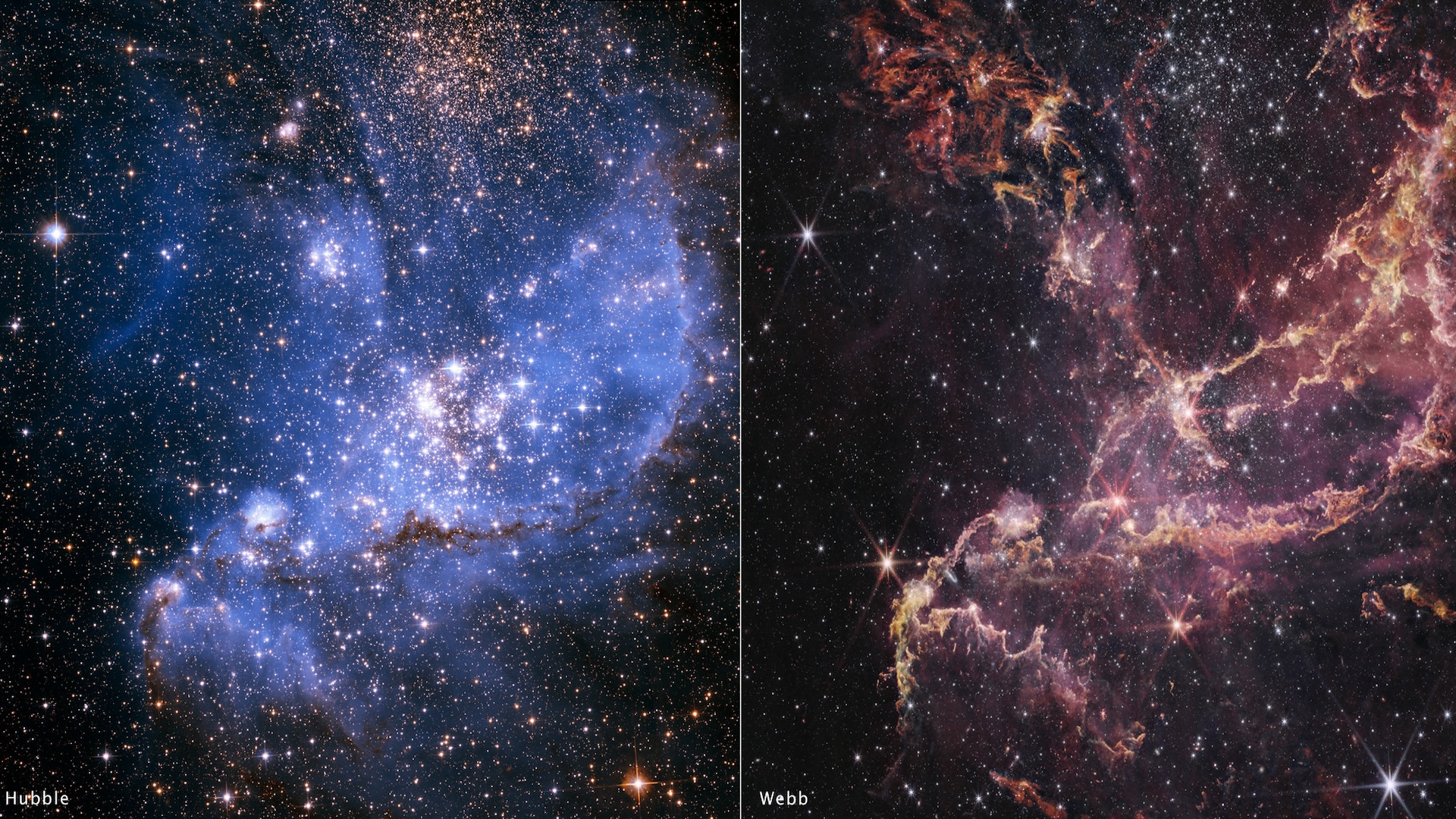
What it is: An open cluster of stars called NGC 346

Where it is: 210,000 light-years away, in the constellation Tucana

When it was shared: Dec. 16, 2024

Why it’s so special: This James Webb Space Telescope (JWST) image has helped astronomers untangle a long-standing mystery about how planets form. The mystery arose more than 20 years ago, when the Hubble Space Telescope spotted the universe’s oldest known planet, which formed earlier in the universe’s history than scientists thought was possible.

Stars form in large clouds of gas and dust called molecular clouds. Any remaining gas and dust gather in disks around the stars. Planets, in turn, form from these disks. Scientists believed that early stars didn’t have planets because there was a lack of heavier elements, such as carbon and iron, which are created by stars’ nuclear fusion and supernova deaths. They thought that these heavier elements were essential for planet-forming disks to exist long enough for planets to form.

Related: Space photo of the week: The tilted spiral galaxy that took Hubble 23 years to capture

But in 2003, Hubble detected a massive planet orbiting an ancient star in the M4 globular cluster, which is about 5,600 light-years distant in the Milky Way. Globular clusters are extremely old and, therefore, lack heavier elements. The exoplanet is about 13 billion years old, which suggests that planets may have formed earlier in the universe’s history than scientists thought was possible. But astronomers were unsure exactly how it formed so early in the universe’s history.

Get the world’s most fascinating discoveries delivered straight to your inbox.

To learn more about the early universe, astronomers use proxies that have similar conditions to ancient galaxies. One such proxy is the star cluster NGC 346, a star-forming region within the Small Magellanic Cloud (SMC), a dwarf galaxy that orbits the Milky Way. Like early galaxies, the SMC lacks heavier elements and is made up mainly of hydrogen and helium.

When astronomers pointed Hubble at NGC 346, they found signs that planet-forming disks existed around stars for 20 million to 30 million years — about 10 times longer than theories predicted such disks could survive. However, the signs were faint, so astronomers needed further proof.

In 2023, JWSTused the unprecedented sensitivity and resolution provided by its Near Infrared Spectrograph and Mid-Infrared Instrument to confirm the existence of long-lived planet-forming disks in NGC 346.

The findings, published Dec. 16, 2024, in The Astrophysical Journal, affirm the Hubble result and suggest that the lack of heavier elements may slow the star’s ability to disperse its planet-forming disk — giving planets more time to form. Another theory is that the initial gas cloud from which the star forms might be larger, resulting in a more massive, longer-lived disk.

For more sublime space images, check out our Space Photo of the Week archives.

Source link

Share. Facebook Twitter Pinterest LinkedIn Tumblr Email
Previous ArticleCeasefire evacuations bring a lifeline for Gaza’s sick and injured children
Next Article What Really Happened to Mary Day, the “Girl Who Died Twice”
Editor
  • Website

Related Posts

Lifestyle

‘The fate of Earth depends on a delicate balance’: Our planet may survive the death of the sun after all, new models hint

June 28, 2026
Lifestyle

Bullseye! Enormous ‘bow and arrow’ galaxy is unlike anything radio astronomers have ever seen — Space photo of the week

June 28, 2026
Lifestyle

IBM creates first sub-1nm computer chip — cramming 100 billion transistors into a tiny fingernail-sized space

June 28, 2026
Add A Comment

Comments are closed.

Categories
  • Entertainment
  • Lifestyle
  • News
  • Sports
  • Tech
  • Travel
Recent Posts
  • ‘The fate of Earth depends on a delicate balance’: Our planet may survive the death of the sun after all, new models hint
  • Bullseye! Enormous ‘bow and arrow’ galaxy is unlike anything radio astronomers have ever seen — Space photo of the week
  • IBM creates first sub-1nm computer chip — cramming 100 billion transistors into a tiny fingernail-sized space
  • New chip harnesses quantum computing’s biggest weakness — and tries to turn it into a strength
  • How did the Romans build such straight roads?
calendar
June 2026
M T W T F S S
1234567
891011121314
15161718192021
22232425262728
2930  
« May    
Recent Posts
  • ‘The fate of Earth depends on a delicate balance’: Our planet may survive the death of the sun after all, new models hint
  • Bullseye! Enormous ‘bow and arrow’ galaxy is unlike anything radio astronomers have ever seen — Space photo of the week
  • IBM creates first sub-1nm computer chip — cramming 100 billion transistors into a tiny fingernail-sized space
About

Welcome to Baynard Media, your trusted source for a diverse range of news and insights. We are committed to delivering timely, reliable, and thought-provoking content that keeps you informed
and inspired

Categories
  • Entertainment
  • Lifestyle
  • News
  • Sports
  • Tech
  • Travel
Facebook X (Twitter) Pinterest WhatsApp
  • Contact Us
  • About Us
  • Privacy Policy
  • Disclaimer
  • UNSUBSCRIBE
© 2026 copyrights reserved

Type above and press Enter to search. Press Esc to cancel.