Close Menu
  • Home
  • UNSUBSCRIBE
  • News
  • Lifestyle
  • Tech
  • Entertainment
  • Sports
  • Travel
Facebook X (Twitter) WhatsApp
Trending
  • Arthritis drug shows antiviral effects against RSV, the leading cause of infant hospitalization
  • Daddy longlegs may be capturing and devouring frogs in the tropical forests of South America
  • Google wants to release 64 million bacteria-riddled mosquitoes across California and Florida. Here’s why scientists are enthusiastic.
  • ‘In an unrecoverable state’: NASA confirms MAVEN spacecraft is officially dead after loss of signal behind Mars
  • 2 rivers merged to form the Euphrates 3.6 million years ago, eventually leading to the Fertile Crescent
  • NASA confirms fireball meteor exploded over northeastern US with force of 230 tons of TNT
  • Astronauts could use lightning-like plasma jets to kill germs on the moon and Mars, demo hints
  • First whole-genome sequence of a Greenland shark holds clues to their extreme longevity
Facebook X (Twitter) WhatsApp
Baynard Media
  • Home
  • UNSUBSCRIBE
  • News
  • Lifestyle
  • Tech
  • Entertainment
  • Sports
  • Travel
Baynard Media
Home»Lifestyle»Space photo of the week: Hubble uncovers the true identity of an odd galaxy — and it’s not spiral or elliptical
Lifestyle

Space photo of the week: Hubble uncovers the true identity of an odd galaxy — and it’s not spiral or elliptical

EditorBy EditorNovember 24, 2024No Comments3 Mins Read
Share Facebook Twitter Pinterest LinkedIn Tumblr Reddit Telegram Email
Share
Facebook Twitter LinkedIn Pinterest Email

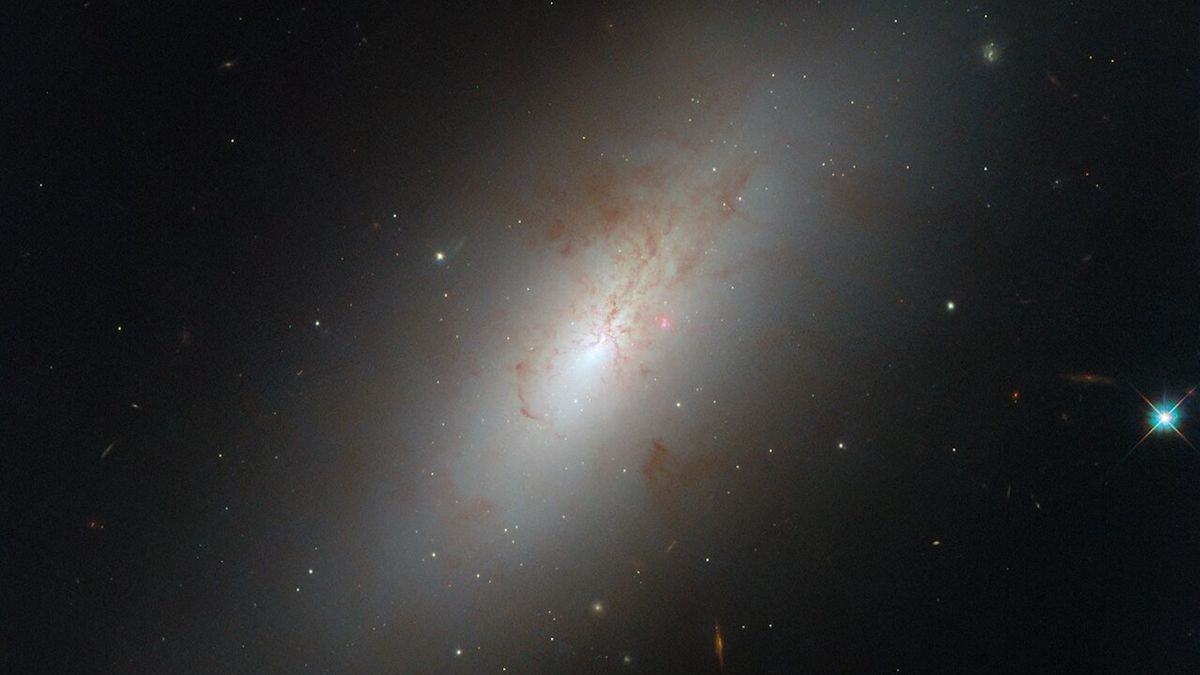
What it is: The galaxy NGC 4694, a member of the Virgo galaxy cluster

Where it is: 54 million light-years from Earth, in the constellation Virgo

When it was shared: Sept. 30, 2024

Why it’s so special: NGC 4694 is a galaxy that cannot be easily classified into one of the two basic galaxy types: spiral and elliptical. Astronomers needed to examine its properties in detail to find its exact classification.

Spiral galaxies, such as our Milky Way, are relatively young and abundant in star-forming gas. They showcase distinct spiral arms adorned with hot, bright, young stars. In contrast, elliptical galaxies are more tranquil. These oval galaxies are composed primarily of older, redder stars. Most galaxies fall into these basic types.

However, NGC 4694 has properties of both types, complicating its classification, Hubble Space Telescope team members explained in a description of the image. It has a smooth-looking, armless shape, like an elliptical galaxy, and a disk with a low star-formation rate. However, it has relatively younger and newer stars forming in its central region. By contrast, elliptical galaxies do not typically contain the ingredients necessary for new stars to form. The active star formation, which powers the bright center, aligns more with the characteristics of a spiral galaxy. Like a young and lively spiral, NGC 4694 is rich in hydrogen gas and dust and is surrounded by a hydrogen gas cloud.

An image of NGC 4694, a smooth, glowing galaxy shaped like an ellipse with barely any star formation

(Image credit: ESA/Hubble & NASA, D. Thilker)

The image also features reddish-brown dust forming unusual structures scattered across the galaxy, spreading out from the core. Interestingly, the surrounding cloud of hydrogen gas forms a long bridge to a faint and tiny nearby galaxy named VCC 2062. An in-depth study of this image revealed that the two galaxies may have interacted in an intense collision, allowing the larger NGC 4694 to steal gas from the smaller VCC 2062. This dramatic collision shaped NGC 4694 into its unique armless, smooth form characterized by active star formation, classifying it as a lenticular galaxy.

Get the world’s most fascinating discoveries delivered straight to your inbox.

Related: Researchers spot rare ‘triple-ring’ galaxy that defies explanation

Lenticular galaxies are intermediates between ellipticals and spirals. They feature a central bulge and a large disk, but they lack majestic spiral arms and contain more fuel for star formation than typical elliptical galaxies.

Using the Hubble Space Telescope, astronomers revealed the galaxy’s classification. The stunning image is a result of combining ultraviolet data with optical data collected by Hubble’s Wide Field Camera 3.

For more sublime space images, check out our Space Photo of the Week archives.

Source link

Share. Facebook Twitter Pinterest LinkedIn Tumblr Email
Previous ArticleLive Commentary – Chelsea Women vs Man Utd Women
Next Article Eat healthy during the holidays with these tips from Dr. Nicole Saphier
Editor
  • Website

Related Posts

Lifestyle

Arthritis drug shows antiviral effects against RSV, the leading cause of infant hospitalization

June 4, 2026
Lifestyle

Daddy longlegs may be capturing and devouring frogs in the tropical forests of South America

June 3, 2026
Lifestyle

Google wants to release 64 million bacteria-riddled mosquitoes across California and Florida. Here’s why scientists are enthusiastic.

June 3, 2026
Add A Comment

Comments are closed.

Categories
  • Entertainment
  • Lifestyle
  • News
  • Sports
  • Tech
  • Travel
Recent Posts
  • Arthritis drug shows antiviral effects against RSV, the leading cause of infant hospitalization
  • Daddy longlegs may be capturing and devouring frogs in the tropical forests of South America
  • Google wants to release 64 million bacteria-riddled mosquitoes across California and Florida. Here’s why scientists are enthusiastic.
  • ‘In an unrecoverable state’: NASA confirms MAVEN spacecraft is officially dead after loss of signal behind Mars
  • 2 rivers merged to form the Euphrates 3.6 million years ago, eventually leading to the Fertile Crescent
calendar
June 2026
M T W T F S S
1234567
891011121314
15161718192021
22232425262728
2930  
« May    
Recent Posts
  • Arthritis drug shows antiviral effects against RSV, the leading cause of infant hospitalization
  • Daddy longlegs may be capturing and devouring frogs in the tropical forests of South America
  • Google wants to release 64 million bacteria-riddled mosquitoes across California and Florida. Here’s why scientists are enthusiastic.
About

Welcome to Baynard Media, your trusted source for a diverse range of news and insights. We are committed to delivering timely, reliable, and thought-provoking content that keeps you informed
and inspired

Categories
  • Entertainment
  • Lifestyle
  • News
  • Sports
  • Tech
  • Travel
Facebook X (Twitter) Pinterest WhatsApp
  • Contact Us
  • About Us
  • Privacy Policy
  • Disclaimer
  • UNSUBSCRIBE
© 2026 copyrights reserved

Type above and press Enter to search. Press Esc to cancel.