Close Menu
  • Home
  • UNSUBSCRIBE
  • News
  • Lifestyle
  • Tech
  • Entertainment
  • Sports
  • Travel
Facebook X (Twitter) WhatsApp
Trending
  • Doctors may soon be able to check your red blood cells by filming your eyeball
  • Chinese medical practitioners used extremely toxic plant as a topical anesthetic 600 years ago, study finds
  • Bead net funerary shroud: A 2,500-year-old beaded veil from Egypt depicting the deceased’s transformation into Osiris
  • Rare genetic disease makes scientists reconsider what the ‘seat of fear’ in the brain really is
  • It’s illegal to repair most of our devices. There’s a surprising reason for that.
  • Jupiter’s Ganymede, the largest moon in the solar system, may be heating up
  • Bizarre patterns on Venus have scientists puzzled
  • Scientists trained an AI model using an IBM quantum computer — and it answered questions correctly that the base model couldn’t
Facebook X (Twitter) WhatsApp
Baynard Media
  • Home
  • UNSUBSCRIBE
  • News
  • Lifestyle
  • Tech
  • Entertainment
  • Sports
  • Travel
Baynard Media
Home»Lifestyle»Space photo of the week: Hubble celebrates 10 years of hunting giants
Lifestyle

Space photo of the week: Hubble celebrates 10 years of hunting giants

EditorBy EditorJanuary 5, 2025No Comments3 Mins Read
Share Facebook Twitter Pinterest LinkedIn Tumblr Reddit Telegram Email
Share
Facebook Twitter LinkedIn Pinterest Email

What it is: Our solar system’s four giant outer planets: Jupiter, Saturn, Uranus and Neptune

Where it is: From about 365 million to 2.8 billion miles (587 million to 4.5 billion kilometers) from Earth

When it was shared: Dec. 9, 2024

Why it’s so special:

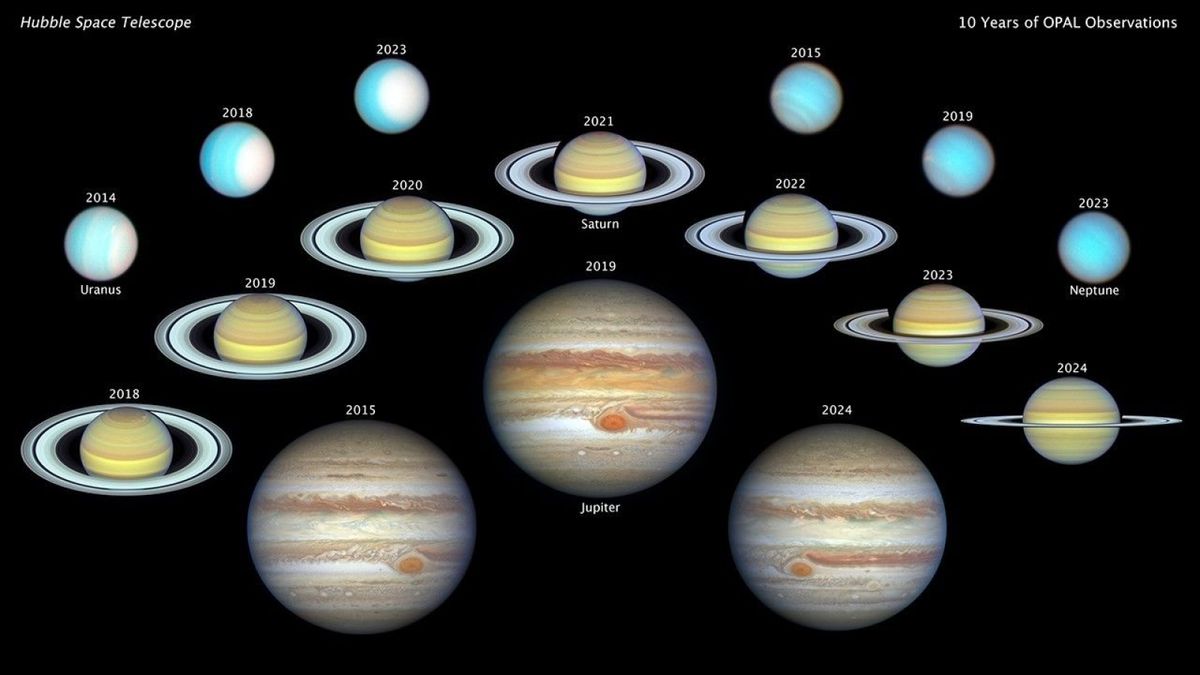
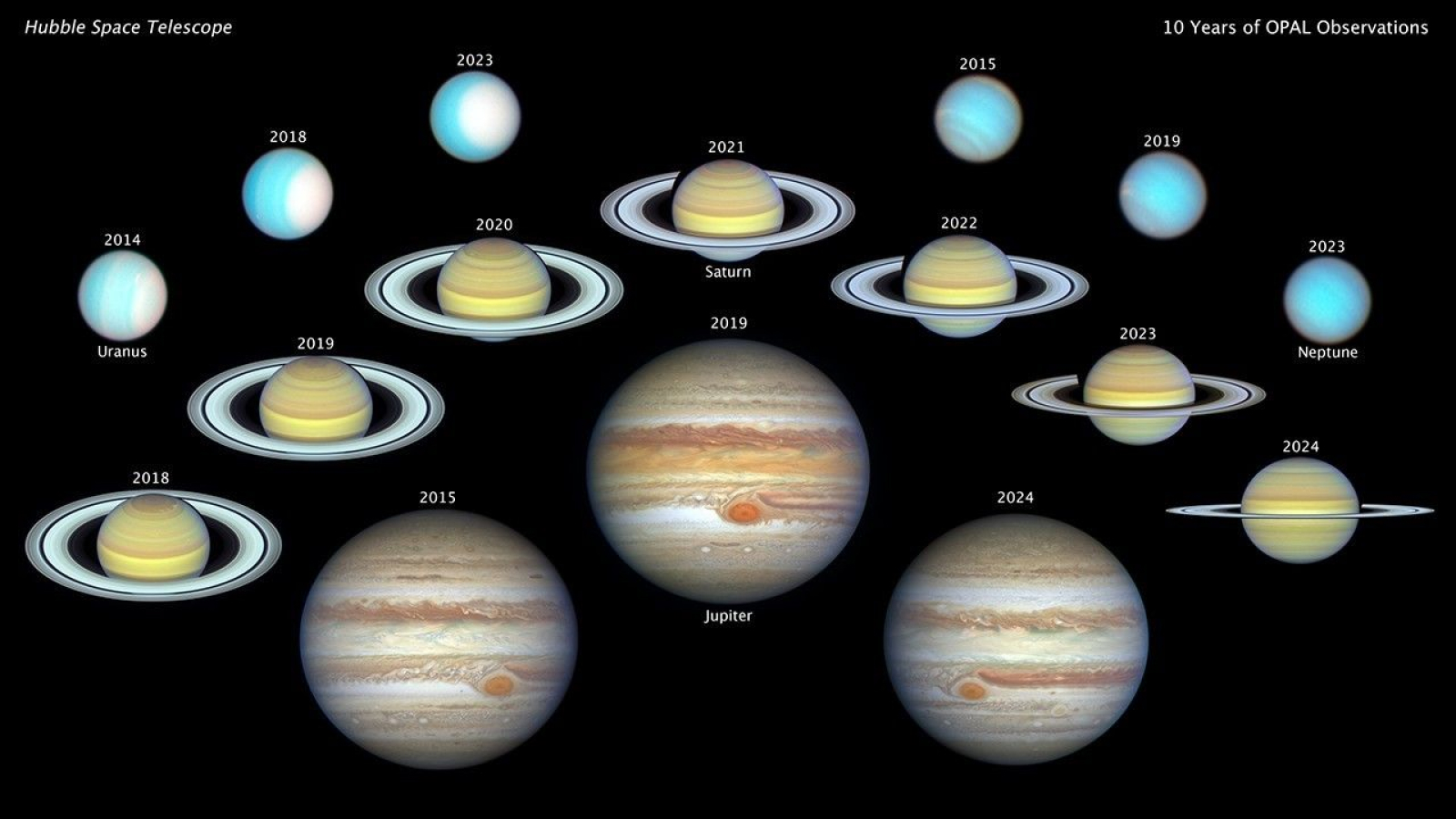
This iconic montage features images of Jupiter, Saturn, Uranus and Neptune captured between 2014 and 2024 as part of the Hubble Space Telescope’s Outer Planet Atmospheres Legacy (OPAL) project. Through OPAL, scientists aim to understand the outer planets’ weather conditions and how they change over time by conducting yearly observations when the planets are closest to Earth. These images allow astronomers to track the atmospheric conditions and dynamics on these planets.

Because of their distance from the sun and different rotational tilts relative to their orbital axes, the outer planets experience seasonal changes and atmospheric conditions unlike those we’re used to on Earth. Studying these differences can help astronomers learn more about the conditions on planets beyond our solar system.

Related: 32 alien planets that really exist

Get the world’s most fascinating discoveries delivered straight to your inbox.

Jupiter has a 12-Earth-year orbit and a 3-degree tilt, leading to limited seasonal changes. OPAL’s images from 2015 to 2024 — particularly those from 2015, 2019 and 2024 highlighted in the montage — showcase shifting cloud structures and the Great Red Spot’s changing position. Astronomers utilized various filters (not shown here) to analyze cloud thickness, large storms, altitudes and chemical compositions.

Saturn, on the other hand, is tilted 26.7 degrees on its axis, leading to significant seasonal changes. Because it is a ringed system, Hubble can capture the rings edge-on. In these views, the superthin rings almost disappear. This occurs every 15 years, with the next event set to occur in March and November 2025. Observations have shown subtle changes in Saturn’s cloud height and winds each year. Its 29-Earth-year orbit results in seasonal shifts roughly every seven years, with more changes expected during each transition.

Uranus has a nearly 90-degree tilt, causing it to rotate on its side. As a result of the planet’s 84-Earth-year orbit, one hemisphere remains in darkness for 42 Earth years. Hubble has observed the northern polar cap brightening annually as it tilts toward the sun. This trend is expected to continue, with the Uranian ring system appearing face-on in 2028.

Neptune’s OPAL observations revealed two significant findings. First, mysterious dark spots were migrating in an unusual fashion, before disappearing. Second, there is a connection between Neptune’s changing cloudy weather and the 11-year solar cycle. Despite receiving only about 1/1000 of the sunlight Earth gets, Neptune’s weather appears to be influenced by the sun.

OPAL will continue to monitor the outer giants, and the database will keep expanding so that scientists can observe the long-term changes in the planets’ atmospheres. Hubble is predicted to continue operating into the mid-2030s.

For more sublime space images, check out our Space Photo of the Week archives.

Source link

Share. Facebook Twitter Pinterest LinkedIn Tumblr Email
Previous ArticleGet a refurbished iPad 6 and Beats Flex headphones for just $140
Next Article Coco Gauff beats Iga Swiatek for second time in a row ahead of Australian Open with United Cup victory | Tennis News
Editor
  • Website

Related Posts

Lifestyle

Doctors may soon be able to check your red blood cells by filming your eyeball

May 26, 2026
Lifestyle

Chinese medical practitioners used extremely toxic plant as a topical anesthetic 600 years ago, study finds

May 26, 2026
Lifestyle

Bead net funerary shroud: A 2,500-year-old beaded veil from Egypt depicting the deceased’s transformation into Osiris

May 25, 2026
Add A Comment

Comments are closed.

Categories
  • Entertainment
  • Lifestyle
  • News
  • Sports
  • Tech
  • Travel
Recent Posts
  • Doctors may soon be able to check your red blood cells by filming your eyeball
  • Chinese medical practitioners used extremely toxic plant as a topical anesthetic 600 years ago, study finds
  • Bead net funerary shroud: A 2,500-year-old beaded veil from Egypt depicting the deceased’s transformation into Osiris
  • Rare genetic disease makes scientists reconsider what the ‘seat of fear’ in the brain really is
  • It’s illegal to repair most of our devices. There’s a surprising reason for that.
calendar
May 2026
M T W T F S S
 123
45678910
11121314151617
18192021222324
25262728293031
« Apr    
Recent Posts
  • Doctors may soon be able to check your red blood cells by filming your eyeball
  • Chinese medical practitioners used extremely toxic plant as a topical anesthetic 600 years ago, study finds
  • Bead net funerary shroud: A 2,500-year-old beaded veil from Egypt depicting the deceased’s transformation into Osiris
About

Welcome to Baynard Media, your trusted source for a diverse range of news and insights. We are committed to delivering timely, reliable, and thought-provoking content that keeps you informed
and inspired

Categories
  • Entertainment
  • Lifestyle
  • News
  • Sports
  • Tech
  • Travel
Facebook X (Twitter) Pinterest WhatsApp
  • Contact Us
  • About Us
  • Privacy Policy
  • Disclaimer
  • UNSUBSCRIBE
© 2026 copyrights reserved

Type above and press Enter to search. Press Esc to cancel.