Close Menu
  • Home
  • UNSUBSCRIBE
  • News
  • Lifestyle
  • Tech
  • Entertainment
  • Sports
  • Travel
Facebook X (Twitter) WhatsApp
Trending
  • Stupid hot: Heat waves cause cognitive changes in animals, making them more aggressive and unable to complete basic tasks
  • Tump administration to remove 900 deep sea monitoring instruments that would have studied the collapsing Atlantic current
  • Science news this week: Ötzi the Iceman used to make sourdough, Italian teenagers discover Roman villa under school, Google plans to release 64 million mosquitos, and RIP to NASA’s Maven probe
  • Coming El Niño will be the strongest ever recorded, new forecast predicts
  • World’s largest scorpion had 6-inch pincers, and prowled UK land and waters 415 million years ago
  • Arthritis drug shows antiviral effects against RSV, the leading cause of infant hospitalization
  • Daddy longlegs may be capturing and devouring frogs in the tropical forests of South America
  • Google wants to release 64 million bacteria-riddled mosquitoes across California and Florida. Here’s why scientists are enthusiastic.
Facebook X (Twitter) WhatsApp
Baynard Media
  • Home
  • UNSUBSCRIBE
  • News
  • Lifestyle
  • Tech
  • Entertainment
  • Sports
  • Travel
Baynard Media
Home»Lifestyle»Space photo of the week: Hubble captures a cosmic snow angel created by a bright, young star
Lifestyle

Space photo of the week: Hubble captures a cosmic snow angel created by a bright, young star

EditorBy EditorDecember 29, 2024No Comments3 Mins Read
Share Facebook Twitter Pinterest LinkedIn Tumblr Reddit Telegram Email
Share
Facebook Twitter LinkedIn Pinterest Email

What it is: An emission nebula, or star-forming region, named Sharpless 2-106

Where it is: 2,000 light-years away, in the constellation Cygnus

When it was shared: December 2011

Why it’s so special:

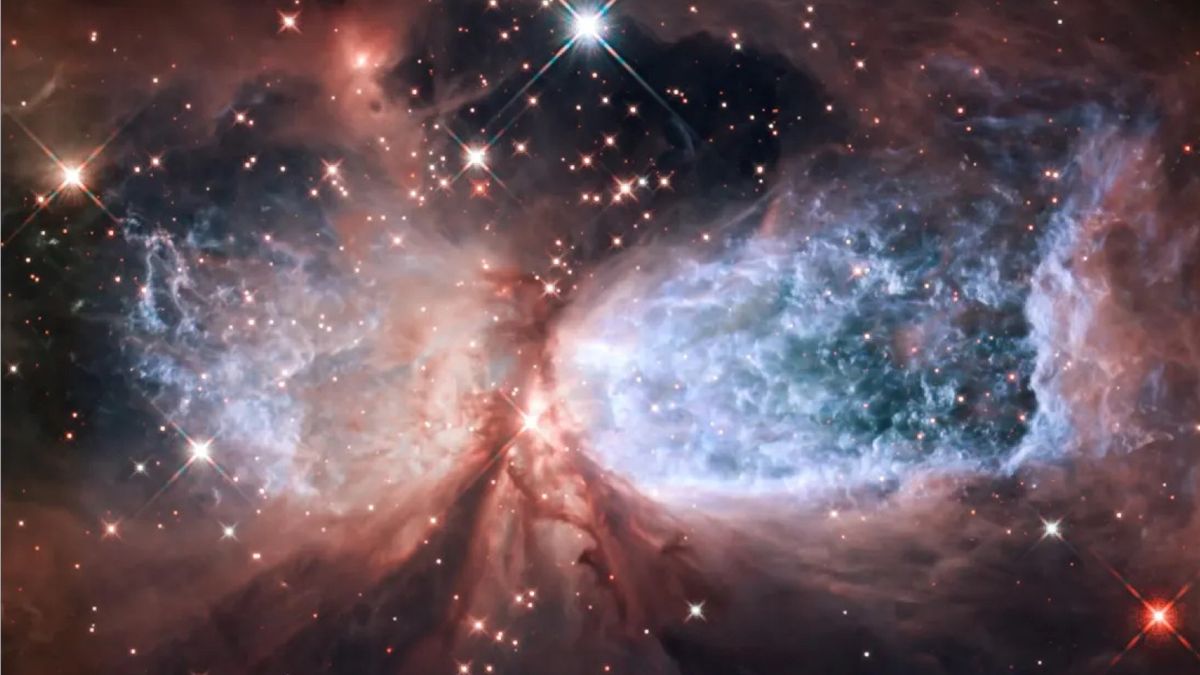
This stunning image from the Hubble Space Telescope depicts a star-forming region called Sharpless 2-106, or S106 for short. Characterized by its “wings,” it is classified as a bipolar nebula and affectionately nicknamed the “celestial snow angel.” The star-forming region, which is about 2 light-years wide, is located in a relatively isolated area of the Milky Way.

Although this image appears peaceful, it actually reflects the violent beginnings of stellar evolution. The majestic structure is created by a massive young star named S106 IR, which has a mass 15 times that of the sun.

The bipolar star-forming region, called Sharpless 2-106, looks like a soaring, celestial snow angel.

A full-size version of the Hubble image (Image credit: NASA, ESA, and the Hubble Heritage Team (STScI/AURA))

This star is in the final stages of its formation, ejecting jets of energetic material at high speeds from its poles and disrupting the surrounding gas and dust. Still embedded in its parent cloud, S106 IR expels high-speed material, which gives the cloud a striking appearance. The expelled material also heats the surrounding gas to temperatures of up to 18,000 degrees Fahrenheit (10,000 degrees Celsius) and ionizes hydrogen gas, causing it to glow. This dynamic process creates intricate details that are clearly visible in the image.

Get the world’s most fascinating discoveries delivered straight to your inbox.

Related: Space photo of the week: James Webb telescope spots a secret star factory in the Sombrero Galaxy

The twin lobes of blazing-hot gas on each side of the star (blue in the image) expand from its center, creating the “wings” of the angel. A thick, red lane of dust separates the regions of superhot gas and consists of cooler, dark material that gives S106 a unique hourglass shape. The cooler dust lane is dense enough to conceal the central star from view. However, the star can be seen peeking through the widest part of the dust trail, positioned slightly off-center in the image.

As the star is in the final stages of its formation, it will continue to eject material, thus losing mass. It will eventually calm down and transition into a relatively quieter main sequence star like the sun.

Released in December 2011, this vibrant Hubble image was created by combining visible and near-infrared light collected by the telescope’s Wide Field Camera 3. The light emitted by hot hydrogen gas was observed using visible-light filters, while the cooler gas and dust were captured using near-infrared-light filters.

For more sublime space images, check out our Space Photo of the Week archives.

Source link

Share. Facebook Twitter Pinterest LinkedIn Tumblr Email
Previous ArticleGaza’s babies struggle to cope with plummeting temperatures
Next Article Neville Hotels Hurdle: Brighterdaysahead blows away State Man in Leopardstown romp to boost Champion Hurdle challenge | Racing News
Editor
  • Website

Related Posts

Lifestyle

Stupid hot: Heat waves cause cognitive changes in animals, making them more aggressive and unable to complete basic tasks

June 6, 2026
Lifestyle

Tump administration to remove 900 deep sea monitoring instruments that would have studied the collapsing Atlantic current

June 6, 2026
Lifestyle

Science news this week: Ötzi the Iceman used to make sourdough, Italian teenagers discover Roman villa under school, Google plans to release 64 million mosquitos, and RIP to NASA’s Maven probe

June 6, 2026
Add A Comment

Comments are closed.

Categories
  • Entertainment
  • Lifestyle
  • News
  • Sports
  • Tech
  • Travel
Recent Posts
  • Stupid hot: Heat waves cause cognitive changes in animals, making them more aggressive and unable to complete basic tasks
  • Tump administration to remove 900 deep sea monitoring instruments that would have studied the collapsing Atlantic current
  • Science news this week: Ötzi the Iceman used to make sourdough, Italian teenagers discover Roman villa under school, Google plans to release 64 million mosquitos, and RIP to NASA’s Maven probe
  • Coming El Niño will be the strongest ever recorded, new forecast predicts
  • World’s largest scorpion had 6-inch pincers, and prowled UK land and waters 415 million years ago
calendar
June 2026
M T W T F S S
1234567
891011121314
15161718192021
22232425262728
2930  
« May    
Recent Posts
  • Stupid hot: Heat waves cause cognitive changes in animals, making them more aggressive and unable to complete basic tasks
  • Tump administration to remove 900 deep sea monitoring instruments that would have studied the collapsing Atlantic current
  • Science news this week: Ötzi the Iceman used to make sourdough, Italian teenagers discover Roman villa under school, Google plans to release 64 million mosquitos, and RIP to NASA’s Maven probe
About

Welcome to Baynard Media, your trusted source for a diverse range of news and insights. We are committed to delivering timely, reliable, and thought-provoking content that keeps you informed
and inspired

Categories
  • Entertainment
  • Lifestyle
  • News
  • Sports
  • Tech
  • Travel
Facebook X (Twitter) Pinterest WhatsApp
  • Contact Us
  • About Us
  • Privacy Policy
  • Disclaimer
  • UNSUBSCRIBE
© 2026 copyrights reserved

Type above and press Enter to search. Press Esc to cancel.