Close Menu
  • Home
  • UNSUBSCRIBE
  • News
  • Lifestyle
  • Tech
  • Entertainment
  • Sports
  • Travel
Facebook X (Twitter) WhatsApp
Trending
  • Arthritis drug shows antiviral effects against RSV, the leading cause of infant hospitalization
  • Daddy longlegs may be capturing and devouring frogs in the tropical forests of South America
  • Google wants to release 64 million bacteria-riddled mosquitoes across California and Florida. Here’s why scientists are enthusiastic.
  • ‘In an unrecoverable state’: NASA confirms MAVEN spacecraft is officially dead after loss of signal behind Mars
  • 2 rivers merged to form the Euphrates 3.6 million years ago, eventually leading to the Fertile Crescent
  • NASA confirms fireball meteor exploded over northeastern US with force of 230 tons of TNT
  • Astronauts could use lightning-like plasma jets to kill germs on the moon and Mars, demo hints
  • First whole-genome sequence of a Greenland shark holds clues to their extreme longevity
Facebook X (Twitter) WhatsApp
Baynard Media
  • Home
  • UNSUBSCRIBE
  • News
  • Lifestyle
  • Tech
  • Entertainment
  • Sports
  • Travel
Baynard Media
Home»Lifestyle»Space photo of the week: Galaxies teeter toward collision in the sparkling depths of Virgo
Lifestyle

Space photo of the week: Galaxies teeter toward collision in the sparkling depths of Virgo

EditorBy EditorJanuary 26, 2025No Comments2 Mins Read
Share Facebook Twitter Pinterest LinkedIn Tumblr Reddit Telegram Email
Share
Facebook Twitter LinkedIn Pinterest Email

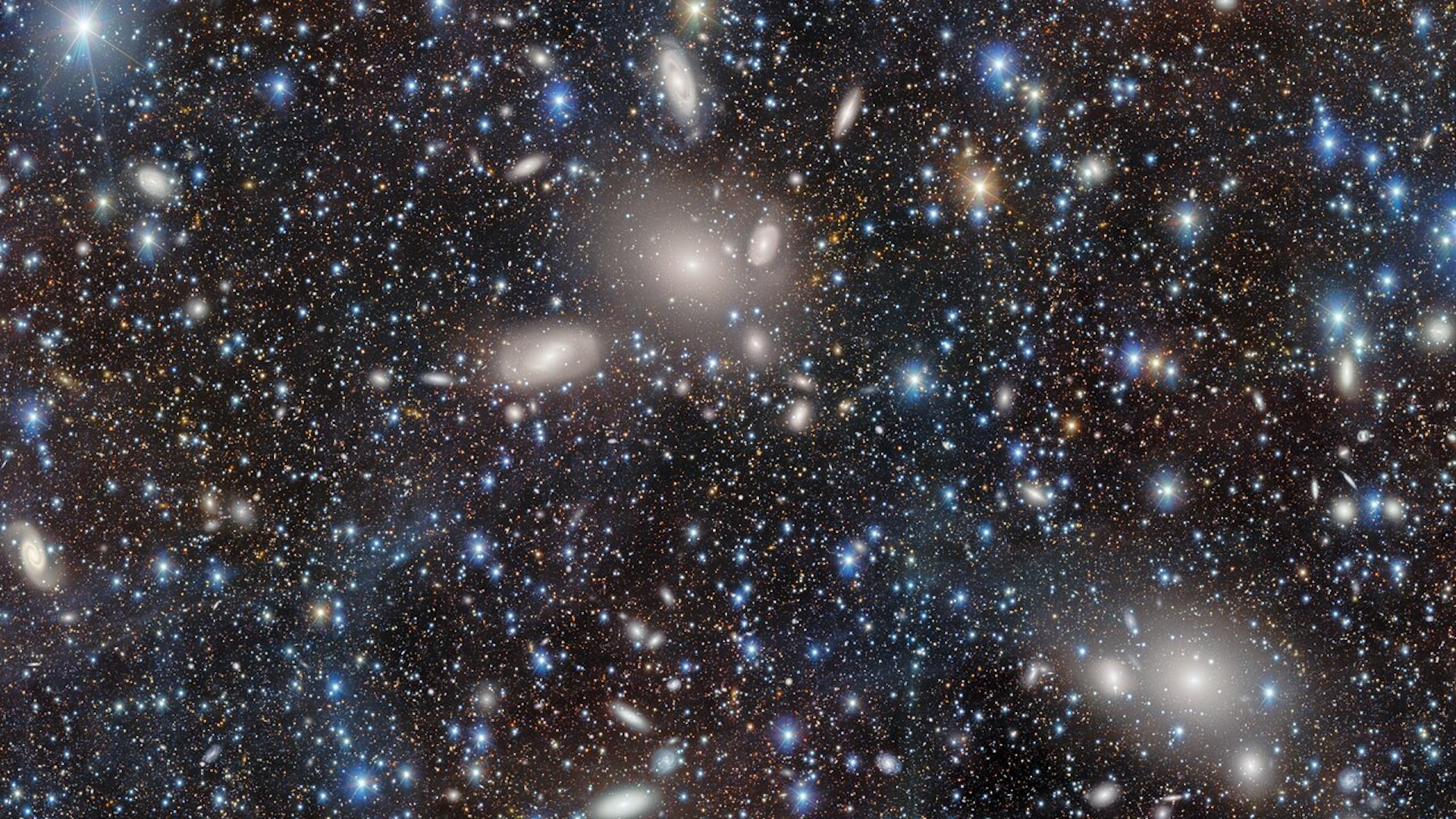
What it is: The Antlia Cluster of galaxies (also called Abell S636)

Where it is: 130 million light-years distant in the constellation Antlia, also known as the Air Pump

When it was shared: Jan. 1, 2025

Why it’s so special: Astronomers used a telescope in Chile equipped with a highly sensitive camera to capture the best-ever image of a cluster of galaxies near our Milky Way.

The researchers pointed the Víctor M. Blanco 4-meter Telescope’s Dark Energy Camera (DECam) at the Virgo Cluster in order to help solve one of astronomy’s biggest mysteries — the nature of dark matter.

Also available as a zoomable version, the image reveals NGC 3268 (center) and NGC 3258 (lower right) — both massive, lenticular galaxies that have a central bulge like the Milky Way but no spiral arms, and where star formation has fizzled out, according to NASA. One study suggests that the two galaxies are gradually merging, which may indicate that the Antlia Cluster is, or was, two separate clusters.

However, what fascinates astronomers is the Antlia Cluster’s rich diversity of galaxies. Technological advances have helped reveal not just lenticular galaxies but also irregular galaxies, dwarf galaxies, compact ellipticals and blue compact dwarfs. Even odder, little-seen galaxy types are suspected to be hiding within Antlia — many of which are thought to be rich in dark matter.

Get the world’s most fascinating discoveries delivered straight to your inbox.

This strange substance appears to make up about 25% of the universe. Dark matter may be made up of invisible particles that absorb, reflect or emit no light or energy and as a result is impossible for telescopes and cameras to detect, according to NASA. However, its gravitational effect on visible matter can be seen everywhere astronomers look — especially within the catwalk of galaxy types in the Antlia Cluster.

The DECam, built by the U.S. Department of Energy, is a 570-megapixel camera in Cerro Tololo Inter-American Observatory in Chile, a Program of the National Science Foundation’s National Optical Infrared Astronomy Research Lab.

For more sublime space images, check out our Space Photo of the Week archives.

Source link

Share. Facebook Twitter Pinterest LinkedIn Tumblr Email
Previous ArticleGet a 3-pack of KeySmart SmartCards for $79.97
Next Article DP World Tour: Alejandro Del Rey claims maiden title with Ras Al Khaimah Championship victory | Golf News
Editor
  • Website

Related Posts

Lifestyle

Arthritis drug shows antiviral effects against RSV, the leading cause of infant hospitalization

June 4, 2026
Lifestyle

Daddy longlegs may be capturing and devouring frogs in the tropical forests of South America

June 3, 2026
Lifestyle

Google wants to release 64 million bacteria-riddled mosquitoes across California and Florida. Here’s why scientists are enthusiastic.

June 3, 2026
Add A Comment

Comments are closed.

Categories
  • Entertainment
  • Lifestyle
  • News
  • Sports
  • Tech
  • Travel
Recent Posts
  • Arthritis drug shows antiviral effects against RSV, the leading cause of infant hospitalization
  • Daddy longlegs may be capturing and devouring frogs in the tropical forests of South America
  • Google wants to release 64 million bacteria-riddled mosquitoes across California and Florida. Here’s why scientists are enthusiastic.
  • ‘In an unrecoverable state’: NASA confirms MAVEN spacecraft is officially dead after loss of signal behind Mars
  • 2 rivers merged to form the Euphrates 3.6 million years ago, eventually leading to the Fertile Crescent
calendar
June 2026
M T W T F S S
1234567
891011121314
15161718192021
22232425262728
2930  
« May    
Recent Posts
  • Arthritis drug shows antiviral effects against RSV, the leading cause of infant hospitalization
  • Daddy longlegs may be capturing and devouring frogs in the tropical forests of South America
  • Google wants to release 64 million bacteria-riddled mosquitoes across California and Florida. Here’s why scientists are enthusiastic.
About

Welcome to Baynard Media, your trusted source for a diverse range of news and insights. We are committed to delivering timely, reliable, and thought-provoking content that keeps you informed
and inspired

Categories
  • Entertainment
  • Lifestyle
  • News
  • Sports
  • Tech
  • Travel
Facebook X (Twitter) Pinterest WhatsApp
  • Contact Us
  • About Us
  • Privacy Policy
  • Disclaimer
  • UNSUBSCRIBE
© 2026 copyrights reserved

Type above and press Enter to search. Press Esc to cancel.