Close Menu
  • Home
  • UNSUBSCRIBE
  • News
  • Lifestyle
  • Tech
  • Entertainment
  • Sports
  • Travel
Facebook X (Twitter) WhatsApp
Trending
  • NASA’s Perseverance rover finds record-breaking trove of carbon molecules at Bright Angel rock formation on Mars
  • Some of the last surviving Neanderthals were remarkably diverse ‪—‬ suggesting inbreeding didn’t doom them
  • 'This is the next jump in technology': World's first sub-1nm chip keeps Moore's Law alive a little longer
  • Scientists find thousands of earthquakes in a perfectly straight line in Alaska, revealing a hidden ‘microplate’
  • ‘You can’t patch your way out of it’: Cheap AI worm can spread between devices without human guidance — but how did scientists create it?
  • Diagnostic dilemma: After taking a medicine for years, a man suddenly had weird changes in his taste that made food disgusting
  • ‘A weird result from an already weird hominin’: Archaeologists discover all Homo naledi skeletons found in South African cave are female
  • China’s Einstein Probe detected a mysterious cosmic explosion — and scientists have no idea what caused it
Facebook X (Twitter) WhatsApp
Baynard Media
  • Home
  • UNSUBSCRIBE
  • News
  • Lifestyle
  • Tech
  • Entertainment
  • Sports
  • Travel
Baynard Media
Home»Lifestyle»Soar through 44 million stars in Gaia telescope’s latest 3D map of our galaxy — Space photo of the week
Lifestyle

Soar through 44 million stars in Gaia telescope’s latest 3D map of our galaxy — Space photo of the week

EditorBy EditorSeptember 21, 2025No Comments3 Mins Read
Share Facebook Twitter Pinterest LinkedIn Tumblr Reddit Telegram Email
Share
Facebook Twitter LinkedIn Pinterest Email

QUICK FACTS

What it is: A 3D map of where stars form in the Milky Way

Where it is: Up to 4000 light-years away, in the star-forming regions of the Milky Way

When it was shared: Sept. 16, 2025

A craggy mountain peak, a tower, perhaps even a finger — in this new celestial dreamscape from the James Webb Space Telescope (JWST), something seems to be pointing at a cluster of bright stars above, as if a stargazing session were going on deep in the Milky Way.

This is Pismis 24, a small open star cluster at the core of the Lobster Nebula in the constellation Scorpius. This vast region of interstellar gas and dust is one of the closest sites to the solar system where our galaxy’s most massive and extreme stars burn fast and die young.

The orange and brown craggy peaks are huge spires of gas and dust, the European Space Agency wrote in a description of the image. The tallest, in the center of the image, is 5.4 light-years from base to tip — as wide as about 200 solar systems placed side by side out to Neptune’s orbit. Erosion within these spires is caused by powerful stellar winds and ultraviolet radiation from the massive newborn stars in the star cluster above. It’s all part of the process — as the gas is eroded and compressed by young stars’ radiation, new stars are born within the spires.


You may like

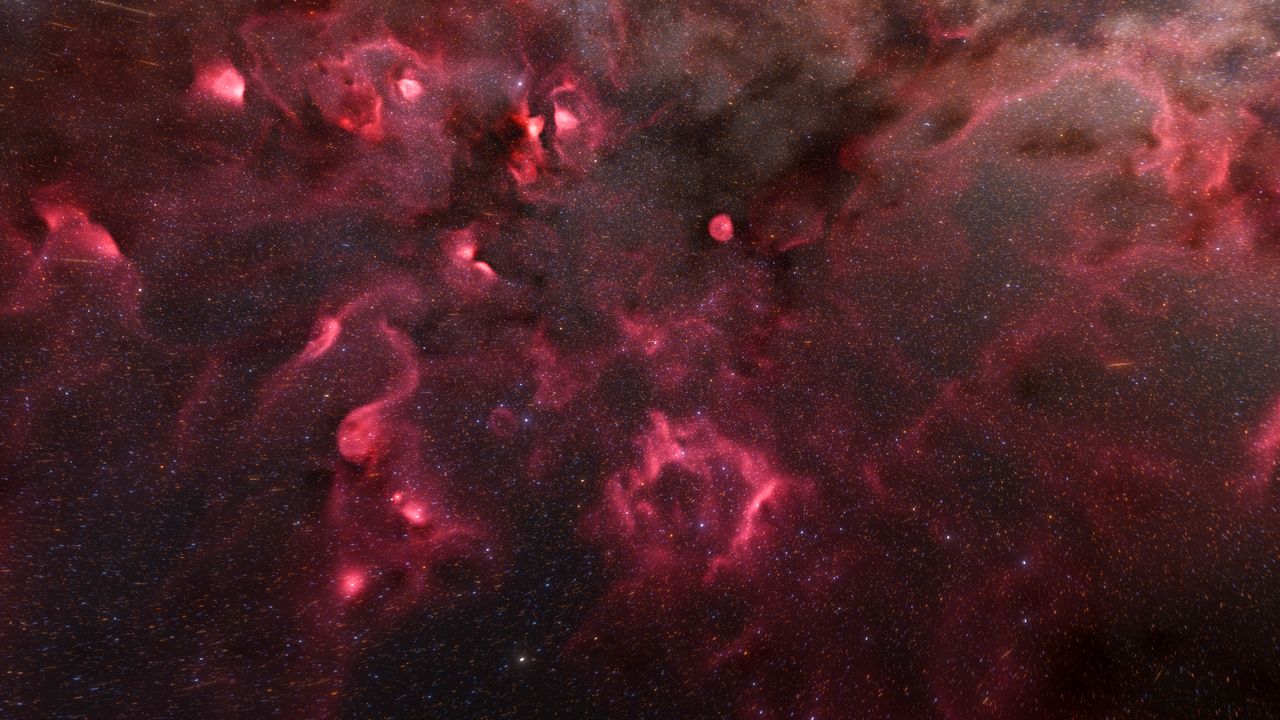
Sweeping wisps of fuchsia form an ethereal backdrop to millions of bright white pinpricks in a new image made from Gaia Space Telescope data. The glorious image is a peek into the vibrant cosmic kindergartens for newborn stars, which was previously hidden from view.

These are reddish-pink nebulas and sparkling stars in the star-forming regions of the Milky Way, made as part of the three-dimensional map of stars up to 4000 light-years from the sun.

Within the collection of 44 million “ordinary” stars Gaia captured lies 87 O-type stars — rare infant stars, which are both extremely massive and hot. They emit bright ultraviolet light that oozes so much energy that the rays blast electrons off of any hydrogen atoms they hit, ionizing them. This process creates a cloud of charged hydrogen gas around the O stars, called HII regions.

Scientists can look for patches of this ionized gas to identify where the starry seedbeds reside within the galaxy. They can also see how far the impacts of the O stars reach.

Get the world’s most fascinating discoveries delivered straight to your inbox.

Astronomers already had a good idea of what these nurseries looked like while peering at them from Earth, but how they looked from other directions was a blindspot. Using the 1 billion pixel camera of the Gaia Space Telescope, which was launched Dec. 19, 2013 and remained operational until Jan 15, 2024, scientists made a 3D map of these regions.

Now, anyone can sweep through the Milky Way and get a glimpse of these stellar nurseries from various perspectives, the European Space Agency (ESA) wrote in a description of the image. The map includes the Gum Nebula, the North American Nebula and the California Nebula. ESA also released a video to accompany the image, showing a three-dimensional tour of the newly mapped regions.

For more sublime space images, check out our Space Photo of the Week archives.

Source link

Share. Facebook Twitter Pinterest LinkedIn Tumblr Email
Previous ArticleRep. Ilhan Omar defends sharing Charlie Kirk video in clash with CNN host
Next Article U.K. formally recognizes Palestinian state
Editor
  • Website

Related Posts

Lifestyle

NASA’s Perseverance rover finds record-breaking trove of carbon molecules at Bright Angel rock formation on Mars

June 25, 2026
Lifestyle

Some of the last surviving Neanderthals were remarkably diverse ‪—‬ suggesting inbreeding didn’t doom them

June 25, 2026
Lifestyle

'This is the next jump in technology': World's first sub-1nm chip keeps Moore's Law alive a little longer

June 25, 2026
Add A Comment

Comments are closed.

Categories
  • Entertainment
  • Lifestyle
  • News
  • Sports
  • Tech
  • Travel
Recent Posts
  • NASA’s Perseverance rover finds record-breaking trove of carbon molecules at Bright Angel rock formation on Mars
  • Some of the last surviving Neanderthals were remarkably diverse ‪—‬ suggesting inbreeding didn’t doom them
  • 'This is the next jump in technology': World's first sub-1nm chip keeps Moore's Law alive a little longer
  • Scientists find thousands of earthquakes in a perfectly straight line in Alaska, revealing a hidden ‘microplate’
  • ‘You can’t patch your way out of it’: Cheap AI worm can spread between devices without human guidance — but how did scientists create it?
calendar
June 2026
M T W T F S S
1234567
891011121314
15161718192021
22232425262728
2930  
« May    
Recent Posts
  • NASA’s Perseverance rover finds record-breaking trove of carbon molecules at Bright Angel rock formation on Mars
  • Some of the last surviving Neanderthals were remarkably diverse ‪—‬ suggesting inbreeding didn’t doom them
  • 'This is the next jump in technology': World's first sub-1nm chip keeps Moore's Law alive a little longer
About

Welcome to Baynard Media, your trusted source for a diverse range of news and insights. We are committed to delivering timely, reliable, and thought-provoking content that keeps you informed
and inspired

Categories
  • Entertainment
  • Lifestyle
  • News
  • Sports
  • Tech
  • Travel
Facebook X (Twitter) Pinterest WhatsApp
  • Contact Us
  • About Us
  • Privacy Policy
  • Disclaimer
  • UNSUBSCRIBE
© 2026 copyrights reserved

Type above and press Enter to search. Press Esc to cancel.