
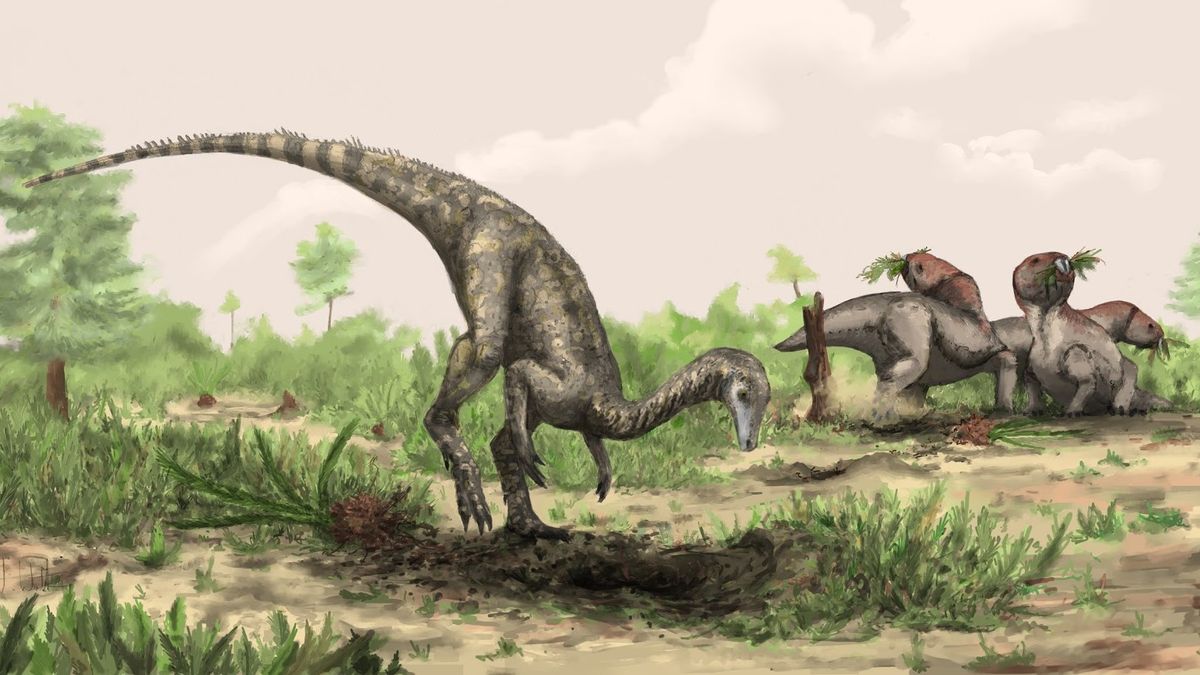
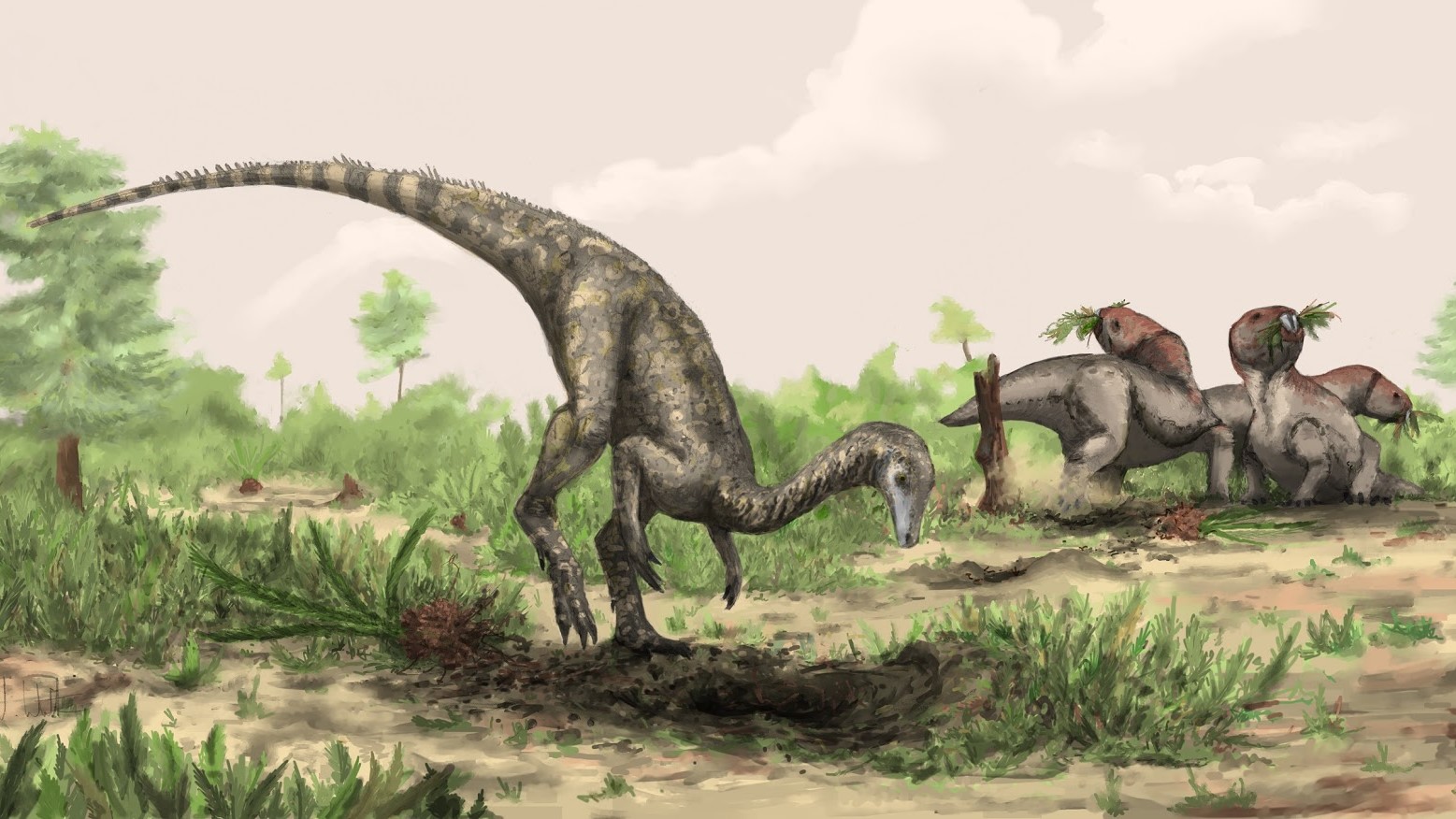
Remains of the very first dinosaurs on Earth may be buried deep beneath the Sahara desert and Amazon rainforest, a new study suggests.
If found, these fossils could trace the history of dinosaurs much further back than 230 million years, the age of the oldest dinosaur bones unearthed to date. Such a discovery would also radically change scientists’ understanding of where — and how — dinosaurs first evolved.
“Dinosaurs are well studied but we still don’t really know where they came from,” lead author Joel Heath, a doctoral student in Earth sciences at University College London (UCL) in the U.K., said in a statement. “The fossil record has such large gaps that it can’t be taken at face value.”
Fossils recovered to date suggest dinosaurs first appeared in the southernmost regions of the ancient supercontinent Gondwana, which included present-day South America, Africa, India, Australia, New Zealand, parts of the Middle East and Antarctica. Researchers regularly find fossils in southern Brazil, Argentina and Zimbabwe that indicate dinosaurs inhabited the southern polar region toward the middle of the Triassic period (251.9 million to 201.3 million years ago).
Related: Giant horned dinosaur’s fossils were destroyed in WWII — but photos reveal it was an unknown species
Yet stark differences between some of these fossils may indicate that dinosaurs originated earlier in the Triassic period than we thought, evolving distinct characteristics as they spread across the world, according to the new study, published Thursday (Jan. 23) in the journal Current Biology.
New origin story?
For the study, Heath and colleagues simulated the distribution of the very earliest dinosaurs using a computer model. They incorporated known evolutionary relationships between early dinosaur groups, as well as climatic and geographic barriers that may have blocked the movements of these prehistoric reptiles. The researchers also accounted for gaps in the fossil record by treating areas where no fossils have been found so far as “missing information,” rather than as areas where dinosaur fossils simply don’t exist.
Their results showed that the earliest dinosaurs likely emerged in Gondwana’s hot equatorial regions, which include present-day Amazonia, the Sahara desert and the Congo basin. These dinosaurs would have been much smaller than their descendants — similar in size to chickens or dogs, according to the statement.
“Our modeling suggests that the earliest dinosaurs might have originated in western, low-latitude Gondwana,” Heath said. “This is a hotter and drier environment than previously thought, made up of desert and savanna-like areas.”
The reasons why researchers haven’t found fossils in these regions are that they are overlooked and often inaccessible, Heath said.
The recent discovery of fossils belonging to the oldest-known dinosaur in North America — a 230 million-year-old, chicken-size raptor — bolsters the new findings, because it showed that dinosaurs existed in the Northern Hemisphere at this time. Paleontologists previously assumed that dinosaurs were confined to the Southern Hemisphere, but the groundbreaking discovery rejigged the map to make the equator a midpoint, rather than a northernmost boundary.
Proposing that dinosaurs first evolved near the equator is less far-fetched now that their distribution around 230 million years ago has been rewritten, according to the statement. If dinosaurs were present in the Northern and Southern Hemisphere, the equatorial regions can’t have been closed off to them, Heath told New Scientist. “They have to have been crossing that region,” he said.
The new study suggests the earliest dinosaurs were adapted to hot temperatures and arid climates. “Out of the three main dinosaur groups, one group, the sauropods, which includes the Brontosaurus and the Diplodocus, seemed to retain their preference for a warm climate,” study co-author Philip Mannion, a professor of paleobiology at UCL, said in the statement.
The two other groups, the theropods and ornithischians, may have evolved the ability to generate their own body heat, and therefore moved closer to the poles, Mannion added.
